
One-minute news
▶ On October 26, the Korea AeroSpace Administration held a System Integration Readiness Review for the Active Debris Removal Satellite (ADR-SAT), which is tasked with removing space debris, at the KAIST Satellite Technology Research Center in Daejeon.
▶ The satellite is scheduled to launch aboard the sixth Nuri rocket in 2027. After its primary mission, it will approach a satellite left in orbit, capture it with a robotic arm and gripper, lower its altitude, and release it so that it burns up from atmospheric friction as it reenters Earth’s atmosphere.
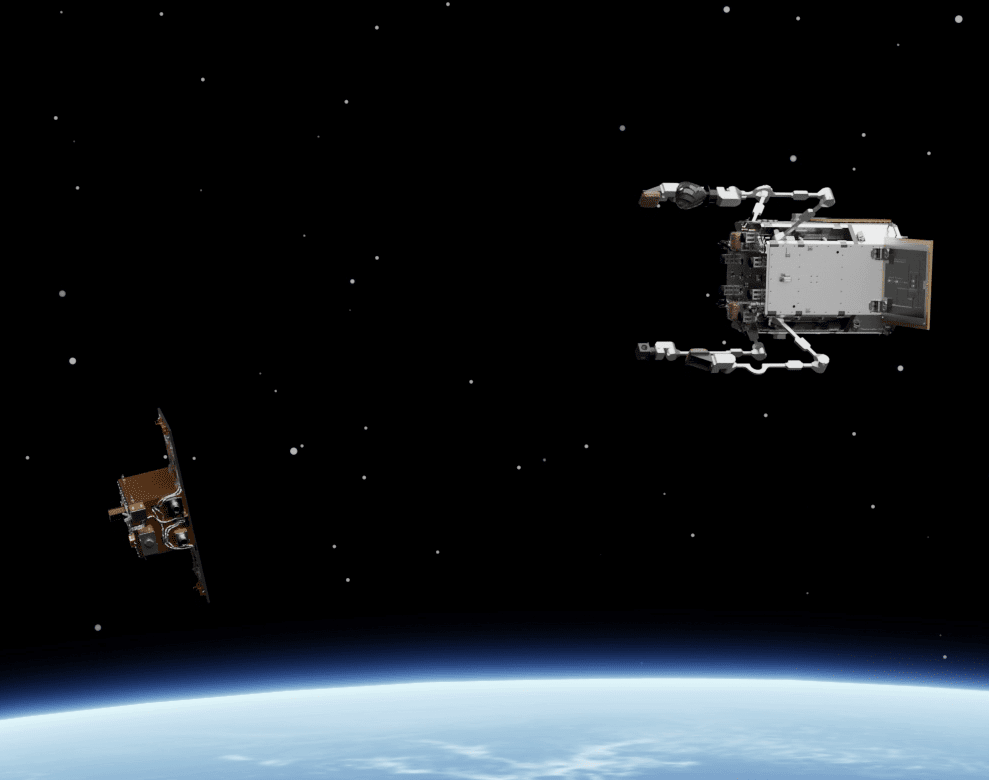
The Korea AeroSpace Administration said it held a System Integration Readiness Review for the Active Debris Removal Satellite (ADR-SAT), which will carry out a space-debris removal mission, at the KAIST Satellite Technology Research Center in Daejeon on October 26.
External reviewers drawn from industry, academia and research examined the readiness of components and subsystems, as well as technical risks that could arise during integration. They concluded that the project could proceed with system integration.
The Satellite Technology Research Center will begin assembling the flight model in November. The satellite will launch aboard the sixth Nuri rocket in 2027 and demonstrate the capture and deorbiting of a satellite whose mission has ended.
◆ External reviewers decide whether assembly can begin
The System Integration Readiness Review (S-IRR) is a checkpoint in satellite development held before components, equipment and subsystems are brought together. External reviewers check whether each part is ready on schedule and whether the plans, procedures, facilities and equipment needed for integration are in place.
The Korea AeroSpace Administration’s Korean Systems Engineering Handbook, developed as a guideline for satellite development, sets out the conditions for passing this review. ADR-SAT met those conditions, and the Satellite Technology Research Center will begin assembling the flight model (FM) in November. Unlike a test model, the flight model is the spacecraft that will actually be sent into space.
The sixth Nuri launch is scheduled for 2027. The satellite manifest announced in December last year by the Korea AeroSpace Administration and the Korea Aerospace Research Institute includes five primary payloads—the small satellite constellation satellites Nos. 7–11—as well as six CubeSats selected through an open call, the third domestically made component and parts verification satellite, and the active debris removal satellite developed by the KAIST Satellite Technology Research Center.
◆ Capture, lower and release: a six-step mission
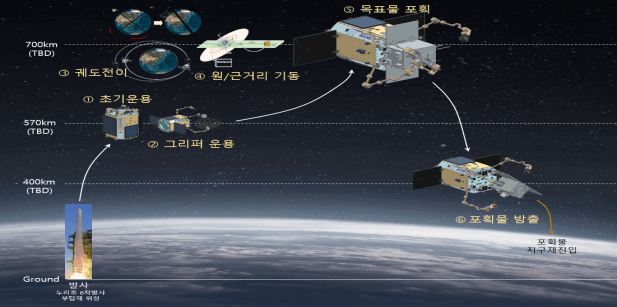
The satellite is built on a small-satellite platform. The technology of locating an object in orbit and approaching it to change its position or orbit—or capturing it and sending it into Earth’s atmosphere to be destroyed—is known as active debris removal. The Korea AeroSpace Administration has outlined six mission stages.
① During the initial operations stage, the satellite will be checked after launch to confirm that it is functioning normally and is ready for its mission.
② During the gripper operations stage, the satellite will test the robotic arm and gripper in space to verify their performance.
③ During the orbit-transfer stage, it will change its altitude and orbital plane to travel to the orbit where the target is located.
④ During the far- and close-range maneuvering stage, it will locate the target from a distance, determine its position and gradually approach while avoiding a collision.
⑤ During the target-capture stage, the satellite will use its robotic arm to capture a national space asset whose mission has ended.
⑥ During the captured-object release stage, it will lower its altitude while holding the target and then release it. The target will fall into the atmosphere and burn up from frictional heat.
“This active debris removal technology involves approaching space debris moving at high speed in orbit, capturing it and then bringing it back into the atmosphere to burn up. It is a highly challenging satellite technology that the world is attempting for the first time,” said Korea AeroSpace Administration Administrator Oh Tae-seok. “We will strengthen South Korea’s ability to respond to space hazards by developing, with our own capabilities, the core technology needed to remove space debris that threatens the safety of our satellites, which are national assets.”
◆ 68,450 objects larger than 10 cm; more than 300 launches a year
Space debris refers to human-made objects left in Earth’s orbit after they have ceased to function. It includes satellites that have completed their missions, rocket fragments, and debris generated by collisions or explosions.
According to statistics updated by the European Space Agency (ESA) on the 23rd, ground-based monitoring networks track about 47,260 objects in orbit. An estimated 68,450 objects are larger than 10 cm, of which about 11,300 are functioning satellites. There are an estimated 1.5 million fragments measuring 1–10 cm and 230 million fragments measuring 1 mm–1 cm. More than 660 events involving objects breaking apart, exploding or colliding in orbit have been recorded.
Activity in space is also increasing. According to the ESA’s 2026 Space Environment Report, more than 300 launches took place in 2025, placing over 4,000 payloads in orbit—an average of about 10 a day.
The ESA’s index measuring pressure on the space environment rose from about 4 to about 50 in just one year. A reading above 1 means activity has exceeded a sustainable level.
Regulations are also tightening. The U.S. Federal Communications Commission requires low-Earth-orbit satellites to be removed from orbit within five years of the end of their missions. The ESA has also shortened its disposal deadline from 25 years to five.
◆ Europe targets 2028; Japan has not set a launch date; South Korea aims for 2027
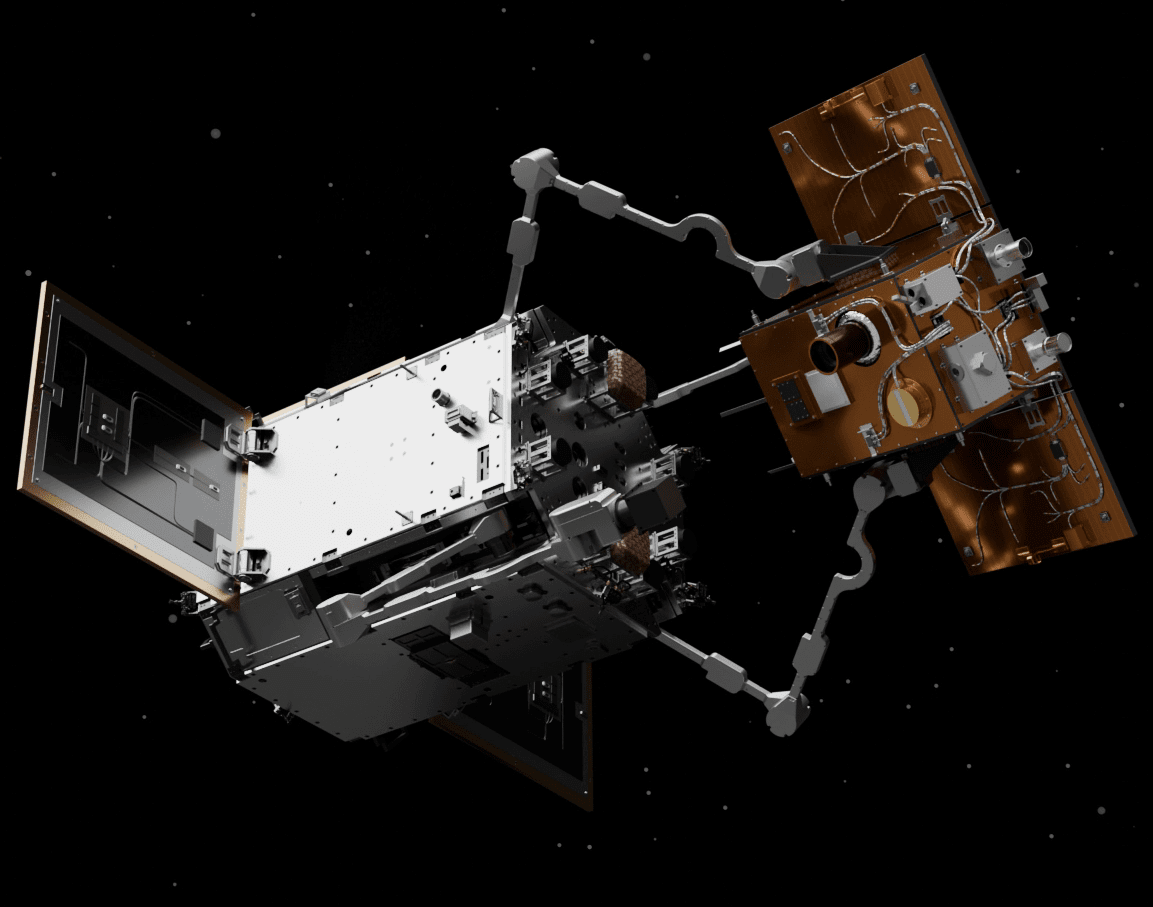
Europe and Japan have been pursuing similar technology. ClearSpace-1, which the ESA contracted Swiss company ClearSpace to develop for 86 million euros (about 139 billion won) in November 2020, is designed to capture its target by enveloping it with four arms.
The mission was originally scheduled to launch in the second half of 2026, but has been pushed back to 2028. Its target has also changed: instead of a rocket adapter believed to have collided with another piece of debris in 2023, the target will be ESA’s small satellite PROBA-1.
In 2021, Japan’s Astroscale successfully captured a test target fitted in advance with a magnetic plate using its ELSA-d satellite. In 2024, its ADRAS-J satellite approached and observed the upper stage of a Japanese H-2A rocket. The follow-up mission, ADRAS-J2, is designed to capture that rocket stage with a robotic arm and remove it from orbit. Astroscale signed a contract worth about 13.2 billion yen (about 123 billion won) with the Japan Aerospace Exploration Agency (JAXA) for the mission. On September 1, Astroscale selected Germany’s Isar Aerospace as the launch provider, but has not announced a launch date.
No country has yet completed a demonstration in which a robotic arm captures an actual derelict satellite that was not prepared in advance and sends it into the atmosphere. South Korea’s active debris removal satellite has a total project budget of 44.7 billion won, with 2.5 billion won allocated in 2024, 12.4 billion won in 2025, 18.8 billion won in 2026, 10 billion won in 2027 and 1 billion won in 2028. If the sixth Nuri launch takes place as scheduled in 2027 and all six orbital mission stages are completed in sequence, the demonstration will conclude in 2028. Beginning assembly in November will be the first step involving the actual spacecraft.