
In Brief
▶ Market research firm Counterpoint Research said on November 5 that global DRAM revenue in the third quarter approached $200 billion (about 277 trillion won), up 369% from a year earlier.
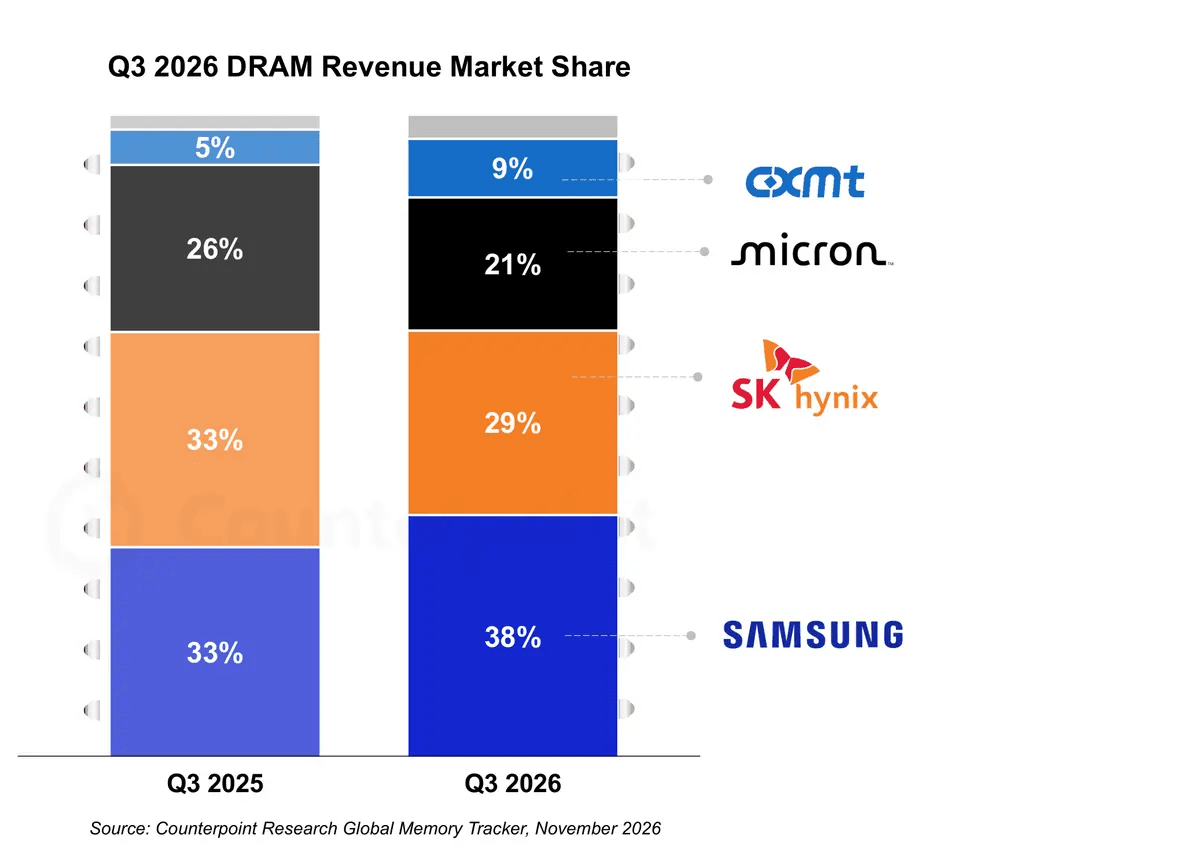
▶ Market shares were Samsung Electronics 38%, SK hynix 29%, Micron 21%, and CXMT 9%.
▶ Samsung Electronics lost the top spot to SK hynix last year amid HBM supply disruptions in the first quarter, but reclaimed it in the fourth quarter and has held on to the lead since.
Global DRAM revenue hit a record, driven by demand from AI data centers and rising prices. Samsung Electronics retained the top spot, while SK hynix increased its market share and narrowed the gap.
In its Global Memory Tracker for the third quarter of 2026, released on November 5, market research firm Counterpoint Research said global DRAM revenue approached $200 billion (about 277 trillion won), a 369% increase from the same period last year.
Samsung Electronics held on to first place with a 38% share of revenue. SK hynix followed at 29%, ahead of Micron at 21% and China’s ChangXin Memory Technologies (CXMT) at 9%.
Shipments rose 4%, but revenue was five times higher
Rising memory prices drove the boom. According to Counterpoint, the average selling price (ASP) of DRAM climbed to $1.9 per gigabit in the third quarter. Although the pace of increases slowed from the first half of the year, prices remained strong and lifted overall revenue.
Bit shipments rose about 4% from the previous quarter. Bit shipments measure the total storage capacity of memory shipped. Counterpoint said the market’s growth was led by higher prices, while shipment growth remained limited.
Jung-gu Choi, a principal researcher at Counterpoint, described the boom as a “supercycle” driven by prices rather than volumes. As AI expansion has tightened memory supplies, he said, buyers are focusing on securing supply rather than negotiating prices.
Prices rose sharply not only for HBM but also for conventional DRAM. Revenue from DDR, used in servers and PCs, increased about 500% year over year, while revenue from LPDDR, used in mobile devices, rose about 400%.
HBM revenue also nearly doubled from a year earlier, but conventional DRAM grew even faster. As a result, HBM’s share of total DRAM revenue actually declined.
Samsung holds first place as SK hynix closes the gap
Samsung Electronics maintained the DRAM market lead it regained in the fourth quarter of last year through the third quarter of this year. SK hynix, meanwhile, increased its market share as its third-quarter revenue rose more than 40% from the previous quarter.
Counterpoint’s previously reported second-quarter market shares were 39% for Samsung Electronics and 26% for SK hynix. The gap between the two companies was 13 percentage points, but narrowed to 9 points in the third quarter.
Micron’s share fell from 25% in the second quarter to 21% in the third. China’s CXMT also slipped, from 10% to 9%. However, CXMT’s share had been just 5% in the same period last year, meaning it rose to 9% in a year. The growing influence of Chinese companies in the conventional DRAM market is noteworthy.
Counterpoint said CXMT’s share of revenue could fall further if major suppliers expand HBM4 deliveries, given CXMT’s greater reliance on conventional DRAM.
HBM4 competition gathers pace, with next year’s market leadership at stake
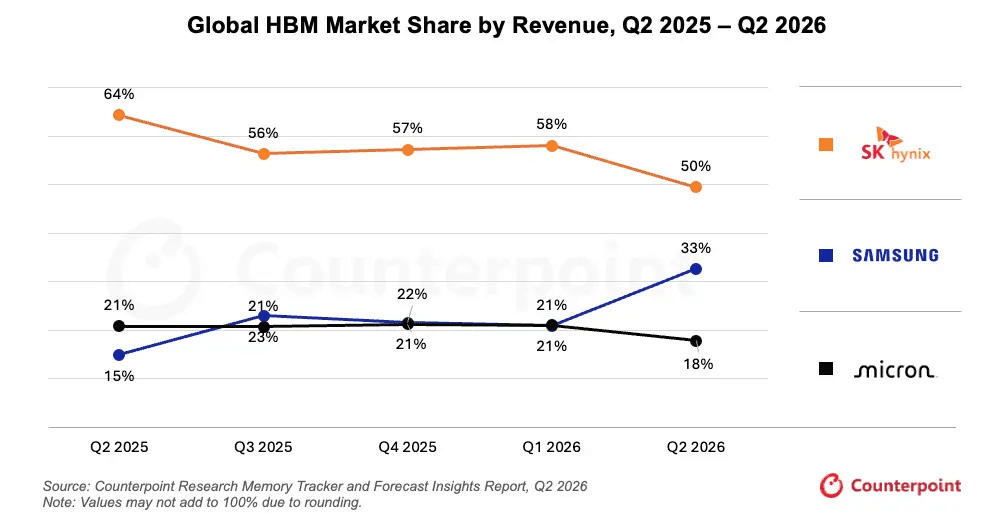
Samsung Electronics leads the overall DRAM market, but SK hynix is the frontrunner in HBM.
Counterpoint reported that SK hynix held 50% of HBM revenue in the second quarter of this year, compared with 33% for Samsung Electronics. However, the competitive landscape could shift as deliveries of the next-generation product, HBM4, ramp up.
Hwang Min-sung, research director at Counterpoint, said SK hynix had led the HBM3E market but that its growth had recently slowed. Samsung Electronics’ HBM4, by contrast, has received positive responses from customers, he said, forecasting that Samsung will regain the top spot in the HBM market next year.
Memory prices are also expected to remain strong for the time being. Long-term supply contracts are supporting prices, and a shortage could persist because large new semiconductor plants are not scheduled to begin operating until 2028, according to the analysis.
Expanding investment in AI data centers is creating an opportunity for memory makers to improve their results. For manufacturers of servers, PCs, and smartphones that purchase memory, however, rising prices are increasing costs.
Samsung Electronics and SK hynix together account for 67% of the global DRAM market. The key questions going forward are how long the rise in conventional DRAM prices will last and how expanded HBM4 supplies will affect companies’ revenue and market shares.