
Key takeaways
▶ China’s ChangXin Memory Technologies (CXMT) captured 9% of the global DRAM market by revenue in the third quarter of this year, up 4 percentage points from 5% in the same period last year.
▶ The global DRAM market expanded rapidly, fueled by investment in AI data centers and rising memory prices.
▶ CXMT’s third-quarter revenue surged sevenfold year over year to 118.71 billion yuan. However, South Korean companies remain ahead in the high-bandwidth memory (HBM) market.
China’s memory chipmaker ChangXin Memory Technologies (CXMT) is rapidly increasing its share of the global DRAM market. The Chinese company is expanding its influence in a market led by Samsung Electronics, SK hynix and U.S.-based Micron.
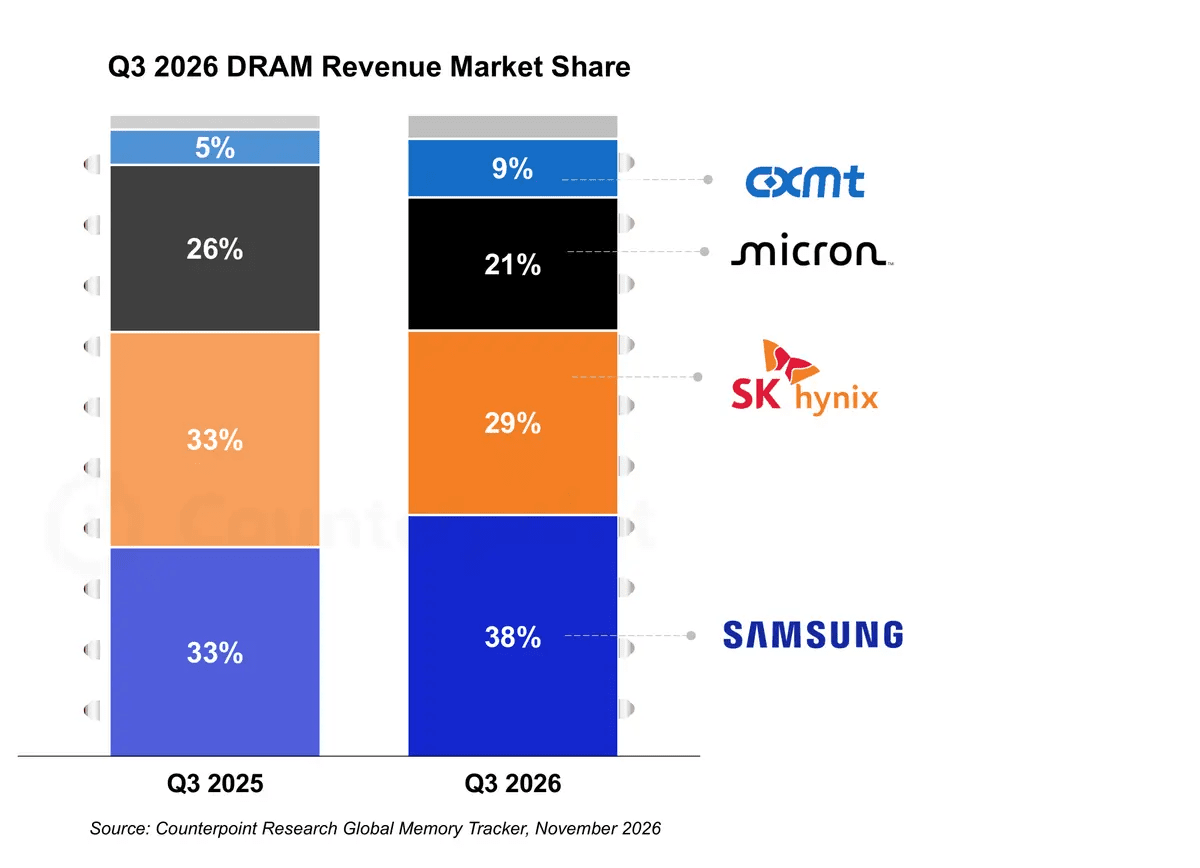
According to data released on Nov. 5 by market research firm Counterpoint Research, CXMT ranked fourth in the global DRAM market in the third quarter of this year, with a 9% share by revenue. That was up 4 percentage points from 5% in the same period last year, but down 1 percentage point from 10% in the second quarter.
Samsung Electronics held the top spot with 38%, followed by SK hynix at 29% and Micron at 21%. SK hynix narrowed the gap with Samsung after its DRAM revenue rose more than 40% from the previous quarter.
DRAM boom driven by prices, not shipments
The global DRAM market posted record revenue, driven by increased investment in artificial intelligence (AI) data centers and rising prices.
Counterpoint said DRAM revenue in the third quarter jumped 369% year over year. Bit-based shipments, by contrast, increased only about 4% from the previous quarter. The average selling price (ASP) rose to $1.90 per gigabit (Gb).
The analysis suggests that higher prices, rather than increased sales volume, were the main driver of the current boom.
Jung-gu Choi, a principal research analyst at Counterpoint, described the market as a supercycle led by prices rather than volume. As AI growth creates a memory shortage, he said, buyers are focusing on securing supply rather than negotiating prices.
Price increases have spread beyond HBM to conventional DRAM. According to Counterpoint, DDR revenue rose about 500% year over year, while revenue from LPDDR, used in mobile devices and other products, increased about 400%.
HBM revenue also nearly doubled, but conventional DRAM grew more rapidly. As a result, HBM’s share of total DRAM revenue actually declined.
CXMT revenue surges sevenfold in third quarter
CXMT significantly increased its earnings amid rising DRAM prices and supply shortages. The company’s third-quarter report, released Oct. 30, showed revenue of 118.714 billion yuan, up 613.18% from a year earlier. Its gross margin was 89.53%.
CXMT cited the global DRAM supply shortage and rising selling prices as factors behind its improved results. It also said higher sales volume and lower production costs contributed.
However, growth has slowed. Third-quarter revenue rose 19.3% from the previous quarter, a sharp deceleration from the 95.9% quarter-over-quarter increase recorded in the second quarter.
CXMT is expanding mainly in conventional DRAM. It still trails leading companies such as Samsung Electronics and SK hynix in high-value HBM memory used in AI accelerators.
HBM4 supply expansion could shape future market shares
Analysts say whether CXMT can sustain its market-share gains will depend on competition in the next-generation HBM market.
Counterpoint forecast that CXMT’s share could fall further if major suppliers, including Samsung Electronics and SK hynix, expand HBM4 shipments starting in the fourth quarter.
DRAM market share is measured by revenue. Increased sales of higher-priced products such as HBM can lift a company’s share. Conversely, a company focused on conventional DRAM could lose share of the overall market even as its revenue grows.
Competition for HBM leadership is also intensifying among South Korean companies. Hwang Min-sung, a research director at Counterpoint, said SK hynix had led the HBM3E market but that its growth had recently slowed. Samsung Electronics’ HBM4, meanwhile, has received positive feedback from customers, he said, predicting that Samsung will regain the top spot in the HBM market next year.
Counterpoint expects the memory shortage to continue into next year. It cited the fact that large new semiconductor plants will not begin operating until 2028 and that long-term supply contracts are supporting prices.
China’s CXMT is building its presence in the conventional DRAM market, while South Korean companies are strengthening their competitiveness in the high-value segment, particularly HBM.