
Key points
▶ On Oct. 13, when the KOSPI plunged 5.46%, forced selling against margin-trading receivables totaled 59.35 billion won, the highest since July 31, when the aftershocks of single-stock leveraged products tied to Samsung Electronics and SK hynix rocked the market. The forced-selling ratio against margin-trading receivables was also at its highest since July 31, at 5.6% versus 7.1%.
▶ The balance of margin loans for stock purchases edged down from the previous day to 34.25 trillion won but remained above 34 trillion won. It was the first time the balance had been in the 34-trillion-won range since July 15, when volatility related to leveraged single-stock products was at its peak.
▶ The KOSPI closed at 6,035.35 on Oct. 13 after foreign investors sold a net 4.52 trillion won worth of shares. The index fell for five consecutive trading sessions beginning Oct. 6, losing a cumulative 13.83%, and dipped as low as 5,911.11 intraday—below the 6,000 mark for the first time since July 31.
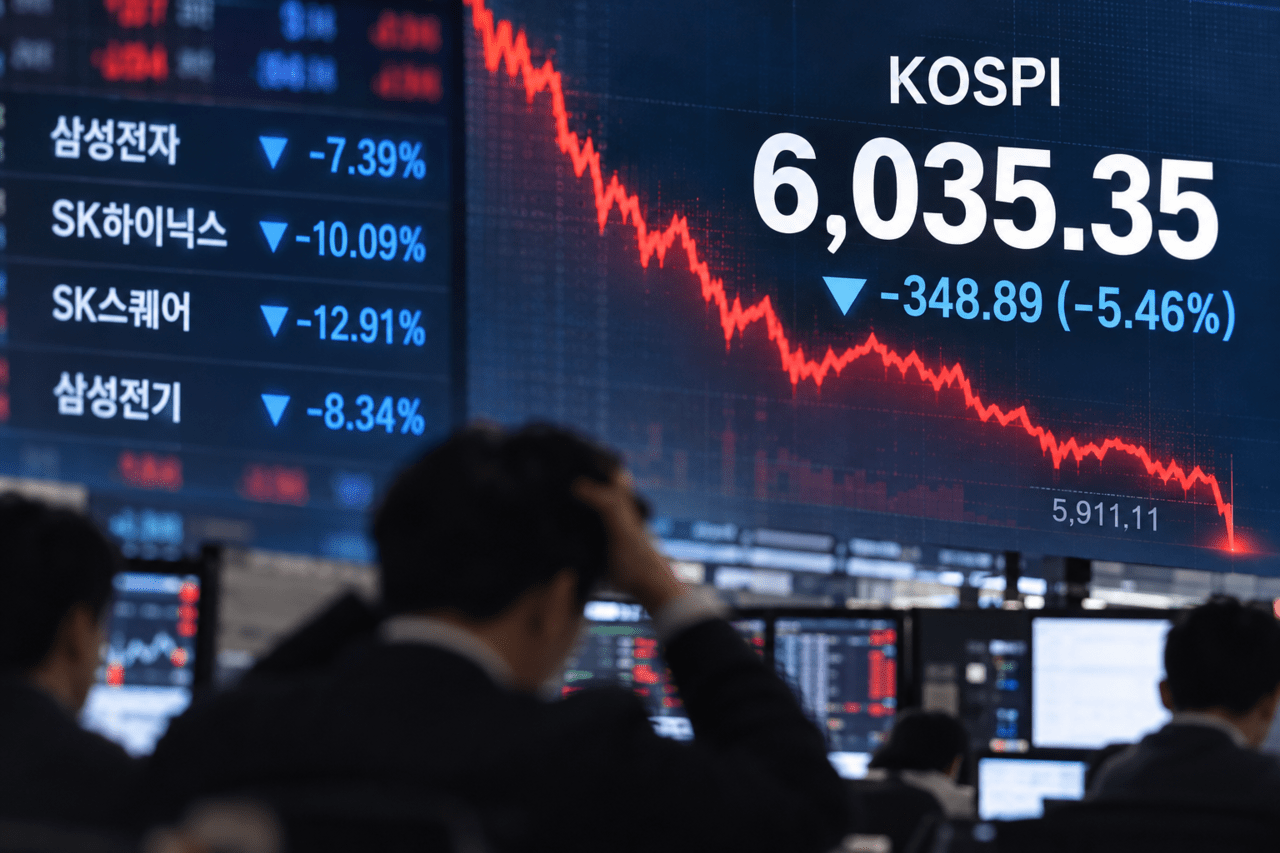
After the KOSPI fell more than 5% on Oct. 13, forced sales of shares in accounts with insufficient collateral reached their highest level since the “single-stock leverage fallout” at the end of July.
According to the Korea Financial Investment Association on Oct. 14, actual forced sales against margin-trading receivables totaled 59.35 billion won on Oct. 13.
This was the largest amount since July 31, when market volatility intensified in the wake of single-stock leveraged and inverse products linked to Samsung Electronics and SK hynix. The forced-selling ratio against margin-trading receivables was 5.6%, also its highest since July 31, when it stood at 7.1%.
When collateral falls short, securities firms sell
Forced selling occurs when the collateral value of shares bought with a margin loan falls below a set level, prompting a securities firm to sell the shares without the investor’s consent.
Before carrying out a forced sale, the securities firm asks the customer to cover the collateral shortfall using the method specified in their margin-trading agreement. If the customer does not make an additional deposit, the forced sale goes ahead.
Investors continue to hold large amounts of shares bought with borrowed money. The balance of margin loans for stock purchases stood at 34.25 trillion won on Oct. 13, slightly down from 34.29 trillion won on Oct. 12 but still above 34 trillion won.
Margin loans for stock purchases are amounts investors have borrowed from securities firms to buy shares and have yet to repay. They are considered an indicator of “debt-funded investing.” The balance last reached the 34-trillion-won range on July 15, amid peak volatility related to single-stock leveraged products.
Foreign investors sell 4.5 trillion won; chip stocks drag market lower
The KOSPI closed at 6,035.35 on Oct. 13, down 348.89 points, or 5.46%, from the previous trading day. After opening down 3.10%, it moved lower throughout the session, falling more than 7% at one point to 5,911.11.
It was the first time the index had fallen below 6,000 intraday since July 31, when the leverage fallout was at its peak. A sell-sidecar was triggered at 9:47 a.m. after KOSPI 200 futures plunged. The index had fallen for five consecutive sessions since Oct. 6, with cumulative losses of 13.83%.
Foreign investors were net sellers of 4.52 trillion won, while individual investors bought a net 2.24 trillion won and institutions bought 1.69 trillion won. Selling was concentrated in large-cap semiconductor stocks.
Samsung Electronics closed at 232,000 won, down 7.39%, while SK hynix fell 10.09% to 1.443 million won.
SK Square dropped 12.91% and Samsung Electro-Mechanics fell 8.34%. The declines came after Micron and SanDisk fell 3.88% and 5.97%, respectively, in the U.S. market the previous day, as well as news that China’s CXMT plans to release next-generation server memory this year.
Im Jeong-eun, a researcher at KB Securities, cited the CXMT news and comments by Broadcom’s CEO about constraints on expanding AI development as factors behind the sell-off in semiconductor stocks. The KOSDAQ closed down 1.43% at 837.03.
On Oct. 14, the KOSPI rose about 1.9% early in the session on bargain hunting. Samsung Electronics and SK hynix also opened 2% to 3% higher.