
Key points
▶ ASML reported third-quarter revenue of €11.662 billion (about 17.45 trillion won) and net income of €4.96 billion (about 7.42 trillion won) on the 14th (local time).
▶ Revenue rose 55.2% and net income 133.4% year over year, setting quarterly records. Net income was 20.7% above the market estimate of €4.11 billion.
▶ ASML raised its full-year revenue forecast from €43 billion–€45 billion to €44 billion–€45 billion. It expects fourth-quarter revenue of €14.2 billion–€15.2 billion.
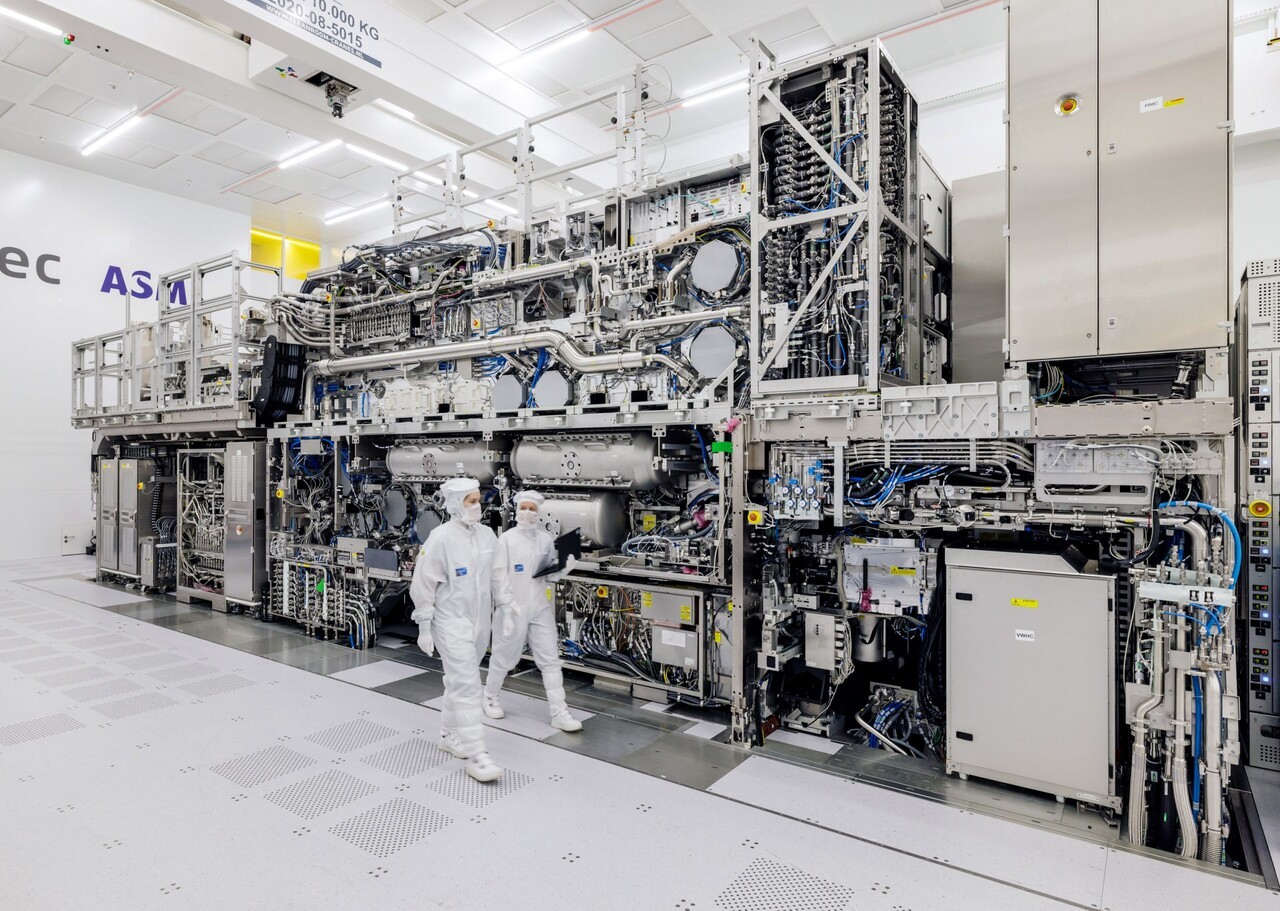
Dutch company ASML, the world’s largest maker of semiconductor lithography equipment, posted record quarterly revenue in the third quarter, fueled by increased investment in AI.
ASML reported third-quarter revenue of €11.662 billion (about 17.45 trillion won) and net income of €4.96 billion (about 7.42 trillion won) on the 14th (local time). Revenue rose 55.2% year over year, while net income surged 133.4%. Net income came in 20.7% above the market estimate of €4.11 billion, and the gross margin was 57.5%, topping the forecast of 56.1%.
ASML forecast fourth-quarter revenue of €14.2 billion–€15.2 billion. It raised the lower end of its full-year revenue outlook, from €43 billion–€45 billion to €44 billion–€45 billion. However, its share price fell 1.86% on the day the results were announced.
“Customers are asking about orders through 2030”
Demand ahead is drawing even more attention than the results. ASML makes lithography machines that etch semiconductor circuits onto wafers. Its major customers include Samsung Electronics, SK hynix and Taiwan’s TSMC. Semiconductor manufacturers need to secure ASML equipment before they can expand their factories.
ASML CEO Christophe Fouquet said some customers were already expressing interest in ordering equipment for 2029 and even 2030. He added that the production capacity currently planned for 2027 and 2028 would not be enough to meet customer demand.
ASML plans to increase equipment production capacity by 30% in 2027 and a further 30% in 2028. With demand growing faster than expected, it is also considering expanding its 2028 capacity beyond the current plan.
The company also aims to increase the output of each machine. It plans to raise the next-generation lithography systems’ throughput from 230 wafers per hour to 260, enabling more chips to be produced in the same amount of time. ASML is expected to ship about 65 extreme ultraviolet (EUV) lithography machines this year, more than 50% above last year’s total.
South Korea ranks second, with 31% of sales
By region, Taiwan accounted for 32% of equipment sales in the third quarter, South Korea 31%, China 23% and the United States 13%. South Korea ranked second, one percentage point behind Taiwan. EUV systems made up 49% of equipment sales and immersion ArF systems 39%. By application, logic chips accounted for 54% and memory for 46%.
Samsung Electronics and SK hynix are expanding their facilities to meet demand for AI semiconductors. Samsung is focusing investment on high-bandwidth memory (HBM) and foundry operations, while SK hynix is concentrating on HBM and next-generation DRAM.
Samsung plans to use next-generation high-numerical-aperture EUV (High-NA EUV) equipment in DRAM mass production by 2028. The technology can etch finer circuits than conventional EUV, reducing the number of process steps. Each machine costs about $400 million (approximately 560 billion won). TSMC plans to introduce the equipment in mass production in 2030, while Intel is already using it in production.
Price increases to take effect from 2027
Equipment prices are set to rise. ASML said it had completed discussions with major customers on new pricing. The increases will have some effect in 2027 and will be reflected more fully from 2028 onward. This will add to the investment burden on South Korean semiconductor companies.
ASML forecast a gross margin of about 57% for the fourth quarter and approximately 56% for the full year.