
Key points
▶ A joint research team from Cornell University in the United States and the University of Bristol in the United Kingdom used observations from the James Webb Space Telescope (JWST) to confirm that the atmosphere of the exoplanet WASP-17b is not a perfect circle but a distorted sphere, with one side stretched farther out. The team announced the finding on October 14 (local time). The study was published in Nature Astronomy.
▶ The researchers used for the first time the “transmission strings” technique developed by David Grant and Hannah Wakeford of the University of Bristol.
▶ The method measures light passing through the edge of a planet’s atmosphere at different angles as the planet crosses in front of its star. This differs from previous analyses, which assumed the atmosphere had a uniform radius and produced only an average spectrum.
▶ WASP-17b, a “hot Jupiter” about 1,300 light-years from Earth, has a more expanded atmosphere on the evening side of its equator than on the morning side.
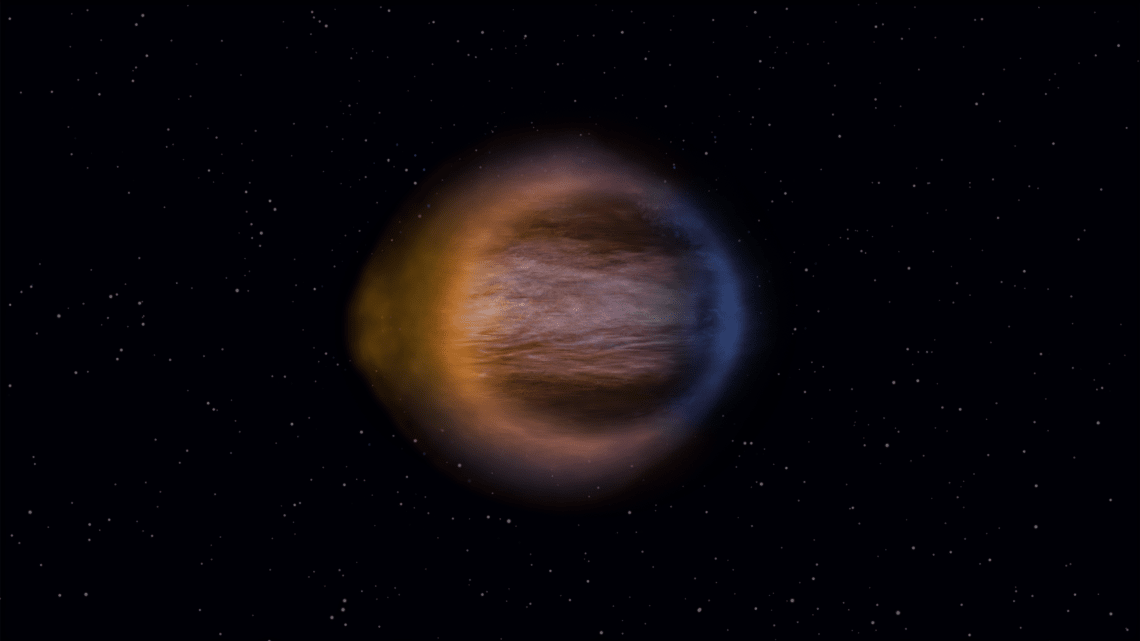
For the first time, the shape of an exoplanet’s atmosphere has been measured all the way around its circumference.
An international team led by Cornell University in the United States and the University of Bristol in the United Kingdom said on October 14 (local time) that, by applying the “transmission strings” technique to data from the James Webb Space Telescope (JWST), it had found that WASP-17b’s atmosphere is not perfectly circular but extended farther on one side.
Until now, exoplanet atmospheres have been depicted as round. The findings were published the same day in Nature Astronomy.
◆ From a single circle to points around the circumference
Scientists analyze exoplanet atmospheres by measuring how much starlight is absorbed as it passes through the atmospheric edge when a planet crosses in front of its star.
Previous methods assumed the atmosphere had the same radius in every direction and produced a single spectrum averaged across the entire edge.
The transmission strings technique, developed by David Grant and Hannah Wakeford of the University of Bristol, reads light passing through the atmospheric edge at different angles as the planet moves in front of its star.
This makes it possible to measure separately the distance from the planet’s center to the outer edge of its atmosphere at each point around its circumference. The researchers call this approach “transit mapping.” It complements “eclipse mapping,” previously attempted with JWST, which measures changes in light as a planet passes behind its star.
“Rather than assuming that the atmosphere has the same radius in every direction, our technique can determine different distances from the center of the planet to its edge,” said lead author Lily Alderson, a Klarman Postdoctoral Fellow at Cornell. “You could say we’ve moved from seeing a ring to knowing where the jewels are set around it.” Alderson began the research while earning her PhD in physics at the University of Bristol.
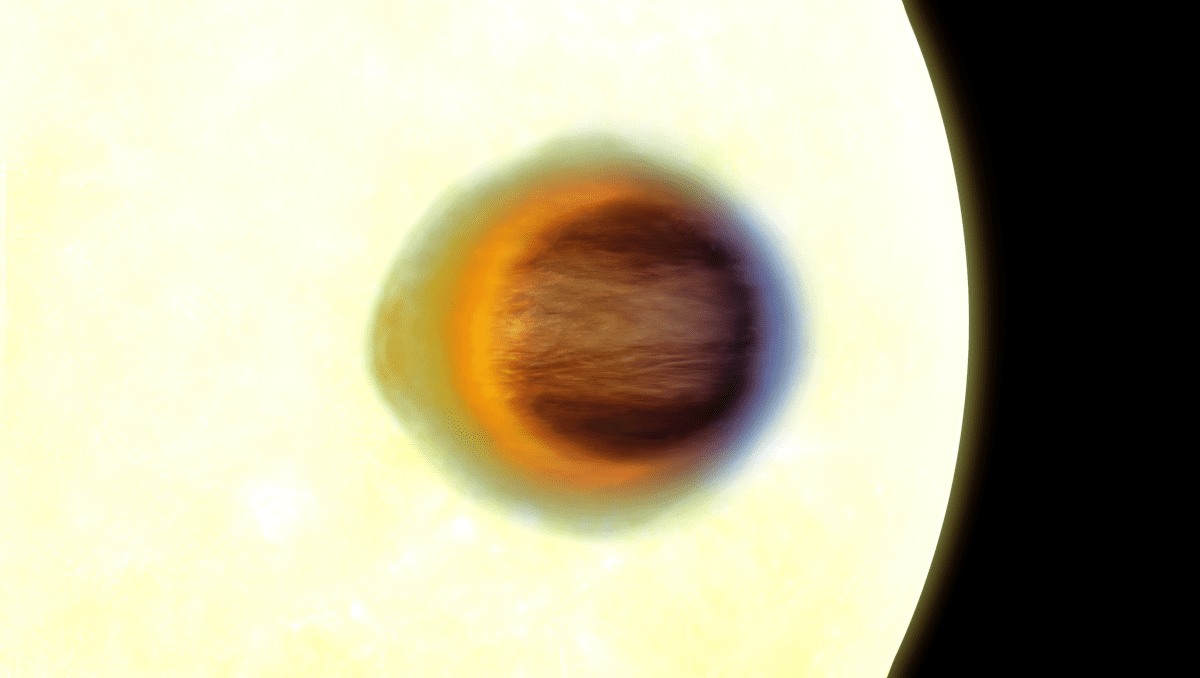
◆ The “jewel” was on the evening side
The target was WASP-17b, about 1,300 light-years from Earth. It is a giant gas planet orbiting very close to its star, known as a “hot Jupiter.” One side always faces the star and remains in daylight, while the opposite side is permanently dark.
Measurements showed that the atmosphere is round but asymmetrical, with the evening side of the equator extending farther out. This is where jet winds carry heat from the dayside to the nightside, and where theories and earlier models predicted the atmosphere would bulge. The equatorial morning side was cooler and less expanded.
“Theory predicts a large temperature difference between the morning and evening sides, and WASP-17b fits that pattern well. It was exactly what we expected,” Alderson said.
She added: “This is proof of concept that planets are truly three-dimensional objects, and that what we predicted happens consistently as they orbit their stars. Seeing it in reality is a different matter from doing the calculations.”
The temperature changes from equator to poles and from dayside to nightside, as well as variations in chemical composition, also matched theoretical predictions and the results of other models. Water and carbon dioxide were distributed similarly around the atmosphere.
The researchers said they combined the measurements to create one of the most complete three-dimensional pictures yet of an exoplanet’s atmosphere. It will provide a benchmark for comparison with the more than 6,000 exoplanets identified to date.
◆ Beyond day and night: weather by latitude
“Planets are changeable, and their atmospheres are complex and chaotic,” said co-author Wakeford, an associate professor of astrophysics at the University of Bristol. “It is incredibly exciting that all these measurements come together to show such a structured and dynamic picture of a giant planet more than 1,000 light-years away.”
“We now have a very robust mathematical model that can be applied to state-of-the-art data,” she said. “The results beautifully reveal the dynamics of a multidimensional, multifaceted world.”
Having validated the technique on WASP-17b, the researchers believe it can be applied to many more exoplanets. They said the work goes beyond distinguishing between dayside and nightside conditions and begins to separate conditions by latitude—a first step toward mapping weather-scale patterns in exoplanet climates.
The data came from TST DREAMS, a JWST guaranteed-time observing program in which a team of telescope scientists uses multiple instruments to investigate exoplanet atmospheres in depth. Cornell professor Nikole Lewis is the principal investigator. The paper has 20 authors, and the research was funded by NASA, the UK Science and Technology Facilities Council (STFC), and the Klarman Fellowship.