
Key points
Samsung Electronics is reportedly planning to unveil its self-developed humanoid robot for the first time at CES 2027, which will be held in Las Vegas next January.
The robot is said to have 40 motors in total, with 20 in each hand. The goal is to give it the dexterity to perform tasks as precise as smartphone assembly.
Samsung is reportedly developing two versions: the standard HR (Human Reference) and the high-performance HE (Humanoid Extreme).
The robot’s joints use hinge technology found in the Galaxy Z Fold and Z Flip. Its face will feature an OLED panel from Samsung Display to create expressions such as eyes and a mouth.

Samsung Electronics’ self-developed humanoid robot is expected to make its debut early next year.
According to industry sources on the 24th, Samsung is pursuing plans to unveil the robot at CES 2027, the world’s largest consumer electronics and information technology trade show, which will be held in Las Vegas next January.
The company is applying component and manufacturing technologies developed for smartphones and home appliances to robotics. In particular, it is focused on developing precise manipulation capabilities that would allow the robot to pick up and assemble small parts like a person. Specific exhibition plans and product specifications have not yet been officially announced.
The hands are the key challenge
Samsung is focusing on the robot’s hands. Each hand is reportedly equipped with 20 motors, for a total of 40. The goal is to reproduce the precise hand movements needed to assemble smartphones.
The hands are considered one of the most technically challenging parts of humanoid development. Picking up a tiny screw or connecting a thin cable requires precise control of finger movements and force. The company must also address weight and heat issues while fitting multiple motors into a compact space.
Samsung is reportedly using a direct-drive system that transmits rotational force from the motors directly to the joints. Compared with systems that move the fingers by pulling cables like tendons, this shortens the force-transmission path. Compact motor design and heat-management technology will be essential for precise control.
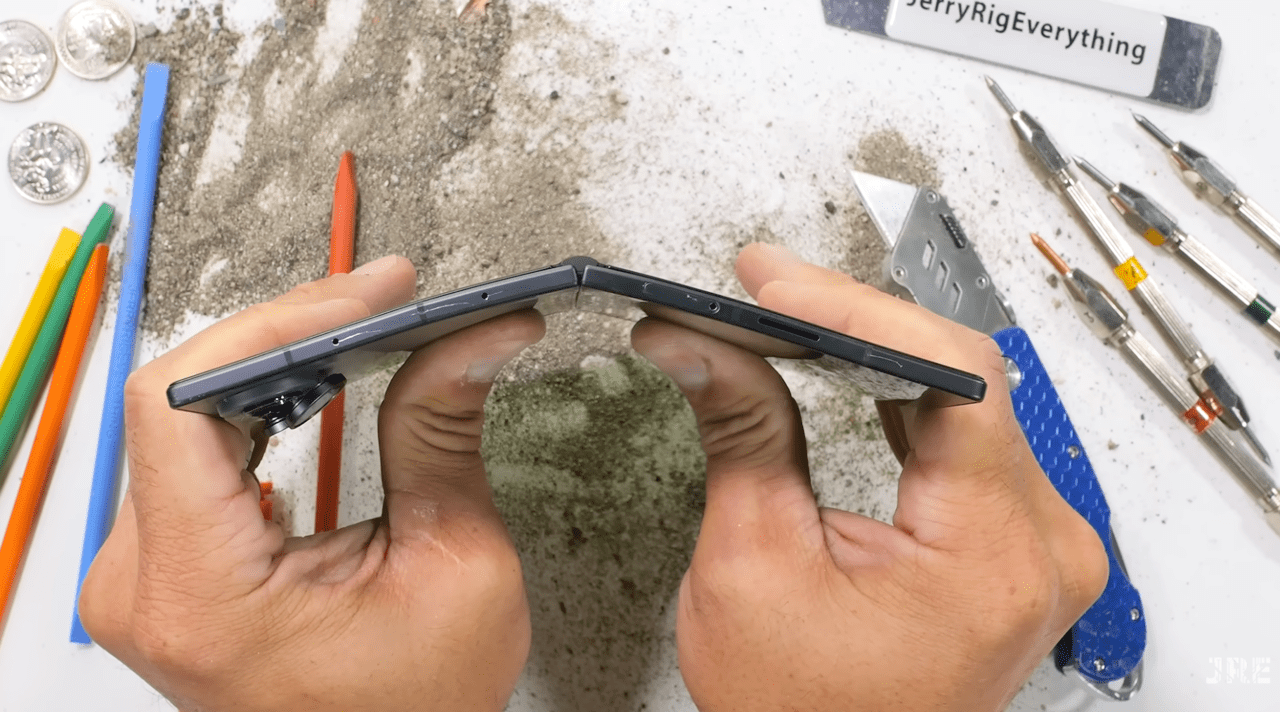
Foldable smartphone technology is also reportedly being used in the robot’s joints. The hinges used in the Galaxy Z Fold and Z Flip are designed to withstand repeated folding and unfolding in a compact space. Samsung also established a dedicated robot-hand development team, called Hand Lab, this year.
The humanoid’s face is reportedly set to feature an OLED panel from Samsung Display, enabling it to show a range of expressions through its eyes, mouth, and other features. Two models are in development: the standard HR and the high-performance HE. Their detailed specifications and performance differences have not been officially disclosed.
A dedicated robotics organization
Samsung reorganized its robotics-related teams and personnel this year. In July, it launched the Robot Experience (RX) Business Development Office under TM Roh, head of the Device eXperience (DX) division. The move brought together robotics development capabilities that had been spread across the company.
The RX office oversees robotics strategy, hardware, AI and software development, and commercialization. Samsung is also continuing its collaboration with Rainbow Robotics, in which it became the largest shareholder last year.
Samsung plans to validate its robotics technology in manufacturing facilities before expanding into business and home applications. In March, it announced a goal of converting domestic and overseas manufacturing sites into AI-driven autonomous factories by 2030. Humanoid robots and task-specific robots will be introduced in stages for equipment management, logistics, and assembly.
Smartphone assembly involves repeatedly positioning and connecting small components with precision. Robot hands therefore need precise movement and stable control. Samsung can use its own manufacturing facilities to validate robot performance and collect operational data.
The company is also moving ahead with plans to build production facilities and AI infrastructure. Samsung Electronics and Samsung SDS plan to invest a total of 19 trillion won in Gumi, North Gyeongsang Province. The project includes facilities for mass-producing humanoid robots, a robot data factory, and an AI data center (AIDC).
A robot data factory collects and processes the operational data needed to train robots. Samsung plans to use the AI data center that Samsung SDS is building for completion in 2028 to process the data and train robots in precise assembly tasks.
The humanoid race
Companies around the world are developing technology and conducting real-world trials to commercialize humanoid robots. Tesla is developing Optimus. U.S.-based Figure AI has been testing humanoids in manufacturing facilities. Hyundai Motor Group’s Boston Dynamics is also preparing to deploy Atlas on production lines.
Samsung can draw on component technologies from its affiliates in semiconductors, displays, and batteries, as well as its own manufacturing infrastructure. The precision manufacturing expertise it has accumulated through smartphone and home appliance production is another asset it can apply to robot development.
The humanoid currently under development is reportedly at the prototype stage. Its price and mass-production schedule have not been disclosed. Its performance in areas essential to actual manufacturing—including the accuracy and speed of hand movements, continuous operating time, and durability—remains to be seen.
CES 2027 will be held in Las Vegas from January 6 to 9 next year.