
Tang Hongbo, 51, Wu Fei, 39, and Muhammad Zeeshan Ali, 40, are scheduled to launch from Jiuquan at 9:18 a.m. Korea time on Nov. 25.
Key points
▶ The China Manned Space Agency (CMSA) has announced the crew of Shenzhou 24: Chinese astronauts Tang Hongbo, 51, and Wu Fei, 39, and Pakistani astronaut Muhammad Zeeshan Ali, 40.
▶ The spacecraft is scheduled to launch aboard a Long March 2F rocket from the Jiuquan Satellite Launch Center in northwestern China at 8:18 a.m. on Nov. 25 (9:18 a.m. Korea time).
▶ Ali, a former air force pilot, will serve as a payload specialist. He will spend about a week in orbit and carry out four scientific projects in biotechnology and materials science, including an experiment involving photosynthetic microorganisms.
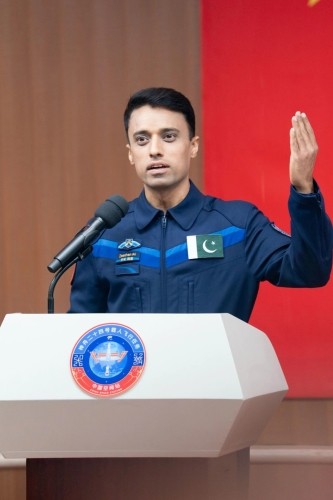
China has selected the first foreign astronaut to visit its Tiangong space station. According to the Associated Press, the China Manned Space Agency (CMSA) announced on Nov. 24 that the Shenzhou 24 crew will comprise Chinese astronauts Tang Hongbo, 51, and Wu Fei, 39, and Pakistani astronaut Muhammad Zeeshan Ali, 40. China’s state-run Xinhua News Agency reported the announcement.
The launch is scheduled for 8:18 a.m. on Nov. 25 (9:18 a.m. Korea time) from the Jiuquan Satellite Launch Center in northwestern China, aboard a Long March 2F rocket. Reuters reported that this will be the 41st mission under China’s human spaceflight program. The CMSA said the crew was in good condition and launch preparations were complete.
On Nov. 8, the CMSA said a Pakistani astronaut would fly on Shenzhou 24 but did not disclose the person’s name. The candidates were air force pilots Ali and Khurram Dawood. Ali was confirmed for the mission a day before launch.
◆ He will stay for a week and return ahead of the others
The three crew members have different mission durations. Tang Hongbo will command the mission, while Wu Fei will serve as flight engineer. Both will remain aboard the station for a long-duration mission. China has sent three-person crews on six-month missions since 2021.
Ali’s mission will be shorter. China’s state-run CCTV reported that he will serve as a payload specialist. Rather than pilot the spacecraft, payload specialists conduct experiments and operate equipment. Ali will assist with routine operations in orbit and focus mainly on experiments conducted in cooperation between China and Pakistan. There will be four projects in biotechnology and materials science, including one involving photosynthetic microorganisms. Pakistan’s daily Dawn reported that his stay will last about a week.
He will return aboard a different spacecraft. Once Shenzhou 24 arrives, its crew will join the astronauts already aboard the station from Shenzhou 23. Ali will return to Earth with the two Shenzhou 23 crew members aboard their spacecraft. Zhu Yangzhu, who traveled to the station on Shenzhou 23, will remain there to continue China’s first yearlong mission.
Tang Hongbo is embarking on his third spaceflight. CCTV reported that he will become the first astronaut to visit Tiangong three times. This will be the first spaceflight for both Wu Fei and Ali.
◆ He first had to learn Chinese
The crew members said language was one of their biggest challenges. At a news conference, Tang Hongbo said it was harder than on other missions to work in sync because of differences in language, culture and mindset. “All the signs and operating instructions inside the spacecraft and space station are in Chinese, but the Pakistani astronaut began training with virtually no basic knowledge of Chinese,” he said. He added that he and Wu had also stepped up their English studies, and said the efforts on both sides were paying off.
The training period was also short. According to Dawn, Ali and Dawood were selected for training in April and came to China. The training period, initially set at one year, was shortened to seven months.
At the news conference, Ali spoke in a mix of Chinese and English. In Chinese, he quoted a classical verse about climbing one level higher to see farther, saying, “It is like the training we do every day. Each day, we reach a new height.” He thanked the Chinese government for helping him fulfill his dream. In English, he said the mission was “not the finish line,” but part of a long journey. He said he hoped space cooperation between the two countries would grow from one astronaut and one flight to multiple joint missions, and extend beyond the Moon and Mars.
He also addressed children in Pakistan. “To every child watching while I am in orbit: look up at the sky and remember that I am up there with your dreams.”
◆ Pakistan: “From the Himalayas to space”
Pakistan’s prime minister weighed in. Shehbaz Sharif wrote on X, “Tomorrow, Pakistan will look to the skies with anticipation, pride and deep gratitude.” He said the leadership of Chinese President Xi Jinping had taken relations between the two countries to unprecedented heights. He also credited Pakistani scientists, the military and national institutions.
The two countries signed an agreement in February 2025 and have since selected and trained Pakistani astronauts. Pakistan has never sent a person into orbit.
Tiangong is a space station built and operated solely by China. China has not been allowed to participate in the International Space Station, which is jointly operated by the United States, Russia, Europe, Japan and Canada. China selected an astronaut from its longtime ally Pakistan to become the first foreign national to visit Tiangong.
The competition to reach the Moon is also underway. China is preparing to carry out its first crewed lunar landing by 2030. The U.S. National Aeronautics and Space Administration (NASA) aims to land astronauts on the lunar surface in 2028.