
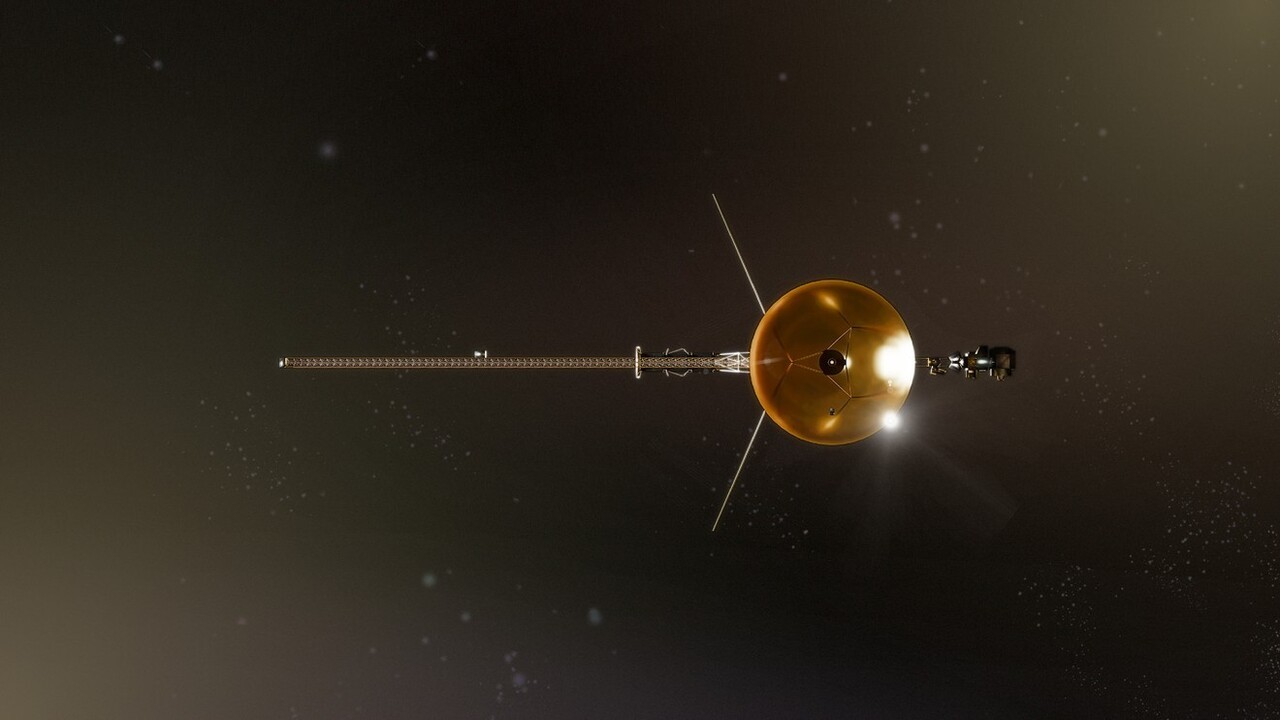
A human-made object has traveled for the first time to a distance that light covers in one day.
According to NASA, Voyager 1 passed a point one light-day from Earth at 5:16:07 a.m. Eastern time on the 18th. In Korea, it was 7:16:07 p.m. that day.
A light-day is the distance light travels in 24 hours—about 25.9 billion kilometers, or roughly 173 times the distance between Earth and the Sun. Voyager 1 was launched on Sept. 5, 1977. It took more than 49 years of flight to reach this distance.
◆ It takes two days to send a command and receive a reply
A light-day is not a physical boundary. The environment around the spacecraft does not change at that point. What changes is the time it takes to communicate with Earth. Radio signals travel at the speed of light.
A command sent from Earth takes a full 24 hours to reach Voyager 1, and a reply from the spacecraft takes another 24 hours to return. It takes the operations team two days to send a command and see the result.
NASA illustrated the scale of these distances by comparing them with other destinations. The Moon is an average of 384,400 kilometers away, a distance light covers in 1.3 seconds. Sunlight travels about 150 million kilometers and reaches Earth in 8 minutes and 20 seconds. The time it takes to communicate with Mars varies from 3 to 22 minutes, depending on the planets’ positions. Neptune, the outermost planet in the solar system, is 4 light-hours and 10 light-minutes away. Voyager 2 took 12 years to reach Neptune.
Voyager 1 is traveling at about 61,000 kilometers per hour. It is the most distant human-made spacecraft, but it is slow compared with light. Since it took 49 years to travel one light-day, at its current speed it would take about 17,700 years to travel one light-year.
Proxima Centauri, the closest neighboring star, is 4.24 light-years away. Voyager 1 is heading toward Gliese 445 in the direction of Ursa Minor and is expected to pass within 1.7 light-years of the star in about 40,000 years.
◆ Only two of its 10 instruments are still operating
Voyager 1 is powered by a radioisotope thermoelectric generator, which converts the heat produced by the decay of radioactive material into electricity. Its power output decreases by about 4 watts each year.
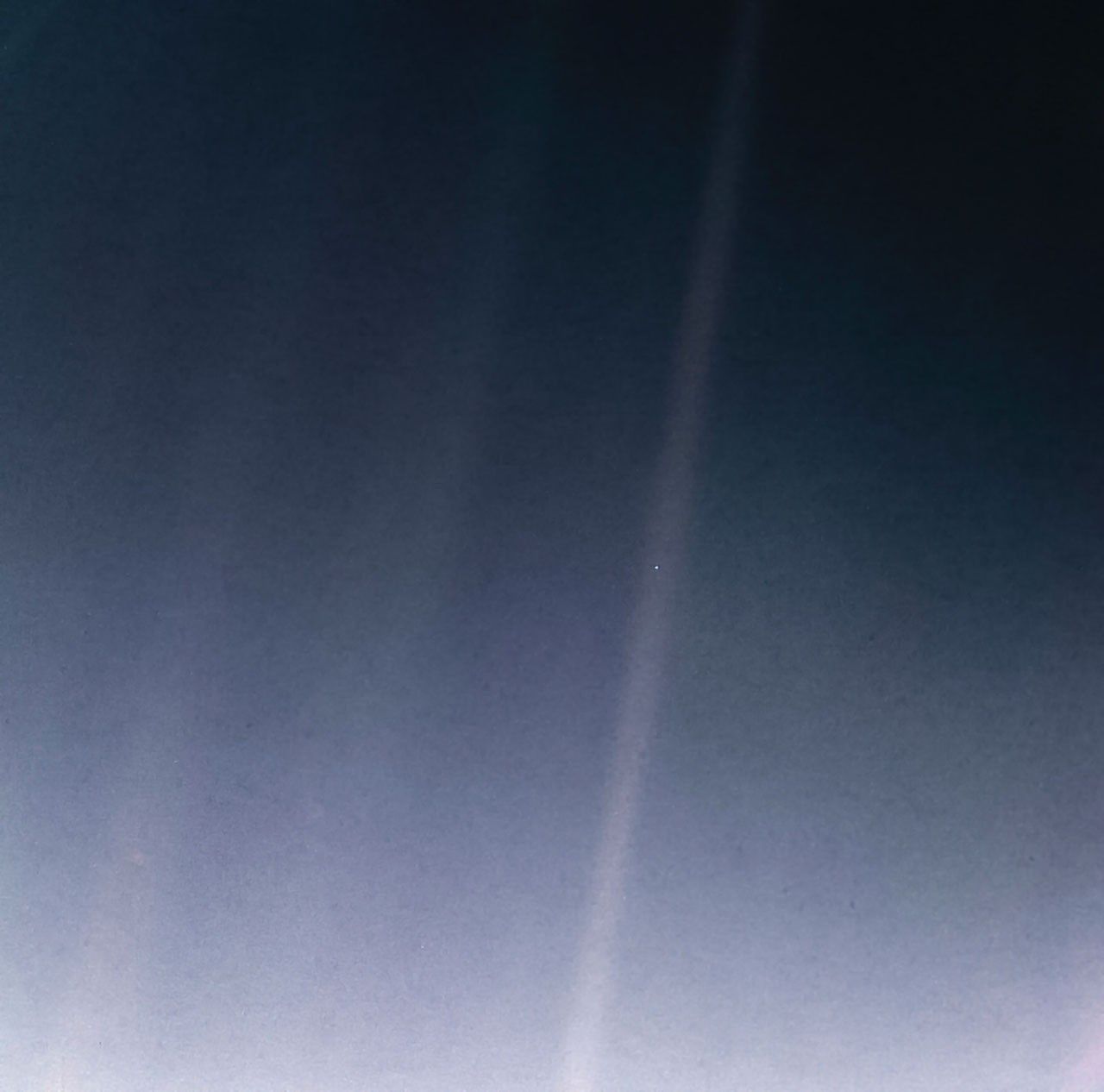
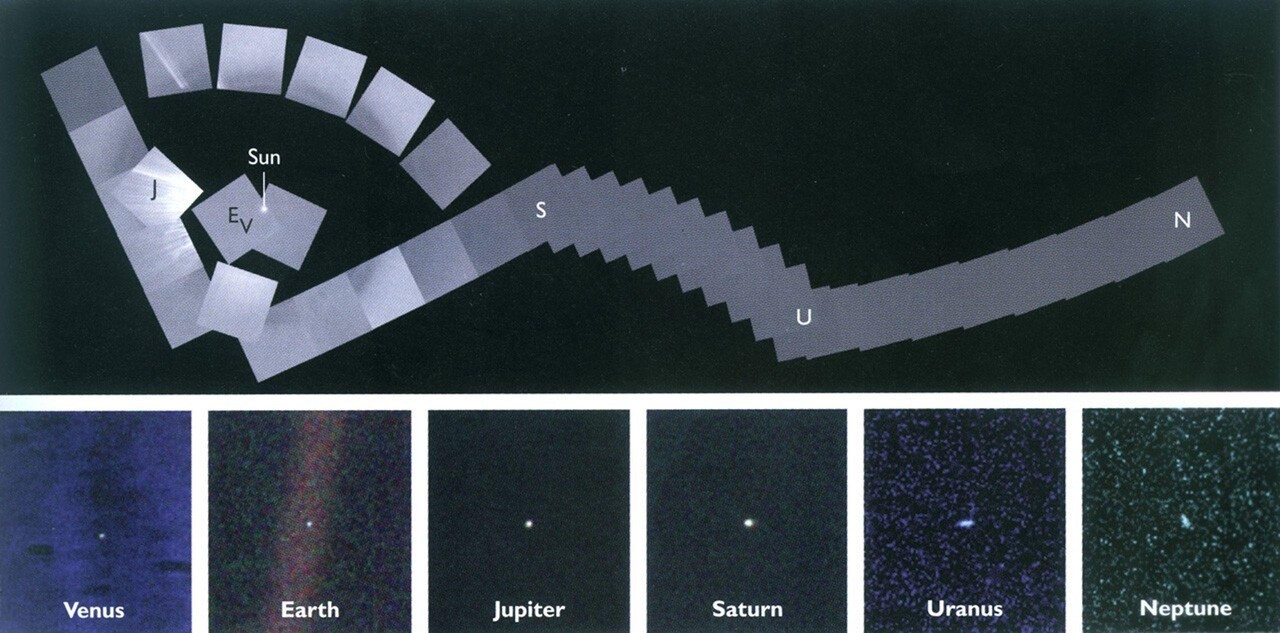
NASA has been turning off scientific instruments one by one to conserve power. Of the 10 instruments aboard at launch, only two remain on: a magnetometer that measures magnetic fields and an instrument that detects plasma waves. The cameras were switched off after taking the solar system family portrait and the “Pale Blue Dot” image in 1990.
The spacecraft faced several critical moments this year. On Feb. 27, its power level fell more than expected during an attitude adjustment. If the voltage dropped further, protective systems could automatically shut down components. On April 17, NASA turned off the low-energy charged-particle instrument. “No one wants to turn off a science instrument, but this is the best option available to us right now,” Voyager mission manager Karim Badaruddin said at the time.
In early September, NASA carried out an operation it called “Big Bang.” It switched off three power-hungry systems and replaced them with three lower-power systems at the same time, so the heat distribution inside the spacecraft would not become unbalanced. NASA said that without the operation, it might have had to turn off another instrument as early as the summer of 2027.
On Oct. 18 and 19, the Deep Space Network (DSN) failed to detect Voyager’s signal twice in a row. The signal returned on the 20th. NASA confirmed that the spacecraft’s protection system had automatically switched from a thruster in use to a backup thruster. It has not been determined whether that caused the loss of signal.
◆ Earth sends the “VGR” signal with cellphones
After sunset on the 17th, the day before Voyager 1 crossed the milestone, NASA organized an event in which people around the world flashed golden lights. Participants used cellphones, flashlights and building lights to send Voyager’s call sign, “VGR,” in Morse code. NASA created a webpage that makes smartphone screens flash the letters automatically.
At noon Eastern time on the 19th—2 a.m. on the 20th in Korea—a public panel discussion will be held at the Von Kármán Auditorium at NASA’s Jet Propulsion Laboratory (JPL) in California. The venue hosted briefings when Voyager flew past Jupiter and Saturn. Participants will include Nicky Fox, head of NASA’s Science Mission Directorate; JPL Chief Scientist Jonathan Lunine; Voyager Project Manager Suzanne Dodd; Project Scientist Linda Spilker; Mission Manager Badaruddin; and Deputy Project Scientist Jamie Rankin. They will discuss the status of both spacecraft, data gathered in interstellar space and the challenges of operating aging spacecraft at such a great distance. A trailer for a documentary due to be released for the 50th anniversary of the launch in 2027 will also be shown. The event can be watched on NASA Live.
◆ Its twin, Voyager 2, will reach the milestone in nine years
Voyager 1 and Voyager 2 were designed to explore the outer planets by taking advantage of a planetary alignment that occurs once every 176 years. Voyager 1 left the heliosphere—the protective bubble created by the Sun—in 2012, and Voyager 2 followed in 2018, entering interstellar space.
Voyager 2 took a different route as it passed Uranus and Neptune and is expected to reach one light-day from Earth in November 2035. Both spacecraft continue to send back data on conditions beyond the heliosphere.