
Key points
▶ The top scorer in the certified tax accountant exam admitted to cheating with the help of generative AI, drawing attention to how far AI use should be permitted in exams and education.
▶ OpenAI recommended that countries set national goals for AI education and distinguish between tasks where students may receive AI assistance and learning activities they must complete independently.
▶ The Ministry of Education has also provided schools with guidance on managing AI use in performance assessments, but concerns remain about the difficulty of verifying whether AI was used and determining whether its use constitutes cheating.
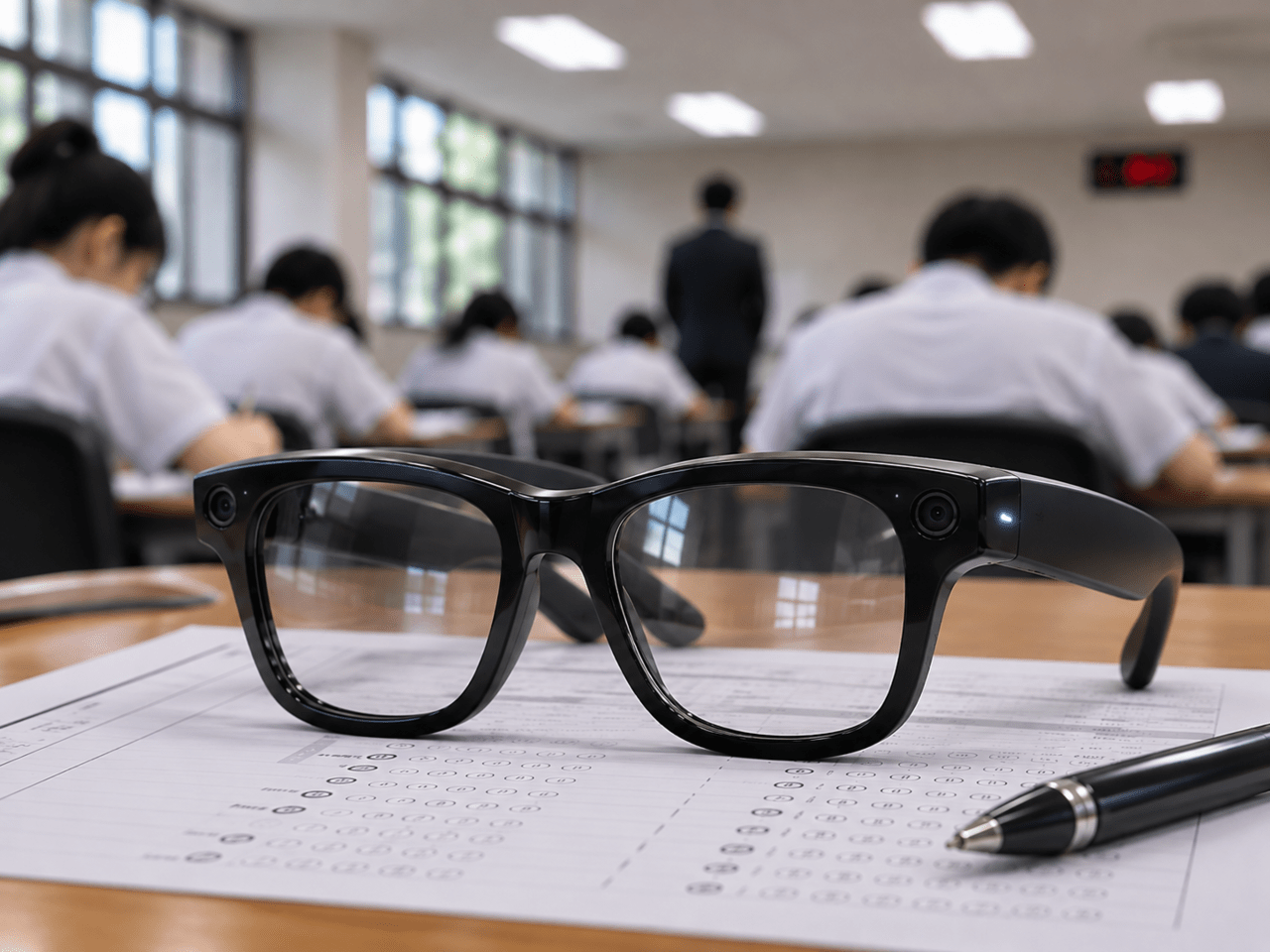
Debate over the scope of AI use and fairness in assessment is spreading through education following an admission of cheating with generative artificial intelligence (AI). The use of AI for homework and assignments is rising rapidly, but critics say rules on what is allowed—and education on how to use it—have not kept pace.
On the 15th, the top scorer in the certified tax accountant exam said in a video posted on the YouTube channel “Attorney Lee Don-ho” that he had cheated using electronic devices and generative AI. He admitted using the same method in both the first and second stages of the tax accountant exam, as well as the first-stage certified public accountant exam.
The exam candidate said he had submitted a statement to the Seoul Metropolitan Police Agency turning himself in. The Human Resources Development Service of Korea had earlier begun an expert review of answer sheets from the second-stage exam after allegations of cheating emerged.
In national qualification exams, using unauthorized electronic devices or outside assistance to write answers constitutes cheating. In schools, AI use may be allowed depending on the nature of an assignment and the teacher’s instructions, prompting calls for more specific standards.
◆ 79% of European teenagers use AI for assignments
According to OpenAI’s report “Responsible AI in Education,” released on the 10th, about eight in 10 European teenagers use AI to do homework or assignments.
The findings come from a survey of about 5,000 students aged 13 to 19 in 10 European countries, including the United Kingdom, France, Germany, Italy and Spain. The survey was conducted by the European think tank ThinkYoung with support from OpenAI. Some 79% of respondents said they used AI for homework and assignments, while only 47% said they had received instruction on how to use AI.
The results point to a gap between the pace at which students are adopting AI for learning and the level of related education offered by schools.
In its report, OpenAI identified setting national AI education goals, strengthening teachers’ capabilities and teaching students to use AI critically as key policy priorities. The aim is to help students verify and assess AI-generated responses rather than accept them at face value.
The report particularly emphasized the need to clearly distinguish between the kinds of AI assistance students may use while completing assignments and the learning activities they must carry out independently.
The report was prepared with support from OpenAI. Its findings and policy recommendations should be considered separately, given that the material reflects the perspective of a company advocating for the expansion of AI education.
◆ Greece sets rules for AI use
As AI spreads rapidly through schools in Europe, efforts are also underway to establish specific standards for its use.
One example cited in OpenAI’s report is Greece. In May, the Greek government set standards for AI use in secondary education, including rules on when AI may be used in assignments and exams and on teacher supervision.
The rules also prohibit fully automated AI-based student assessments and profiling that analyzes the characteristics of students or teachers. Teachers retain final responsibility for student assessments, and human oversight must be maintained when AI is used.
Drawing on these policy examples, OpenAI proposed that governments incorporate AI capabilities into curricula and establish standards that schools can apply in practice.
◆ South Korea has introduced guidelines, but schools face challenges in applying them
South Korea’s Ministry of Education also issued schools guidance this year on “managing AI use in performance assessments,” beginning in the first semester. The guidance covers five areas, including setting limits on AI use, documenting how it was used and providing students with advance instruction.
The aim is to have teachers define the permitted scope of AI use when students work on assignments and make it possible to verify whether AI was used.
Schools, however, face difficulties confirming whether AI was actually used and proving that a student’s use went beyond what was permitted.
In one case, a high school in Yangcheon District, Seoul, decided to hold a retest after suspicions arose that students had used AI during a Korean-language performance assessment.
The difficulty of clearly distinguishing AI-generated work from work written by students themselves is also seen as a challenge to fairness in assessment.
Lee Min-seok, a professor at Kookmin University and head of the Education and Talent Subcommittee of the Presidential National AI Strategy Committee, stressed the need for the Ministry of Education to clarify the scope and standards for student AI use.
He also recommended conducting empirical research to verify how AI use affects academic achievement and educational outcomes.
The point is not to impose a blanket ban on AI or allow it without restriction, but to establish standards according to learning objectives and assessment methods.
◆ Experts call for separate standards in education laws
Experts have also called for legal standards governing the use of AI in student assessment. Article 2 of the AI Basic Act classifies AI used to assess students in school education as high-impact AI. The designation reflects the need for separate oversight when AI is used in areas such as student assessment that can have significant effects on individuals.
Critics say existing legislation does not adequately regulate the range of situations that arise in education, including assessments outside the formal curriculum and cases in which teachers use AI on their own.
Bang Seok-ho, head of the AI Research Center at law firm Lin, noted that the AI Basic Act is primarily designed to regulate the responsibilities of AI providers.
He said that although schools may in some cases qualify as AI providers, separate standards should be established in education-related laws, such as the Elementary and Secondary Education Act, to ensure fairness and reliability in student assessment.
As AI becomes a routine learning tool, debate continues in education over the scope of permitted use, standards for determining cheating and how students should be assessed.
While national qualification exams need stronger oversight to prevent cheating with AI, schools face the challenge of allowing students to use AI for learning while distinguishing that assistance from work students must do themselves.
There are growing calls to refine the Ministry of Education’s guidelines so they can be applied consistently in schools and to update the relevant legal framework.