
One-minute news
▶ Researchers at Australia’s national science agency, CSIRO, independently reanalyzed the image of the supermassive black hole at the center of the M87 galaxy, first released to the public in 2019.
▶ Using a new analysis method to reconstruct the Event Horizon Telescope’s original observational data, they consistently found a ring structure across all the data.
▶ The findings were published in the journal Nature.
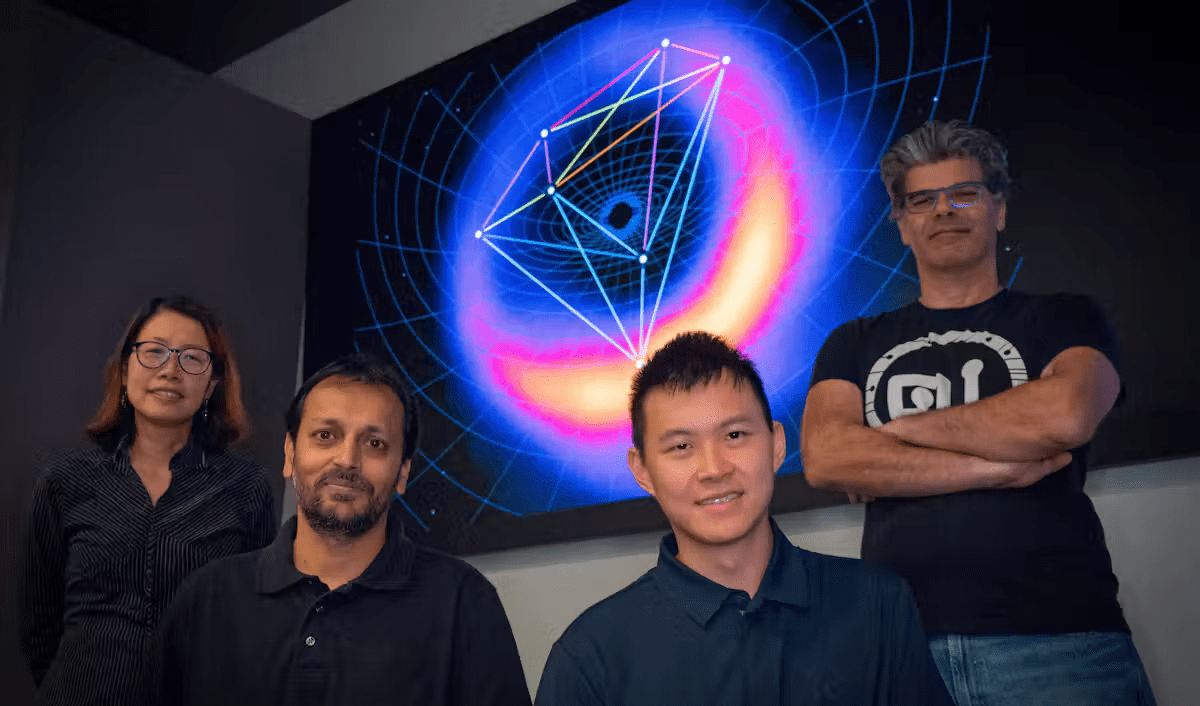
Seven years after humanity’s first black hole image was released in 2019, it has been independently verified using a new analysis technique. An artificial intelligence system that had not been trained on images of black holes analyzed the original observational data and reconstructed the same ring structure seen in the original image. The findings are considered new evidence that may resolve questions about the image’s accuracy.
Four researchers from Australia’s national science agency, CSIRO—Samuel Lai, Nithyanandan Thyagarajan, Ivy Wong, and Phoebos D. K.—published the results of their independent reanalysis of observations from the Event Horizon Telescope (EHT) in the journal Nature on the 11th (local time).
Using new data-processing methods and AI image-reconstruction technology, the researchers confirmed a ring surrounding the supermassive black hole at the center of the M87 galaxy. The reconstructed image matched the 2019 result released by the EHT collaboration in both diameter and overall orientation.
Humanity’s first black hole image
At the center of the M87 galaxy, about 55 million light-years from Earth, lies a supermassive black hole with a mass roughly 6.5 billion times that of the Sun.
Observing this black hole has been compared to photographing a doughnut on the surface of the Moon from Earth. It requires resolving an extremely small angle, making it difficult for a single telescope to achieve the necessary resolution.
The EHT collaboration combined signals from radio telescopes around the world to create a virtual telescope the size of Earth. On April 10, 2019, it released humanity’s first image of a black hole.
The image showed a bright ring surrounding a dark center. It was reconstructed from radio waves emitted by hot gas orbiting the black hole. The dark region at the center corresponds to the black hole’s shadow.
The image was consistent with the structure around a black hole predicted by Einstein’s general theory of relativity. It was regarded as a significant observational result supporting the theory that a supermassive black hole exists at the center of the galaxy.
Academic debate continued over the accuracy of the image-reconstruction process. At the time, four teams within the EHT collaboration independently reconstructed the image, and all found a ring. However, their results differed in the ring’s finer details and brightness distribution.
Questions were raised about whether the algorithms used for image reconstruction and assumptions incorporated into the analysis could affect the results. In 2022, a Japanese research team processed the same observational data using a different analysis method and presented a structure unlike the original ring image. The team argued that an elongated bright shape could better explain the observational data.
Combining three telescopes instead of two reduced observational errors
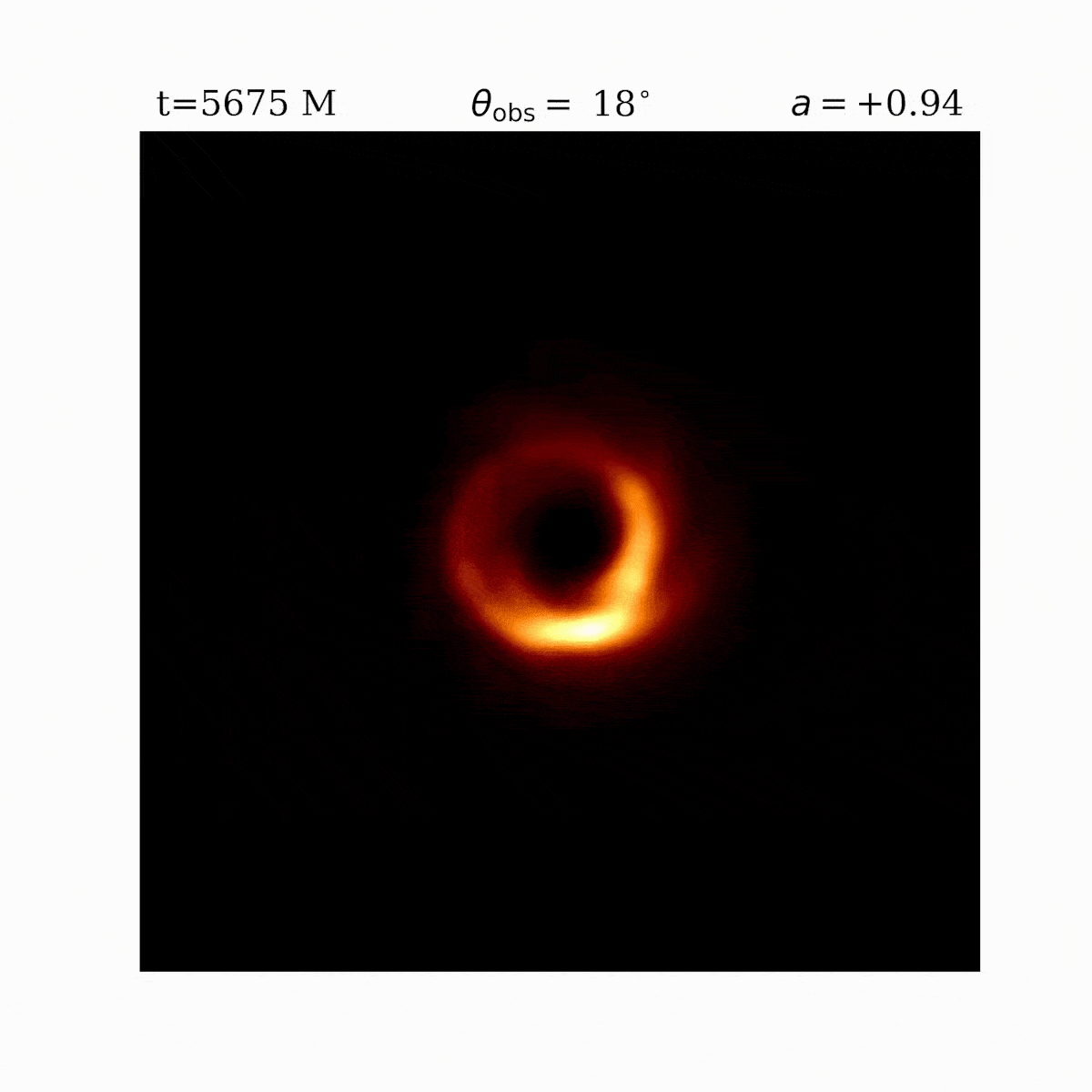
Before reconstructing the image, the CSIRO researchers changed how they combined the radio-telescope observations. The EHT estimates the structure of celestial objects by combining signals collected by radio telescopes spread around the world. The characteristics of each telescope and conditions in Earth’s atmosphere can introduce errors into the observed signals.
Researchers generally estimate and correct for these errors. However, errors that remain after correction may still affect the final image.
The method used by the team is known as “closure invariants.” Unlike conventional analyses, which generally use measurements between pairs of telescopes, it combines observations from three telescopes to cancel out certain error components arising from individual instruments and the atmosphere. This reduces the influence of the equipment and helps extract information about the actual structure of the celestial object.
Researcher Thyagarajan explained that the method removes errors by combining telescope measurements in groups of three rather than in pairs. The team used the processed data to independently verify the results of earlier image reconstructions.
An AI that had not been trained on black hole images
Another notable aspect of the study was its approach to AI image reconstruction. The researchers developed a new machine-learning-based reconstruction method called GenDIReCT. Its goal is to produce images consistent with observational data while minimizing bias from existing black hole images.
The AI was trained on ordinary photographs taken on Earth, including images of cats, dogs, and cars. It was not trained on black hole images or black hole simulations. This design was intended to reduce the possibility that the AI would reproduce a similar result because it had already learned the ring shape from the original EHT image.
The researchers also tested whether the system could reconstruct a variety of structures that were not ring-shaped. They assessed its performance using real observational data from other galaxies, including Centaurus A.
After completing validation, they fixed the training and testing procedures. This was intended to prevent them from modifying the AI model to produce a desired image after seeing the M87 results.
In December last year, the researchers entered EHT observational data of the M87 black hole into the validated AI for the first time.
The result was a ring. The ring structure appeared consistently across all the observational data analyzed by the team. Through independent analysis, an AI that had not been trained on existing black hole images reconstructed the same basic structure as the EHT collaboration.
Supporting the accuracy of the original image
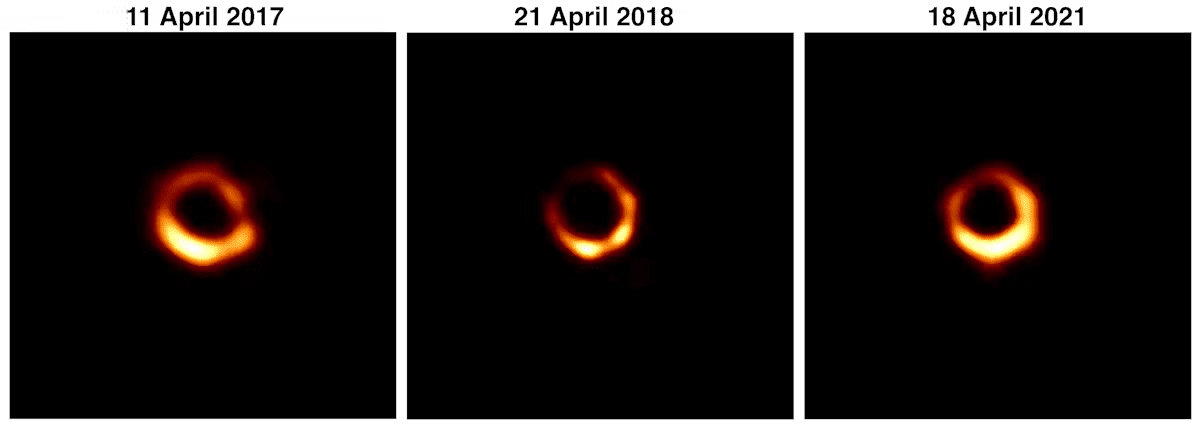
The newly reconstructed image was broadly consistent with the black hole structure reported by the EHT collaboration in 2019. The ring’s diameter and overall orientation matched the earlier findings. It was also consistent with a nearly face-on view of a black hole with a mass roughly 6.5 billion times that of the Sun.
The ring is about 42 microarcseconds in diameter. A microarcsecond is an extremely small angular measurement of how much of the sky an object occupies—one-millionth of an arcsecond.
There were differences in the finer details. The ring’s width and the distribution of brightness around its circumference were not exactly the same as in the original EHT image. The researchers said that although they observed these differences, the basic ring structure and its overall orientation were consistent.
The findings did not rely solely on AI. The researchers developed a separate image-reconstruction method based on conventional statistical analysis and applied it to the same data. It, too, showed a ring structure.
The fact that different image-reconstruction methods produced the same basic structure is seen as strengthening confidence in the original EHT results.
Potential applications beyond black holes, including medical imaging and seismic analysis
The researchers said the analysis techniques developed for this study could potentially be applied beyond black hole observations.
Combining data from multiple instruments or sensors to reconstruct structures that cannot be seen directly is not unique to astronomy. Medical imaging and the analysis of underground structures using seismic data share the challenge of inferring real-world structures from limited measurements. The researchers hope the new data-combination method and image-reconstruction technology can also be used in these fields.
This study is significant as an independent verification of the 2019 black hole image. The researchers confirmed the ring structure using both an analysis method different from that of the original team and an AI that had not been trained on black hole images.
Seven years after the world’s first black hole image was released, new analysis techniques have reinforced the original observations and further increased confidence in black hole image reconstruction.