
Key points
▶ SK Telecom said on Nov. 1 that it would accelerate “AX Innovation 2.0,” advancing its company-wide AI transformation (AX) “from individuals to the organization, and from convenience to practical value.”
▶ More than 4,000 employees have built AI agents themselves this year, and 1,500 agents are used regularly within the company.
▶ The next step is to move beyond individual use of AI and redesign organizational workflows and collaboration around AI.
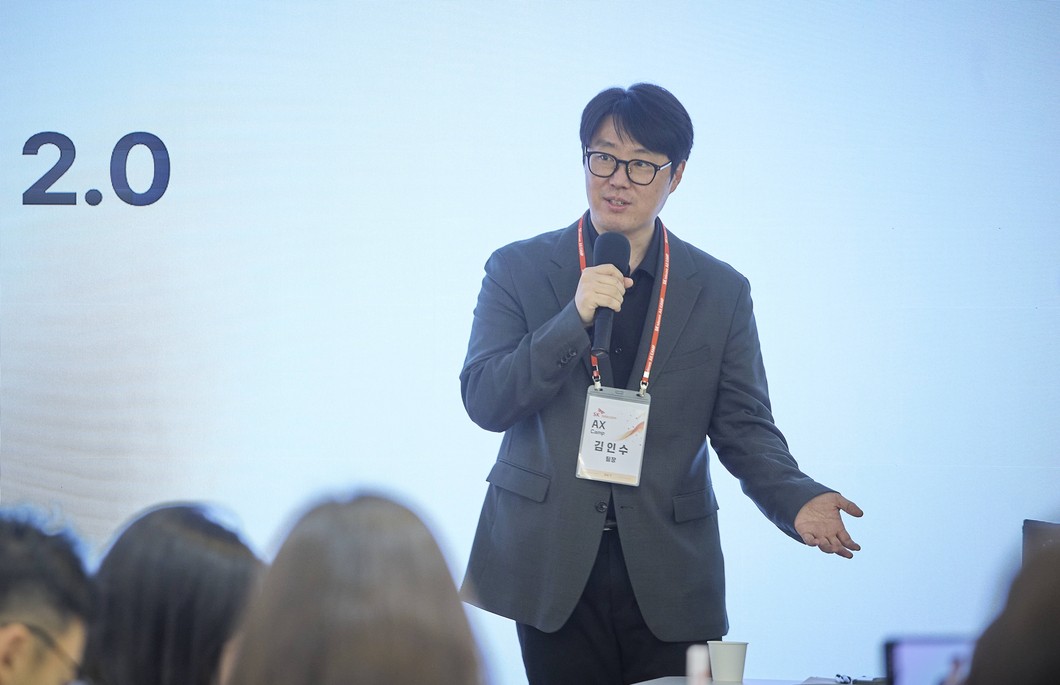
SK Telecom is moving into the second phase of its internal AI transformation. On Nov. 1, the company said it would accelerate “AX Innovation 2.0,” setting its company-wide AI transformation (AX) direction as “from individuals to the organization, and from convenience to practical value.”
The move fleshes out a plan announced by SK Telecom CEO Jeong Jae-heon at the “New Icheon Forum” in June: to give AI agents employee ID numbers and manage them like employees.
The first phase has produced measurable results. More than 4,000 SK Telecom employees have built AI agents themselves this year, and 1,500 agents are used regularly within the company. The company believes that a culture in which employees create agents to help with their own work has taken hold. The second phase will move those agents from individual desks into organizational workflows.
◆ Adoption makes things slower at first
SK Telecom describes the second-phase goal as “getting through the AX J-curve trough.” A J-curve is a graph shaped like the letter J: it dips at first, then rises sharply.
When AI is introduced, productivity initially declines because time is needed to retrain employees, redesign work practices, and reorganize data and teams. The company says that only organizations that get through this trough will see productivity rise. SK Telecom identifies data access, system integration, and security as the main causes of the dip. Even if an agent is built, it is of little use if it cannot access company data, connect to existing systems, or operate within security rules.
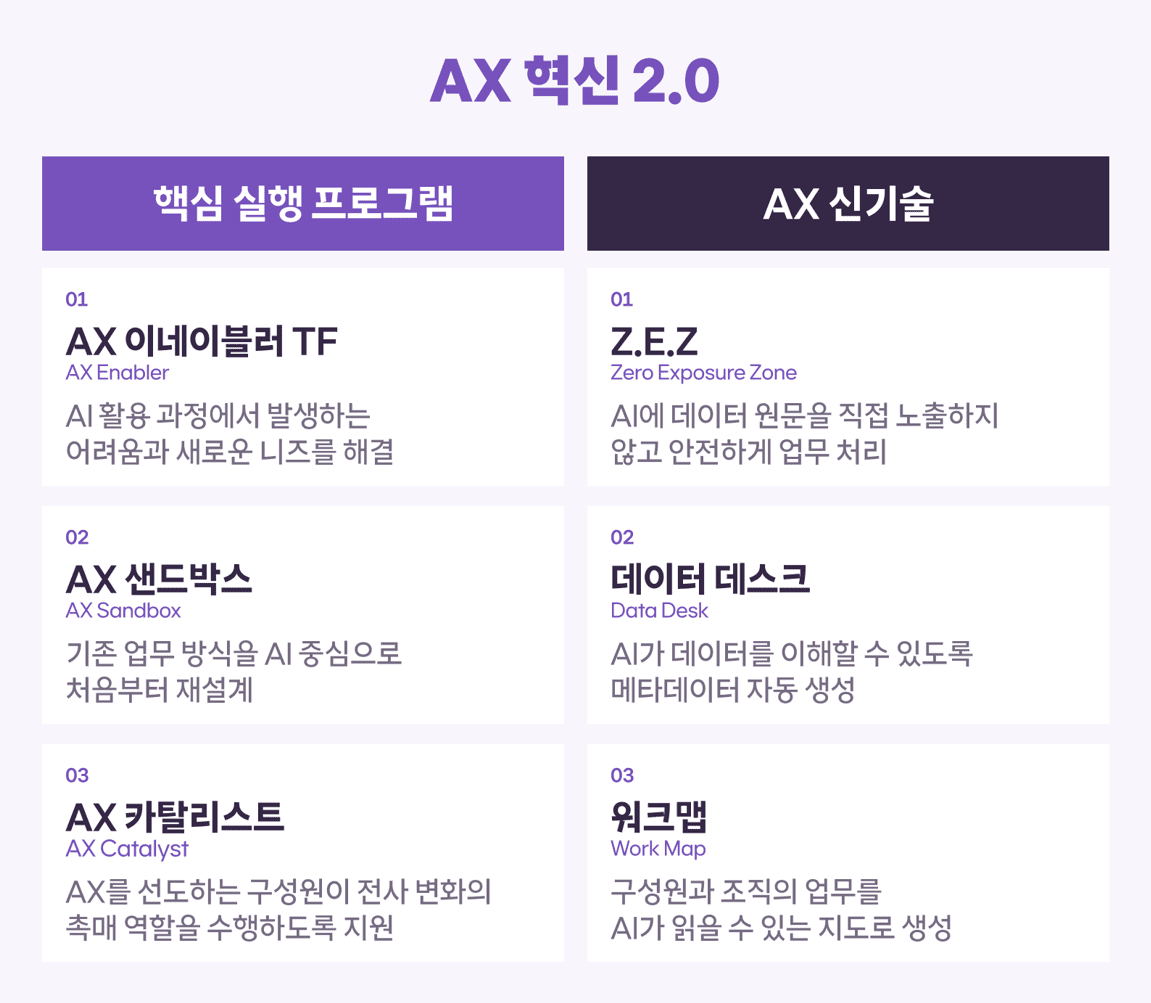
The company is rolling out three programs to address these challenges. The “AX Enabler Task Force” tackles common problems that arise when employees use AI across the company. It is improving training and support, as well as data and security infrastructure, and is also redesigning management infrastructure, including assigning employee ID numbers to AI agents and creating evaluation systems.
The “AX Sandbox” is an experiment in rebuilding existing workflows around AI from the ground up. In the first half of the year, a service development team tested whether one employee, working only with AI agents, could complete the process from planning through development and validation. In the second half, the experiment is expanding company-wide to explore how multiple employees and agents can work together.
The “AX Catalyst” program selected its first group of 10 employees in September from among those actively using AI in their work. It provides support for AI model costs and technical and data integration. The participants work with the Enabler Task Force to resolve barriers involving data, permissions, systems, and security, so that other employees do not run into the same obstacles.
◆ Using AI without exposing the original data
SK Telecom has also introduced technology designed to balance security with practical use. “Z.E.Z. (Zero Exposure Zone)” enables AI to perform tasks without exposing the original data. Sensitive source data, such as personal information, is kept in a separate area, while the AI receives only the results it needs for the task, such as metadata, comparison tokens, and calculated values. For example, the system can let AI determine whether a customer meets certain criteria without showing it the customer’s resident registration number. SK Telecom has filed a patent for the technology.
“Data Desk” helps AI understand company data. Until now, company data has been managed for the convenience of systems and developers, making it difficult for AI to understand what the data means in a work context. Data Desk automatically adds descriptions and business context to each data set, enabling agents to find and use the information they need.
“Workmap,” in turn, organizes people’s work so AI can understand it. AI first reviews existing work materials and goals to identify workflows, then builds a map of the work through conversations with employees. The resulting map establishes standard procedures for people and AI to work together and helps identify tasks that could benefit from agents.
SK Telecom said, “We are creating a work environment in which employees and AI agents work together in order to get through the trough of the AX J-curve. We will connect employees’ voluntary use of AI with company-wide support systems and spread the results of AX innovation throughout the organization.”
◆ Three telecom operators, three different approaches
All three major telecom operators are pushing ahead with internal AX, but their approaches differ. SK Telecom is building its own ecosystem in which employees create agents and the company manages them through employee ID numbers and evaluation systems. Its “A.Dot Biz Co-Work” beta, rolled out internally in May, enables even employees who are not developers to plan, write code, and validate it.
LG Uplus adopted Microsoft Copilot as its company-wide standard work tool in May. Within a month, usage exceeded 80%, with 440,000 prompts submitted in total and an average of 86 prompts per employee. It uses different tools for different tasks: Codex and Claude Code for coding, Figma and Claude for planning, and Gemini for content.
KT is running “AX Degree 2026,” a hands-on training program for all employees. It is also applying its proprietary retrieval-augmented generation technology, “K RAG,” to internal agents and researching personalized agents that can handle entire workflows.