
▶ Data centers are heading into space because they are running into too many obstacles on Earth. A single AI data center can consume as much electricity as half a nuclear power plant, and building a transmission line takes 10 years.
▶ In orbit that receives uninterrupted sunlight, solar panels can generate power around the clock, with efficiency up to eight times higher than on the ground. There is no land to buy, either.
▶ But space brings its own problems. In a vacuum, there is no air to carry heat away, so enormous radiators are needed. Radiation can cause memory errors, and once equipment breaks down, it cannot be repaired.
▶ Launching a payload currently costs about $1,000 per kilogram. Google estimates that the economics will work only if that falls below $200. Elon Musk says space will be cheaper in two to three years, while experts expect it to take more than a decade.
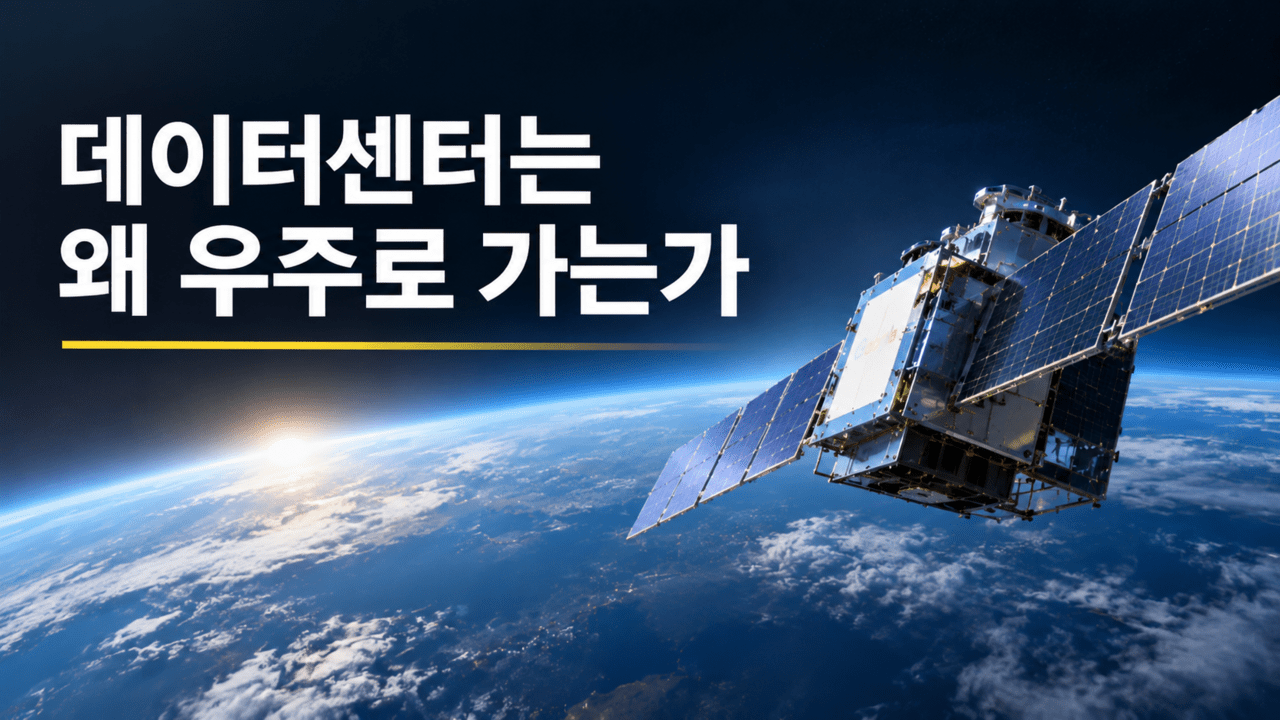
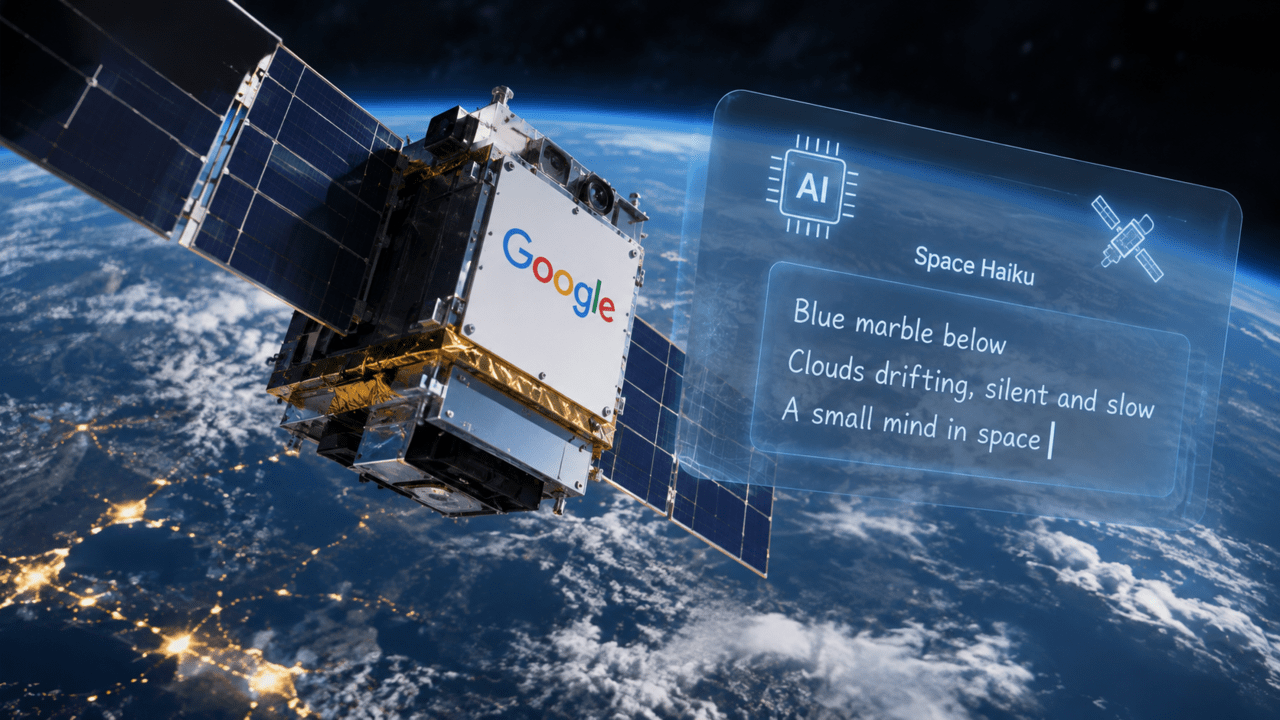
On October 30, a computer hundreds of kilometers above Earth wrote a poem. It was a test satellite that Google sent up aboard a SpaceX Falcon 9 rocket on October 1. When researchers on the ground asked a model installed on the satellite’s AI chip to “write a haiku about what it feels like to be in space,” it sent back a three-line poem that began, “Blue marble below.” Google said the satellite was operating normally.
The reason a satellite writing a poem made the news is that it was a “data center.” A year ago, Google announced Project Suncatcher, an effort to perform AI computations beyond Earth. Its first piece has now begun orbiting the planet.
That same month, Elon Musk pushed ahead with plans to build a space data center using one million satellites, while Jeff Bezos said gigawatt-scale data centers would be in space within 20 years. Why are some of the world’s wealthiest people trying to send servers into the sky? First, we need to look at what is holding them back on Earth.
◆ Electricity is running short on Earth
Data centers are buildings that consume huge amounts of electricity. AI data centers use even more. A single rack of Nvidia’s latest servers draws 120 to 140 kilowatts—as much as 100 households using electricity at the same time.
If the 260,000 Nvidia GPUs that the South Korean government plans to bring into the country were converted into racks, they would require more than 3,600 racks. Including cooling, they would need 500 to 600 megawatts—half the output of a 1-gigawatt nuclear power plant. The International Energy Agency (IEA) expects global data center electricity consumption to more than double, from 415 terawatt-hours in 2024 to 945 terawatt-hours in 2030. That would be 3% of the world’s electricity.
The problem is not just how much electricity there is, but how to get it where it is needed. As of the end of 2022, 70% of South Korea’s data center power demand was concentrated in the Seoul metropolitan area. Including pending applications, that share is expected to exceed 80% by 2029. The region’s transmission network is already at capacity, and building a new transmission line takes more than 10 years.
The Yongin semiconductor cluster alone will use 5 to 8 gigawatts. Under the Distributed Energy Act, which took effect in June 2024, large power-consuming facilities proposed for the Seoul metropolitan area must undergo an assessment of their impact on the power grid. There may be electricity available, but there are no lines to bring it in—and no land on which to build them.
Land and water are problems, too. Data centers occupy sites spanning hundreds of thousands of pyeong and require large amounts of cooling water. In the United States, growing local opposition is blocking construction, while banners opposing data centers have appeared in municipalities on the outskirts of Seoul. Servers generate heat as they run, and removing that heat requires more electricity and water. Data centers on the ground are running into four barriers: electricity, land, water and cooling.
◆ What could space solve?
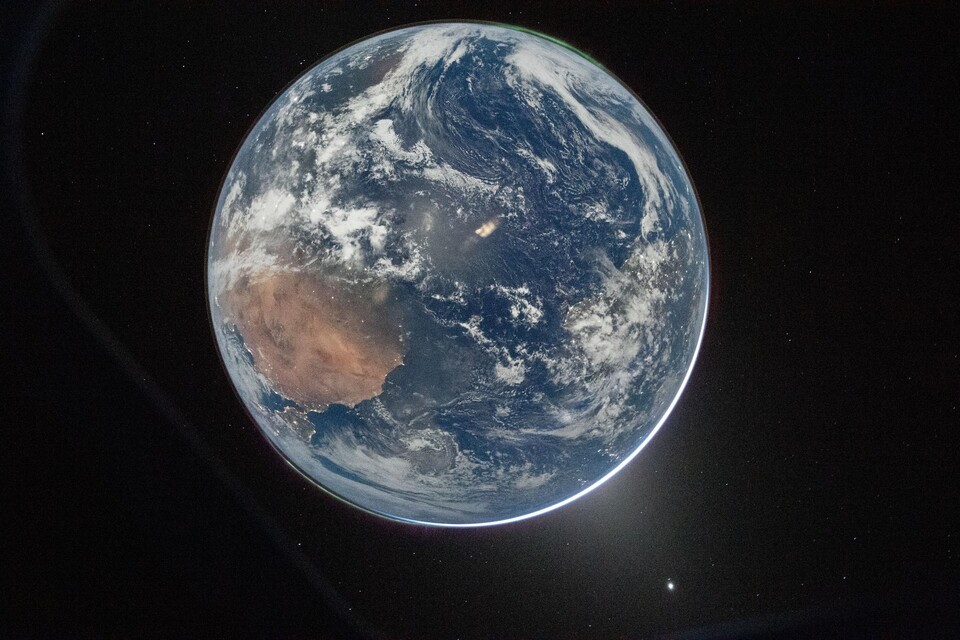
Space has none of those four barriers. First, electricity. In low Earth orbit, there is a path called the “dawn-dusk orbit.” Satellites following the boundary between day and night remain in sunlight. There is no night, cloud or rain. Google estimates that the same solar panels can generate up to eight times more electricity there than on the ground. This is the basis for Bezos’s claim that “massive AI training equipment is better built in space. You have 24/7 solar power up there.”
There is no land problem, either. In orbit, there is no land to buy, no local opposition and no permitting process. Water is similar. There is no way to pipe cooling water into space, but there is no need to: heat can be radiated into space using radiators. Nor are transmission lines needed. Electricity is used where it is generated, and data is relayed between satellites and down to Earth by laser.
Musk’s argument is more sweeping. In a 30-minute interview posted on X last June, he said, “We’re barely using the power of our star,” and that space data centers do not require “some magic that doesn’t exist.” “Compared with things we already do, I don’t think it’s a very difficult problem. It’s ultimately a matter of scale,” he said.
SpaceX has asked the U.S. Federal Communications Commission (FCC) for permission to create an “orbital data center” with as many as one million satellites. There are currently about 14,000 satellites in orbit around Earth. The plan envisions groups of satellites spaced 50 kilometers apart at altitudes of 500 to 2,000 kilometers. Each ton of satellites would carry 100 kilowatts of computing power, and Starship reusable rockets would launch one million tons a year. By this calculation, 100 gigawatts of computing capacity would be added in space each year.
More than 99% of the power would come from solar energy, and satellites would have a five-year lifespan. SpaceX’s first model, AI1, would stand 20 meters tall, have a 70-meter wingspan and produce up to 150 kilowatts. Musk says space-based AI will be cheaper than its Earth-based counterpart within two to three years.
◆ Google is starting small; Musk is thinking big
They share the same ambition, but are taking different approaches. Google’s Project Suncatcher began with a paper published on November 4, 2025. That was the year Alphabet CEO Sundar Pichai announced the company would spend $75 billion on AI infrastructure.
While that amount—nearly four times the $20 billion Google had spent a few years earlier—was going into data centers on Earth, researchers proposed a design for a time when the planet could no longer accommodate that investment. It would group 81 satellites within a one-kilometer radius and link them via optical communications so they could operate as a single data center. The satellites would be spaced 100 to 200 meters apart.
In ground tests, Google sent data at 1.6 terabits per second over a single optical link. The company said that a data center would require tens of terabits per second. It also tested radiation resistance by exposing its in-house AI chip, Trillium, to a proton beam. Memory anomalies appeared at a radiation dose three times the projected level for a five-year mission, but the chip did not fail completely.
The satellite launched on October 1 is the first test vehicle for that design. Built by satellite manufacturer Planet Labs, it carries four TPUs, but power limitations mean it can run only one at a time, for 20 minutes. Its maximum power output is one kilowatt. After three weeks of component checks, it wrote a haiku.
Google is currently looking at thermal distortion and radiation. Radiation can flip the zeros and ones stored in memory, silently corrupting data. In ground tests, radiation had little effect on inference—generating answers—but posed a greater risk to training.
Google plans to launch two more satellites in 2027 to increase available power and test optical communications between satellites. The company describes the effort as a long-term “moonshot” aimed at the 2030s. Alphabet owns a stake in SpaceX, so both companies are counting on Starship achieving full reusability.
Musk, by contrast, is going big: one million satellites and 100 gigawatts of capacity added each year. The FCC typically requires satellite network operators to launch half their satellites within six years of approval and all of them within nine years. SpaceX has asked to be exempted from those deadlines. Its application contains few specifics about satellite weight or equipment.
SpaceX absorbed xAI this year and went public in June. Musk said the IPO proceeds would fund the orbital data center. Bezos’s Blue Origin has also announced Terawave, a laser communications system linking satellites at six terabits per second. Musk has countered that Starlink’s laser links will be faster.
Startups are joining the race, too. Starcloud, which has received investment from Nvidia, launched a satellite carrying an Nvidia H100 GPU last November and ran Google’s Gemma open model in orbit. It was the first time a large language model had been run in orbit on a high-performance GPU. Its second satellite is expected to provide about eight kilowatts. Starcloud CEO Philip Johnston called the achievement “proof” that space data centers are possible.
◆ Has anyone tried putting servers under the sea?
This is not the first effort to move servers somewhere people do not live. In 2018, Microsoft sank a cylindrical data center containing 864 servers to a depth of 36 meters off the coast of Scotland. The project was called Natick.
Seawater cooled the servers, and because no people entered the facility, there was no oxygen or humidity. When Microsoft retrieved it two years later, it found that the failure rate was one-eighth that of servers in a land-based data center. The experiment showed that an environment with stable temperatures and no human traffic could extend server life.
Microsoft did not commercialize the project, but its underlying idea—using the environment itself to eliminate the costs of cooling and human access—is similar to that of space data centers. The difference is that the sea could absorb heat with its water, while space has no water.
◆ Space data centers still have a long way to go
If space were a cure-all, data centers would already be there. The obstacles are clear.
The first is heat. On Earth, data centers push hot air out with fans or cool equipment with water. There is no air in space. With no medium to carry heat away, the only option is to radiate it as infrared energy from radiators.
Rebecca Reed, a Harvard researcher and former NASA employee, told NPR that “all the heat generated by the computers has to be rejected.” She said that combining the radiators and solar panels would make satellites very large. That is why SpaceX’s AI1 has a 70-meter wingspan. MIT professor Olivier de Weck said a 100-megawatt space data center would require 500 to 1,000 times the power of the International Space Station, adding: “It’s possible, but not next year, and not in three years.”
Next comes radiation. When space radiation, normally blocked by Earth’s magnetic field and atmosphere, hits semiconductors, it can flip memory values. Google’s tests also found that memory was the first component to show problems. On Earth, a faulty server can be pulled out and replaced. In orbit, it cannot be repaired.
Databank CEO Raul Martinek said data centers need constant maintenance and upgrades, and that he found claims of deployment within two to three years hard to believe. With satellites lasting five years, the entire data center would have to be launched again every five years.
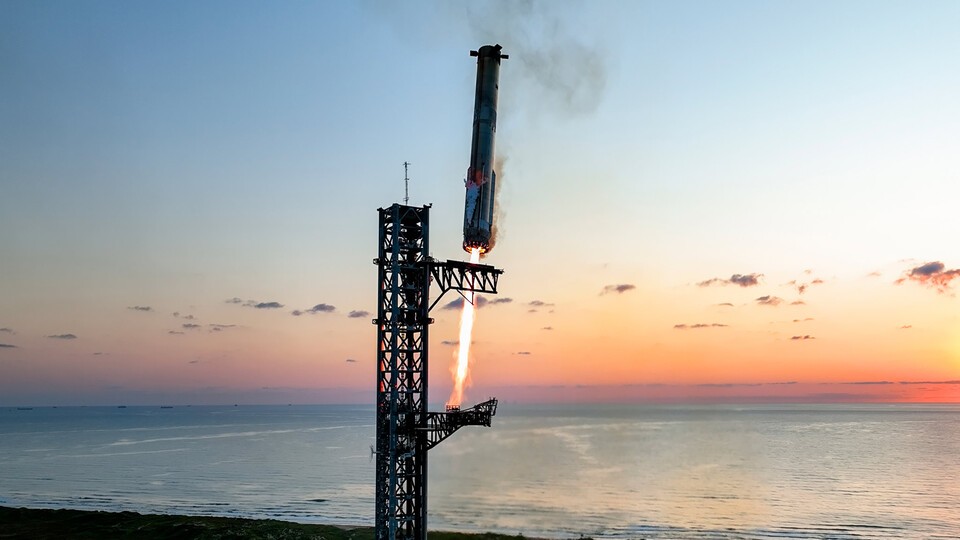
Cost is another problem. Launching a payload currently costs about $1,000 per kilogram. Google estimates that launch costs would need to fall below $200 by the mid-2030s for space data center costs to be comparable to electricity bills on Earth. That means a fivefold reduction. For that to happen, Starship would need to fly repeatedly like an airplane. One paper estimated that it would have to make 1,800 flights to achieve the cost reductions seen with earlier rockets. Starship made five test flights last year: three ended in explosions and two reached orbit, but reusability was not tested.
The final challenge is latency. A single satellite cannot run a large AI system, so multiple satellites must be linked. But laser communications between satellites are slower than cables between servers. That is a serious problem for tasks such as training, where thousands of chips constantly exchange data. It is why Google plans to keep its satellites just 100 to 200 meters apart and initially focus on inference rather than training. Orbital congestion, space debris and the radio frequencies needed for communications with Earth also remain unresolved issues.
Amazon has publicly criticized SpaceX’s plan, while Brandon Lucia, a professor at Carnegie Mellon University, called Musk’s timeline “an optimistic interpretation.” Planet CEO Will Marshall described orbital data centers as “an idea whose time has come,” while acknowledging that when they will become cheaper than ground-based facilities remains “a matter of debate.”
◆ What should we be watching?
For South Korea, satellite data centers are not an immediate prospect. But the reasons for moving into space are directly relevant to the country. Eighty percent of electricity demand is concentrated in the Seoul metropolitan area, transmission lines take 10 years to build, and local governments are blocking data centers. These are precisely the problems Google and Musk are trying to solve in orbit.
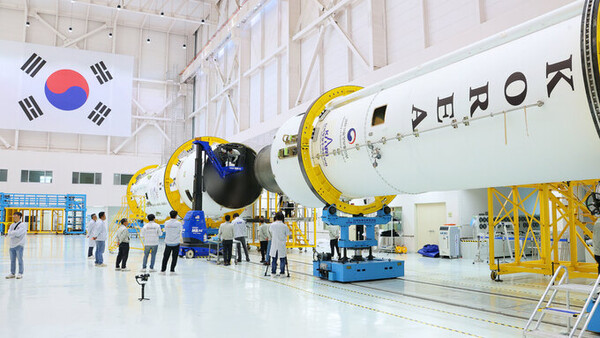
South Korea is not yet in a position to join the space data center race directly. Its homegrown Nuri launch vehicle is still at the stage of putting small satellites into low Earth orbit, and the country has no reusable rocket capable of reducing launch costs to $200 per kilogram. But South Korea has strengths in the AI semiconductors and memory that would go on board. Radiation-resistant memory and energy-efficient computing chips are also useful in data centers on Earth.
Whether or not space data centers succeed, the technologies developed along the way can be brought back to Earth. These include ways to dissipate heat without air, memory designs that withstand radiation, terabit-per-second laser communications between satellites, and systems that bring power generation and computing together.
Building data centers where electricity is available, combining computing and power generation to reduce reliance on transmission lines, and separating training from inference so workloads can adapt to available power are all possible in South Korea today—not just in space. On the day Google’s satellite wrote a haiku, South Korean data centers were still waiting in line outside substations in the Seoul metropolitan area.