
The semiconductor cluster in Cheoin-gu, Yongin, is a mega-project with a total investment of 360 trillion won and is expected to be developed into the next-generation global semiconductor production base. (Photo = Samsung Electronics)
Samsung Electronics has once again stressed the need to move quickly on the Yongin semiconductor cluster project. The remarks came during a meeting held on the 24th at Samsung Electronics’ Pyeongtaek Campus in Pyeongtaek, Gyeonggi Province.
At the meeting, senior executives including Choo Mi-ae, the Democratic Party of Korea candidate for governor of Gyeonggi Province, and Vice Chairman Jeon Young-hyun, head of the Device Solutions (DS) Division, shared updates on the progress of the Yongin cluster project now under way. Vice Chairman Jeon said, “The Yongin semiconductor cluster is an important project in terms of national competitiveness,” expressing the company’s intention to respond with investment and results if government and local support are provided.
The project Samsung Electronics is pursuing in the Cheoin-gu area of Yongin is a large-scale initiative worth 360 trillion won. The blueprint calls for six semiconductor fabs, with construction of the first fab scheduled to begin in January 2028 and full-scale operations targeted for 2030. It is expected to become a next-generation semiconductor production hub following Pyeongtaek.
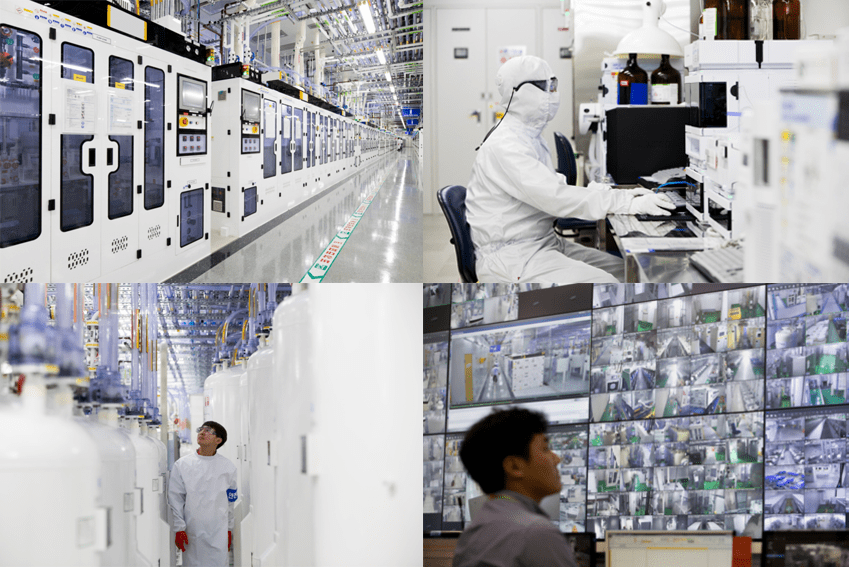
The core message of this announcement is “speed.” As the global semiconductor war is unfolding as a race against time, any delay in the Yongin cluster would not simply mean a longer construction schedule but a direct loss of national competitiveness.
That is why industry observers say the key is not to alter the existing plan, but to push it ahead without disruption.
The reasons Yongin was selected are clear. Securing top talent is the first condition. Skilled personnel who handle line operation, setup, and process management are usually concentrated in the greater Seoul area, and the site is also close to fabless companies in Pangyo.
Communication with design specialists leads to process optimization. Another decisive factor is that customer service centers and training centers for major global equipment companies are located near Yongin.
If equipment problems occur inside a factory, engineers must be deployed within the golden time, but the farther away the site is from the metropolitan core, the slower technical support from global partners becomes.
Yongin also has an advantage in logistics because it is close to Incheon International Airport. Given the semiconductor industry’s high dependence on air transport, the location is favorable both for cost reduction and for faster market response.
It is also notable that products completed at the R&D complex in Samsung Electronics’ Giheung Campus can be transferred directly to the Yongin production lines. Development and mass production can operate in tandem within the same region.
For the Yongin cluster to proceed on schedule, the first task is to remove bottlenecks in administrative procedures. To keep the 360 trillion won investment on track, every step—from site preparation and environmental impact assessments to securing water and power infrastructure—must move smoothly.
There is a growing view that this should not be handled as isolated cooperation by issue, but institutionalized as a permanent fast track. One possible option being considered is applying the administrative know-how accumulated during the construction of the Pyeongtaek Campus directly to the Yongin project.
Pre-planning the talent supply chain is another urgent task. While the concentration of skilled workers in the metropolitan area is an advantage, it also means fierce competition to secure talent.
To ensure a stable supply of line operation and process management personnel by the planned 2030 full-scale launch, an industry-academia cooperation system must begin now. Analysts say the talent pool will expand only when workforce circulation with Pangyo fabless companies and recruitment linked to nearby universities’ semiconductor departments work together.
The joint relocation of materials, parts, and equipment companies is another important variable. Yongin’s procurement advantage in semiconductor materials, parts, and equipment depends on the proximity of global equipment firms’ service centers.
There are also calls for land priority allocation and rent support so that domestic materials, parts, and equipment firms can also move into the cluster area. The distance that allows response within the golden time when equipment issues arise is directly tied to utilization rates.
Preemptive expansion of logistics infrastructure cannot be overlooked either. Even if access to Incheon Airport is a strength, its significance diminishes if road congestion and air cargo handling capacity hit their limits. Experts say a dedicated cargo route from the Yongin cluster to Incheon Airport, along with a dual-hub strategy using Pyeongtaek Port as a backup base, should be pursued in parallel.
Another key issue is tightening the link between R&D and mass production. The distance between the Giheung Campus R&D complex and the Yongin production lines is an advantage, but distance alone does not create automatic integration.
Administrative and technical procedures for moving completed products from development to the mass-production line must be standardized, and an operating system that normalizes personnel exchanges between the two campuses must be established.
Taiwan’s TSMC has smoothly connected development and production through the clustering of advanced process lines and R&D centers, while the company’s Arizona plant has seen production delays due to a shortage of technical personnel—an instructive contrast.
Building a model of coexistence with the local community is also a factor that will determine the project’s pace. If six fabs are built in Cheoin-gu, residents’ lives in the area will change significantly. Conflicts with residents over living conditions, transportation, and environmental issues could become factors that disrupt the project schedule. There are calls to activate a resident participation council from the planning stage and reflect local opinions.
The Yongin cluster is not just a manufacturing site. It is a complex ecosystem in which talent, equipment, design, and logistics are all interlocked.
Although the framework has been set in which the company invests 360 trillion won and the government and local authorities support it administratively, whether it actually works depends on how thoroughly six details are filled in: administrative speed, talent supply, joint expansion by materials, parts and equipment firms, logistics, R&D linkage, and coexistence with residents.