
Hyundai Motor Group is investing about 8 trillion won to build a research hub near Wirye New Town in Seongnam, Gyeonggi Province, to oversee future businesses such as artificial intelligence and software. The facility will be named the “HMG Future Complex.”
Hyundai Motor announced in a board meeting on the 24th that it had decided to contribute 288.85 billion won for the new facility. Kia will invest 236.34 billion won, and Hyundai Mobis 198.8 billion won. Including Hyundai Steel’s 51.64 billion won and Hyundai Rotem’s 46.08 billion won, the group’s total contribution amounts to about 732.8 billion won. With additional investment from other affiliates, the total investment is expected to rise to around 8 trillion won.
The investment will be made in installments over about five years, starting in May or June and continuing until December 2030. The funds will be used for land acquisition and building construction, and completion is scheduled for December 23, 2030. The new corporation will be established next month. The facility will be built north of Bokjeong Station in Songpa District, Seoul, and near Wirye New Town in Seongnam, Gyeonggi Province.
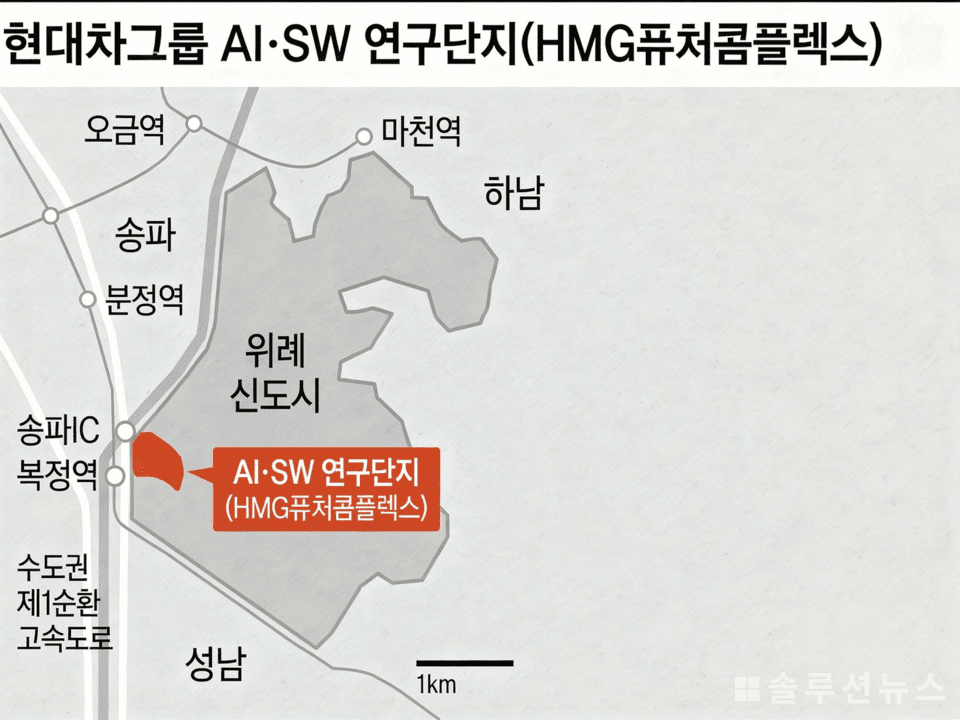
The key point of this investment is “concentration.” Hyundai Motor Group’s software workforce had previously been scattered across the Namyang R&D Center in Hwaseong, offices in Uiwang (Hyundai Mobis and Hyundai Rotem), and Pangyo in Seongnam (the AVP division).
By bringing separately divided research organizations together in one place, the group aims to accelerate its transformation into a physical AI company. In an era when the center of gravity in the automotive industry is shifting from hardware to software, the move is seen as an effort to integrate the group’s R&D system and speed up decision-making.
The choice of location is also meaningful. The Bokjeong Station area is a key hub in the southeastern part of the Seoul metropolitan area linking Songpa District and Seongnam, and large-scale mixed-use development is currently underway.
Its location, which can embrace both Seoul and Gyeonggi Province at the same time, is a powerful advantage in attracting talent.
It lowers commuting burdens for workers living in Gangnam while remaining close to the Pangyo IT belt, making it easier to build external collaboration networks. It is also within a manageable distance from existing hubs in Uiwang and Hwaseong.
To ensure the planned 800 billion won investment proceeds as scheduled, the first bottleneck to remove is administrative procedure. From land acquisition to construction permits and links to the wider transportation network, Songpa District, Seongnam, and Gyeonggi Province are all involved simultaneously.
If schedules differ by local government, the December 2030 completion target will inevitably be affected. Observers say a standing regional consultative body should be activated and permit review steps should be unified.
Talent recruitment strategy is also an urgent task. Bringing dispersed research personnel into one place is not a simple relocation. If the base shifts from Hwaseong, Uiwang, and Pangyo to the Wirye area, the possibility of employee attrition due to changes in commuting routes must also be considered.
Analysis suggests that relocation can proceed without talent loss only when improvements in living conditions and internal transfer support programs work together. It is also necessary to design a residential environment for foreign researchers to secure global AI talent.
Linkage with the Pangyo AI and software ecosystem is another key variable. Pangyo, where the AVP division is located, is Korea’s largest IT cluster, with startups and local branches of global big tech firms concentrated there.
If the newly established Wirye hub operates as a separate space disconnected from Pangyo, the benefits of external collaboration will be reduced. Shuttle services connecting the two hubs, joint research programs, and open-lab operations that allow external developers to enter are being considered.
Synergy with the Bokjeong Station mixed-use development project is also essential. The southeastern district development now underway is being promoted as a combination of residential, commercial, and business functions.
If the HMG Future Complex operates separately from that trend, there is a risk that the research campus will end up as an isolated island. Experts say it needs to be designed as an open campus that naturally blends with nearby commercial and residential areas rather than a closed facility where everything happens only inside the compound.
Building a coexistence model with local residents is another factor in the project’s success. Since Wirye New Town is a high-density residential area, the process of bringing in a large research facility may generate complaints related to traffic, noise, and access to sunlight.
From the stage of site confirmation, there is a need to operate resident briefing sessions and consultative bodies so that opinions can be reflected. It has also been pointed out that a detailed plan should be made for what ripple effects the research facility will have on the local economy.
It will also be crucial to establish an operating system so that R&D integration leads directly to results. Even if the five affiliates — Hyundai Motor, Kia, Hyundai Mobis, Hyundai Steel, and Hyundai Rotem — come together in one place, the significance of integration will be diminished if their individual decision-making structures remain unchanged. Analysts say a new group-wide R&D governance framework should be created, supported by a matrix-style operating method in which personnel from different affiliates can freely combine by project.
The HMG Future Complex is not just a new research center. It is a complex project located at the point where Hyundai Motor Group’s future strategy and changes in the urban structure of southeastern Seoul’s metropolitan area intersect.
For this project, which will involve 800 billion won and five years of work, to reach the goal of a physical AI transformation, six sets of details must be addressed at the same time: administrative speed, talent settlement, linkage with the Pangyo ecosystem, synergy with mixed-use development, coexistence with residents, and R&D governance.