
The Saemangeum Development and Investment Agency announced on the 24th the final approval by the Ministry of Land, Infrastructure and Transport of the “Saemangeum Smart City Plan (2026–2030).” It is a statutory plan established in accordance with Articles 8 and 10 of the Act on the Promotion of Smart City Development and Industry.
The vision is “Saemangeum, a carbon-neutral AI innovation smart city.” By 2030, it will pursue four strategic goals: building an eco-friendly energy ecosystem, establishing an AI-integrated urban management platform, expanding city services based on physical AI, and building essential services.
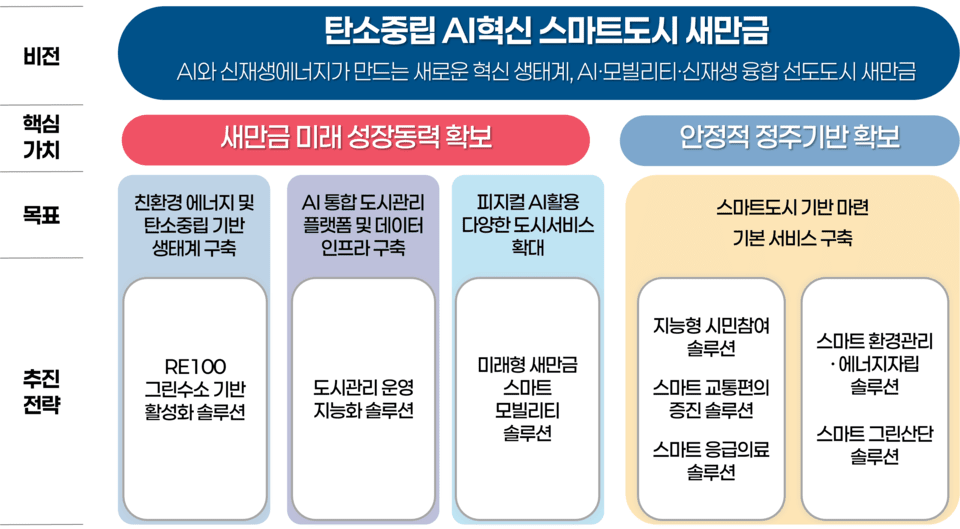
The city services are divided into two pillars: 18 essential services covering overall operations such as disaster safety, environment, and facility management, and 12 advanced specialized services discovered through collaboration with global companies, including robotaxis, demand-responsive transport, and V2G. Key drivers of the project include robot manufacturing, AI data centers, and cooperation on an AI hydrogen city linked to Hyundai Motor Group’s 900 billion won investment in Saemangeum.
Saemangeum has long been described as “land where development has been slow.” What gives this plan significance is that large-scale private investment and a statutory plan are aligned at the same time. Hyundai Motor Group’s 900 billion won investment is an unusual case of private sector participation of this scale in a publicly led smart city project.
Also notable is the phased approach of first developing a model district in the smart waterfront city and then expanding the verified model across Saemangeum. Rather than full-scale development, the structure of testing first and then expanding appears to reflect lessons from past large development projects that collapsed due to a lack of execution capability.
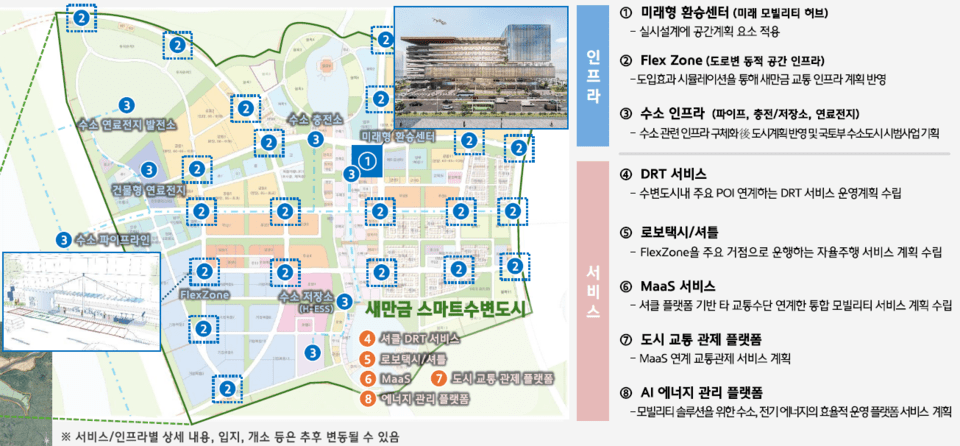
For the plan to actually work, a clear performance verification system must be established first for the model district.
It is pointed out that the standards by which the 18 essential services and 12 advanced specialized services piloted in the smart waterfront city are judged “suitable for expansion across the entire area,” as well as the evaluation metrics and decision-making structure, should be disclosed in advance. If the verification criteria remain opaque, budget waste and administrative inefficiency may be repeated during the expansion phase.
Advanced services such as robotaxis and demand-responsive transport are highly likely to face usability and accessibility issues during the demonstration stage.
Since the number of permanent residents in Saemangeum will inevitably remain limited in the early phase of settlement, service introduction order must be aligned with plans to secure actual residents in order to avoid creating supply without demand.
The link to Hyundai Motor Group’s 900 billion won investment is both a source of momentum and a risk factor. If dependence on a single company becomes excessive, any change in the investment plan could disrupt the entire smart city schedule.
It is necessary to diversify the composition of partner companies and, at the same time, build an open platform structure that allows domestic small and mid-sized enterprises to participate in developing specialized services.
Public safety services such as UAM medical emergency deployment and AI CCTV are areas where regulations must be addressed before the technology itself. If hardware is installed first without legal revisions and inter-ministerial coordination, there will be a prolonged gap before actual operation begins. Now that the Saemangeum Development and Investment Agency has secured ministry approval, the next task is to accelerate regulatory consultations with relevant ministries.