
As Mount Gwanak has emerged as a so-called “SNS hotspot,” it has been struggling under crowds, prompting the Seoul Metropolitan Government to join forces with related agencies and launch an on-site response.
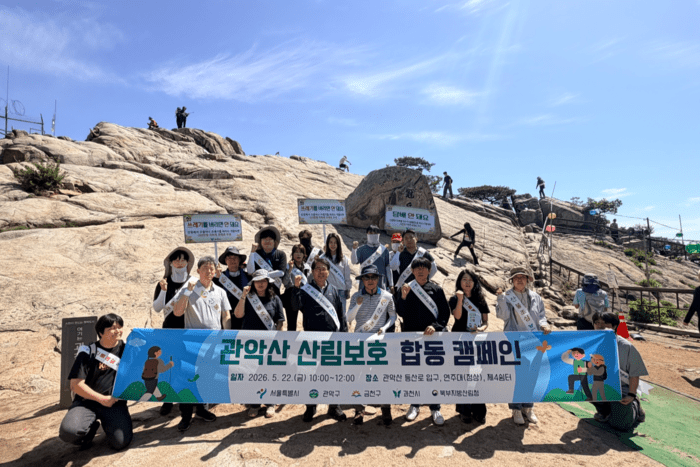
On the 22nd, Seoul said it carried out a joint “Mount Gwanak Forest Protection Campaign” in the Mount Gwanak area with seven related organizations. The effort was aimed at building a safer hiking culture and preventing forest damage. About 80 people from seven organizations participated, including the Seoul Metropolitan Government, Gwanak District, Geumcheon District, Gwacheon City, the Northern Regional Forest Service, police, and fire authorities.
The background to the campaign lies in incidents that have occurred at Mount Gwanak over the past few months.
◆ How far did the damage go after it became an “SNS hotspot”
After Mount Gwanak was mentioned in January by a famous fortune teller on a television program as a mountain with strong “energy,” it gained word-of-mouth fame as a so-called “good-luck spot.” SNS feeds were flooded with 인증 photos from the summit at Yeonjudae, and on weekends people lined up for an hour just to take photos of the summit stone, creating severe congestion.
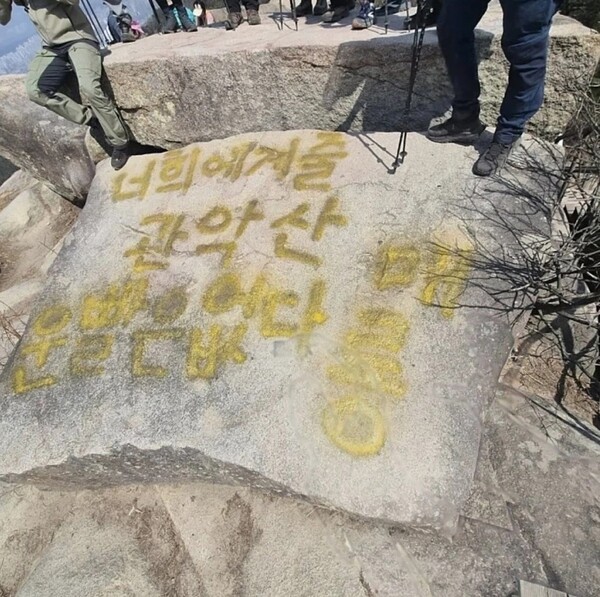
The problem was the damage that came with the crowds. Last month, graffiti was sprayed on Madangbawi Rock, a scenic spot along the first trail.
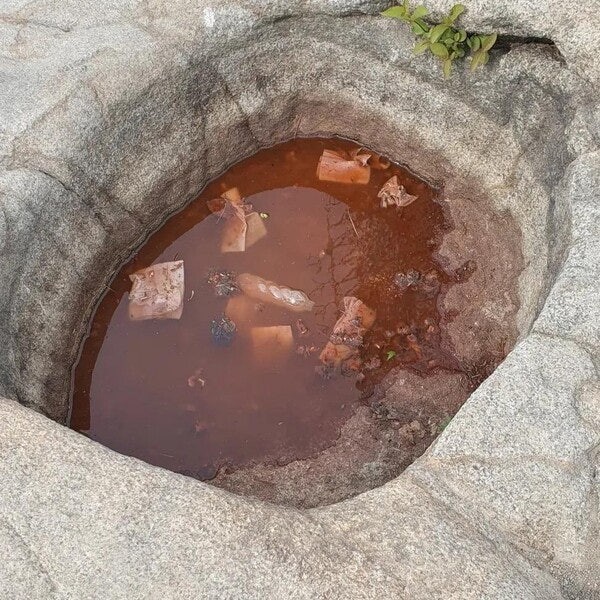
Earlier this month, photos spread on SNS showing a pool near Gamrocheon, a natural spring midway up the trail, stained red with ramen broth and food waste, sparking public outrage.
On May 1, Labor Day, when large crowds gathered around the summit area, Seoul, Gwacheon City, and Anyang City even sent emergency disaster text alerts urging people to refrain from hiking out of concern for safety accidents.
Mount Gwanak, a granite mountain rising 632 meters, has rugged terrain, making slips and collisions more likely in crowded conditions. Despite not being especially high, it is difficult, so the more crowded it becomes, the greater the burden on safety management.
◆ Moving beyond a campaign to improve the structure
This campaign took place at the Mount Gwanak Station (Shinlim Line) trail entrance, the Yeonjudae summit, and around the Fourth Shelter area.
For hikers, officials focused on promoting the importance of taking trash back home, prohibiting forest damage such as graffiti on rocks, following safe hiking rules, and practicing wildfire prevention. In congested areas, on-site safety guidance was also carried out, including directing pedestrian flow and advising against long stays.
However, one-off publicity alone has clear limitations. The key is the emergency budget Seoul has provided to Gwanak District.
Following a joint safety management meeting, the city supported Gwanak District with 110 million won for expanded safety guard operations, 12 million won for installing unmanned counters, and 100 million won for trail repairs such as old stairways. The plan is not simply a campaign, but a simultaneous overhaul of personnel, facilities, and data.
Gwanak District plans to install unmanned counters to analyze visitor data by trail and use that information to establish long-term safety measures.
Instead of relying on rough estimates, the district wants to determine numerically which areas become crowded and when, then deploy personnel accordingly. Gwanak District has increased on-site safety staff on weekends and public holidays from nine to 19 and will introduce a two-person team system in areas at risk of accidents.
Penalty standards were also explained. Under the Forest Protection Act, dumping trash in forests can result in an administrative fine of up to 1 million won. Under the Minor Offenses Punishment Act, damaging nature by carelessly cutting or digging up grass, flowers, trees, or rocks, or carving words into rocks and trees, is punishable by a fine of up to 100,000 won.
Sustained follow-up after the campaign remains the crucial issue. After the campaign ends, Gwanak District and Gwacheon City, where visitor numbers are especially high, will continue promoting forest protection and safe hiking around major trails and congestion-prone areas.
Gwanak District will continue guidance efforts using banners, public announcements, and leaflets, while Gwacheon City will maintain crowd management and safety-rule guidance based on cooperation with related agencies. Weekend patrols and wildfire prevention publicity will also continue.
“As Mount Gwanak is a representative forest recreation space widely used by citizens, managing it with both safety and forest protection in mind is important,” said Kim Young-hwan, head of the Seoul Metropolitan Government’s Garden City Bureau. “We will continue strengthening on-site publicity and safety management in cooperation with related agencies to create a safer hiking environment and prevent forest damage.”