
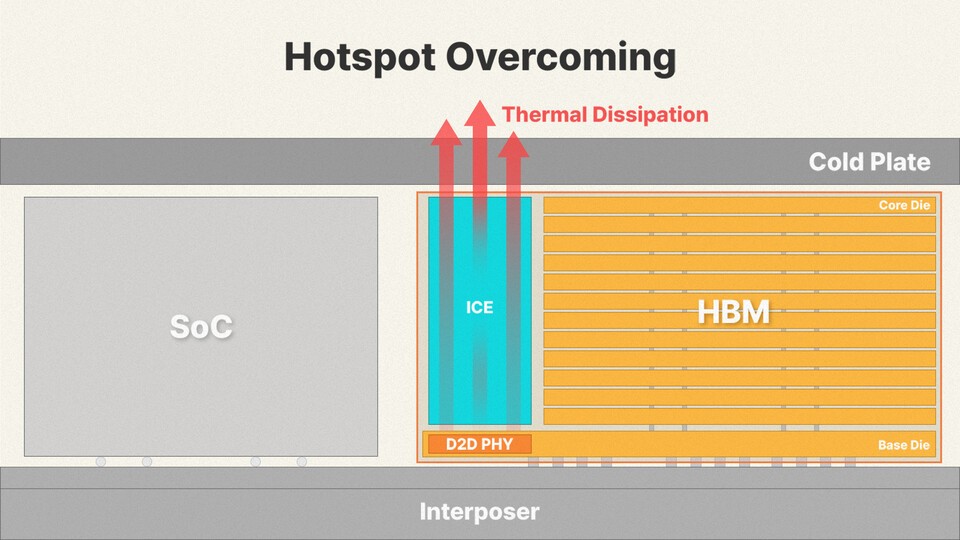
SK hynix has introduced a technology that directly inserts cooling components into high-bandwidth memory (HBM) packages. It is an attempt to structurally control heat.
The company unveiled iHBM technology, which embeds an integrated cooling element called ICE (Integrated Cooling Elements) inside the HBM package, on the 26th. ICE is made of silicon that does not conduct electricity but transfers heat well, creating an additional internal path for heat to escape.
The key point is that it targets the area where heat is most concentrated. The D2D PHY section connecting HBM and the GPU is a pathway for ultra-high-speed data transfer and also a bottleneck where heat builds up.
iHBM places ICE in this area to create a dedicated heat discharge route. As a result, the company says thermal resistance has been reduced by more than 30% compared with existing solutions.
Conventional HBM has relied on an indirect method that carries heat out through the core die. iHBM attacks the source of the heat directly. SK hynix plans to apply the technology starting with HBM5, its eighth-generation product.
The reason this announcement is drawing attention is that it signals a shift in the very criteria used to judge HBM competitiveness.
Until now, HBM competitiveness has been measured by stacking height and data processing speed. The company that stacked more layers and operated faster won. But as both of these factors are pushed further, heat generation per unit area rises sharply. In other words, the very methods used to improve performance have also intensified the heat limit.
Heat is not a simple side effect. If chip temperatures exceed a critical point, operation becomes unstable and lifespan is reduced.
In environments such as AI data centers, where chips run nonstop under heavy load, this issue quickly becomes a system-wide reliability problem. If heat is not controlled, even the fastest memory cannot deliver its full performance.
SK hynix’s decision to dedicate part of the HBM die area to a cooling block and embed it inside the package should be understood in this context. The choice to allocate valuable space to cooling rather than computation shows that heat control is now considered a resource as valuable as speed.
Its emphasis on mass production is also meaningful. The company said it will continue using the already proven MR-MUF-based process. No matter how excellent a new technology may be, adoption will be delayed if mass production is difficult or if customers must redesign everything from scratch. Stressing compatibility with existing processes is less about technical showmanship than about securing actual orders.
Industry views on this technology are mixed.
The core of the positive assessment lies in the phrase “structural solution.” Unlike conventional cooling, which removes heat from outside the package after the fact, iHBM takes an approach that disperses heat directly where it is generated. From the perspective of cutting off the thermal bottleneck at the design stage, it is being praised as a roadmap for the next generation of HBM.
On the other hand, caution remains. The disclosed figures are based on the company’s own measurements showing a 30% reduction in thermal resistance. Whether the same effect will be maintained over long periods of heavy operation in actual AI accelerators must be verified by customers. It has also not yet been fully disclosed externally how the die area sacrificed for the cooling element will affect performance or cost.
Interpretations of its impact on competition are also divided. Samsung Electronics and Micron are likewise treating heat control as a key issue in next-generation HBM, so it is too early to conclude that iHBM will immediately create a gap. Still, there is broad agreement that being the first to present a concrete solution to heat management is a meaningful advantage in the race for leadership.
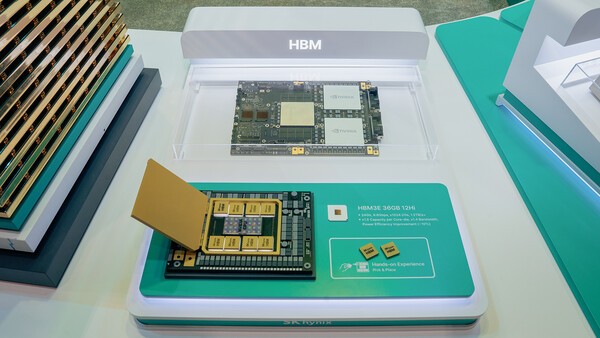
The iHBM announcement is a signal that the HBM market is moving into its next phase.
The HBM5 competition has already begun. All three major memory makers have placed HBM5 on their next-generation roadmaps and are preparing development.
Product cycles are also accelerating. In the past, it took years for one generation to become established in the market, but as competition in AI accelerator performance intensifies, memory makers have shifted to a structure in which they prepare for the next generation while working on the present one.
In this competition, thermal control is no longer a secondary issue. As stacking and speed reach their limits, the ability to deliver the same performance more stably becomes the differentiating factor. iHBM is an attempt to secure that advantage through packaging technology.
For GPU designers as well, the thermal management capabilities of memory are becoming an increasingly important selection criterion. The performance and operating costs of the entire AI accelerator are determined by its weakest link. If memory itself can absorb and manage heat, the overall cooling burden on the system and the operating costs of data centers can both be reduced.
Ultimately, this announcement suggests that the next HBM competition is shifting the question from “how fast is it” to “how fast can it be while remaining stable.”
Given the common challenge of heat generation, the solution cannot be completed by the packaging technology of individual companies alone.
First, memory makers need to transparently disclose verification data beyond their own internal measurements.
Customers need to be able to assess how much the thermal-resistance reduction can be reproduced in real accelerator environments, and what costs in performance and price arise from the area allocated to cooling elements. For a structural solution to be more than marketing rhetoric, it must be backed by verifiable numbers.
At the industry level, it is necessary to acknowledge the limits of optimizing memory, GPUs, and packaging separately.
Heat is generated and accumulated not by a single chip, but across the entire system. When memory makers, GPU designers, and foundries establish a collaboration structure that designs heat paths together from the early stages of development, individual technologies such as cooling inside the package can deliver their full effect.
Solutions at the data center operations level must also proceed in parallel. Alongside efforts to reduce chip-level heat, infrastructure technologies that handle heat across the entire system, such as immersion cooling, must also be combined to cope with the explosive growth in AI computing demand. Improvements in memory thermal management are not a complete solution in themselves, but rather a starting point for easing the cooling burden on data centers.
The essence of the heat problem is that demand for AI computing is growing faster than the pace of technological progress. Technologies such as iHBM are one step toward narrowing that gap. For that step to matter, chips, systems, and operational infrastructure must move in the same direction.