
Four securities firms suffered breaches in a single month; KEPCO leaked approximately 1.52 million records of personal information.
There were 1,236 reported cyber incidents in South Korea in the first half of the year, up 19.5% from the same period last year.
Personal data breaches are occurring one after another at companies and public institutions in South Korea. Information people provided to pay electricity bills or open stock accounts is ending up in hackers’ hands. The leaked data includes not only resident registration and bank account numbers, but also credit card and driver’s license numbers.
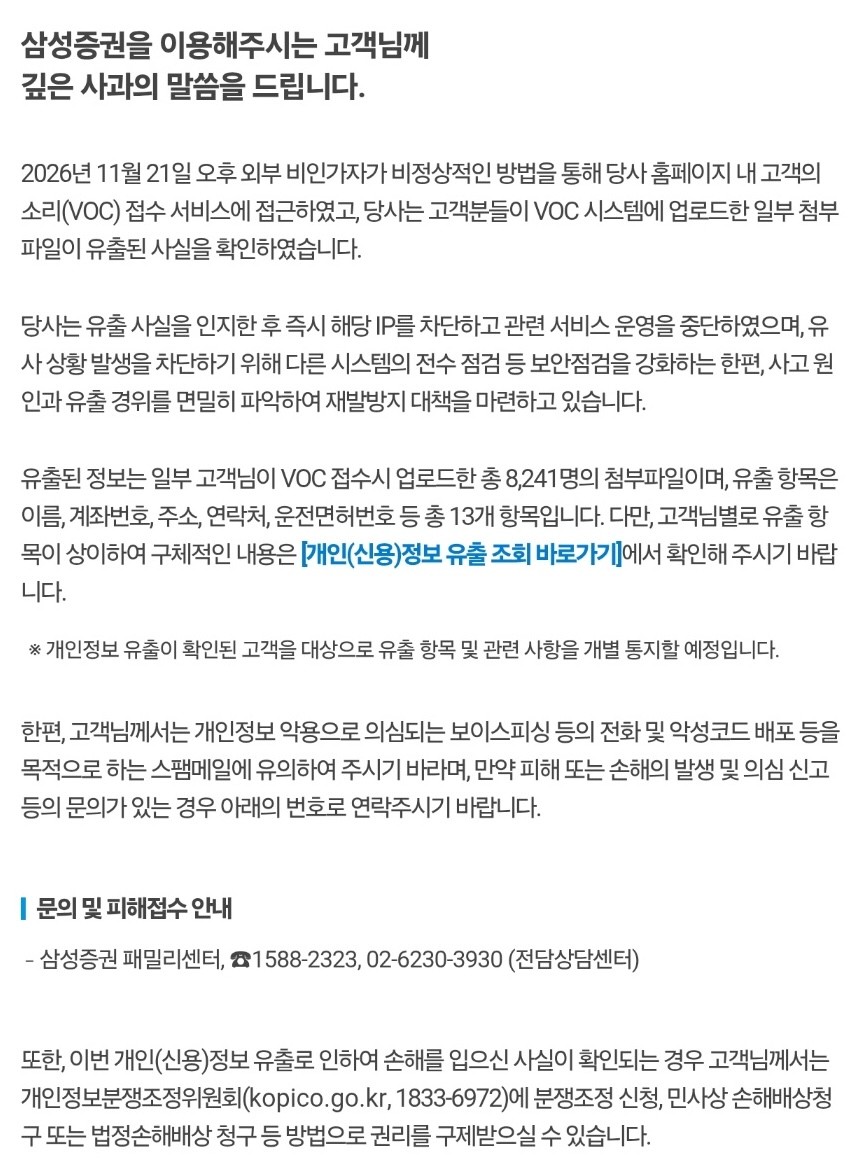
On November 20, Korea Electric Power Corporation (KEPCO) confirmed that personal information had been leaked from its integrated customer service platform, KEPCO ON, and its electronic procurement system. The two systems had around 1.52 million records exposed. The following day, signs of an external intrusion were found in the customer complaint system on the Samsung Securities website. A total of 8,241 customers were affected.
Whenever an incident occurs, companies issue apologies and announce measures to prevent a recurrence. Before long, a similar incident happens at another company. It is time to look beyond individual companies and examine the state of South Korea’s information security system as a whole.
◆ A wave of hacks in the securities industry
One notable aspect of the recent breaches at securities firms is the range of systems targeted. Incidents have affected services not directly involved in stock trading, including account-opening services, business software and customer complaint systems.
On October 28, a server used for non-face-to-face account openings at Daishin Securities was attacked, exposing personal and credit information belonging to 38,490 customers. The next day, an intrusion involving an external groupware solution occurred at Hanyang Securities, leaking 31 records containing customer and employee information. Mirae Asset Securities reported a hacking incident on November 7. On November 21, even Samsung Securities’ customer complaint system was breached.
The information leaked from Samsung Securities was contained in files customers had attached when submitting complaints. It included 13 types of data, such as names, account numbers, addresses, contact information and driver’s license numbers.
Financial companies apply stringent security measures to core systems used for transactions and asset management. But sensitive personal information is also stored in customer service, document-submission and internal business systems. Companies need to check whether services outside their core networks are managed to the same security standards.
◆ Digital transformation and security blind spots
The digital services companies operate are becoming increasingly complex. In the past, security management centered on websites and internal networks. Today, those systems are connected to mobile apps, cloud services, external software and partners’ systems. Every new service adds more systems that need to be managed.
Legacy systems are another problem. Companies often add new features while keeping existing networks in operation. Concern about disrupting business can lead them to delay replacing software or installing security updates. When older systems are connected to newer services, the risk of unexpected security problems also increases.
Dependence on external solutions has grown as well. Companies use outside products for everything from customer management and document creation to electronic approvals. If a vulnerability is found in a particular program, multiple companies using it may be exposed to risk at the same time.
Digital transformation has reduced operating costs and made services more convenient for customers. It has also created more routes for hackers to exploit.
◆ Hacking evolves with AI
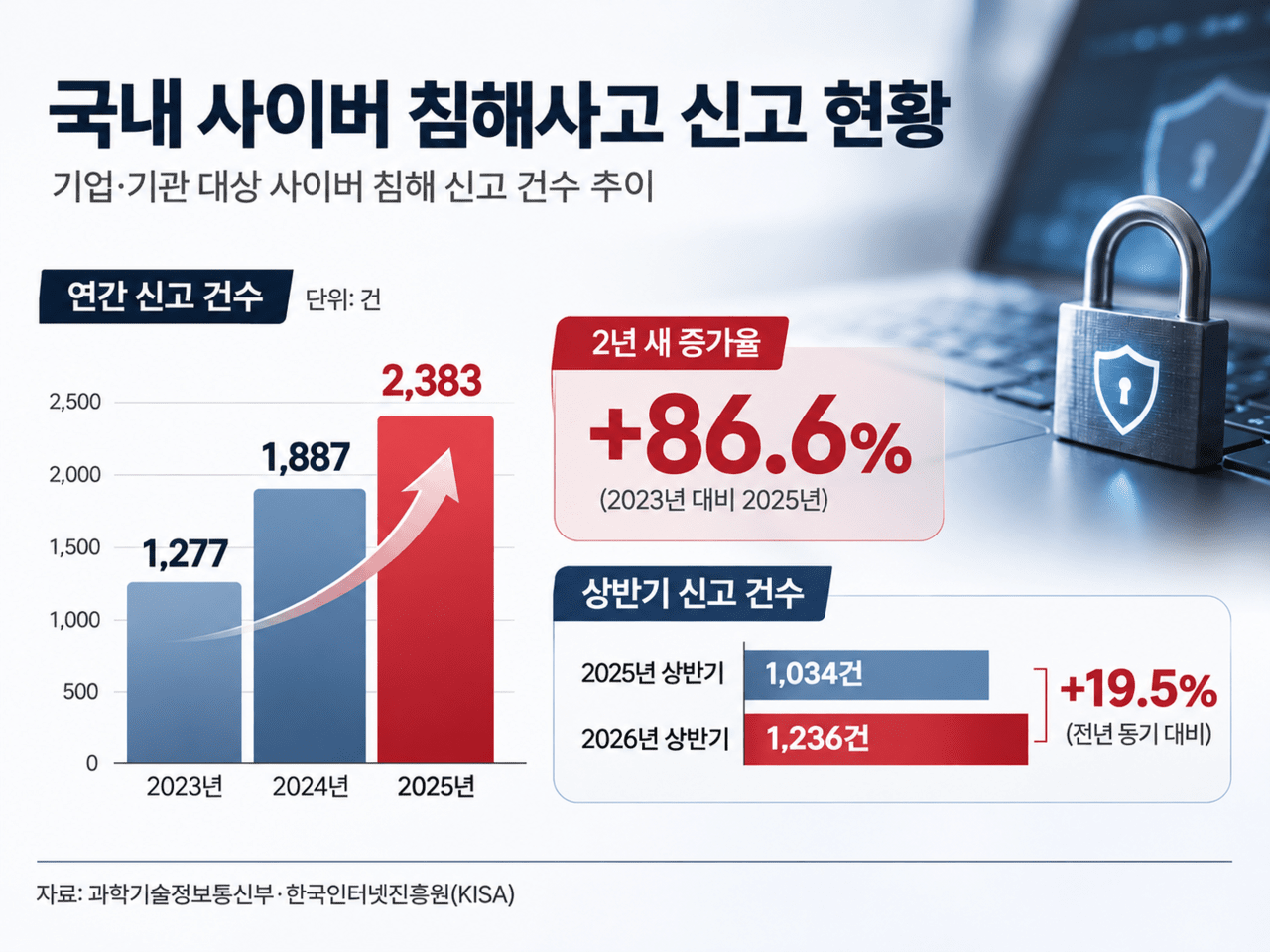
Cyber threats in South Korea are also reflected in the statistics. According to the Ministry of Science and ICT and the Korea Internet & Security Agency (KISA), 1,236 cyber incidents were reported in the first half of this year, up 19.5% from the same period last year.
Annual reports rose from 1,277 in 2023 to 1,887 in 2024. Last year, the number reached 2,383—an increase of about 86.6% in two years.
The spread of generative AI is changing the hacking landscape as well. In its report on cyber threat trends for the first half of this year, the Ministry of Science and ICT warned that the spread of generative AI was intensifying security threats. AI can reduce the time and cost required to research targets and develop malware. It can also be used to write convincing phishing messages in natural Korean or craft fraudulent messages targeting specific companies and employees.
Automation makes it possible to investigate multiple companies at once. It also increases the likelihood that attackers will find vulnerabilities before companies discover them.
It has not been confirmed whether AI was directly used in the recent breaches at KEPCO and securities firms. The causes of each incident require further investigation. But advances in AI and automation are making the range of cyber threats companies must address increasingly diverse.
◆ Personal information has a price
Selling stolen personal information and demanding money from companies have become major forms of cybercrime. The more types of personal information are combined, the greater the potential for misuse. When account numbers, addresses and financial transaction details are added to a person’s name and phone number, the information can be used to target that individual with financial scams.
The information leaked from KEPCO included customer numbers, resident registration numbers, addresses, phone numbers and financial information. Samsung Securities also exposed account numbers and driver’s license numbers, among other data. If information leaked from different sources is combined, the scope of potential harm can grow. Such data can also be used in scams impersonating employees of financial institutions or public agencies.
Companies advise affected customers to change their passwords and be wary of suspicious calls. But resident registration numbers and dates of birth cannot be changed as easily as passwords. Information leaked once could be exploited in crimes months or even years later.
That is why the impact of a personal data breach cannot be assessed solely by the financial losses identified at the time of the incident.
◆ Excessive retention of personal information
Corporate security measures have focused on preventing external intrusions. Going forward, it will also be important to consider how much information could be exposed if an intrusion occurs. Keeping personal information for long periods and storing it across multiple systems increases the burden of managing it. Data that is no longer needed for business becomes a security risk if it remains in storage.
The Samsung Securities incident highlights this issue. Files submitted for customer complaints can contain financial and identity-verification information. Companies need to review who can access these materials, how long they are kept and how they are managed after a complaint has been resolved.
Protecting personal information requires management throughout its entire lifecycle—from collection and storage to use and destruction. Companies should collect only the information needed for their work and, once the legally required retention period has passed, properly destroy data that is no longer necessary to keep.
Sensitive information should be encrypted, and access should be restricted. Simply reducing the amount of unnecessary personal information a company retains can limit the damage if a breach occurs.
◆ Security is a responsibility of corporate leadership
Information security requires ongoing investment. Security software must be updated, outdated equipment replaced and specialized staff hired. The problem is that security spending does not easily translate into increased revenue in the short term. When no incident occurs, it can also be difficult to see the benefits of that investment.
If a company prioritizes short-term results, investment in information security may be pushed back. Even when security staff identify vulnerabilities, a shortage of budget and personnel can make it difficult to respond quickly.
Companies also need to move away from a culture that treats information security as solely the IT department’s responsibility. Decisions about how long to retain personal information, which external software to adopt and when to replace outdated systems are all linked to management decisions. Executives should understand what personal information the company holds across its operations. Systems connected to external partners should also be reviewed regularly.
Companies need systems that provide security staff with adequate budgets and authority, while ensuring executives personally track whether vulnerabilities are being addressed.
◆ Preventing harm and improving the system
Financial regulators and agencies responsible for personal data protection should strengthen preventive oversight, rather than focusing only on investigations and penalties after incidents. This could include reviewing companies’ security investments and progress in fixing vulnerabilities, and conducting proactive inspections in areas where similar incidents keep recurring. There should also be ongoing checks to confirm that companies actually fix problems identified in security reviews.
People have to provide a certain amount of personal information to use corporate services. In the course of everyday life, they have little choice but to entrust their data to companies and public institutions.
Organizations that receive personal information must accept responsibility for protecting it. If a breach occurs, they should promptly inform affected people of the specific data exposed and how to respond. They should also put in place safeguards against secondary harm, such as financial fraud and identity theft, that may occur over an extended period.
It is impossible to block every cyberattack completely. That is why security systems must account for preventing intrusions, detecting them quickly, stopping data from being exposed and minimizing the damage.
Companies and public institutions have focused on how to provide services more conveniently and quickly through digital transformation. They must now also be judged on how safely they manage the personal information they collect from the public in the process.