
Key points
▶ Japanese NAND flash maker Kioxia announced on November 26 that it is working with Nvidia to demonstrate technology that uses SSDs to expand GPU memory.
▶ The companies installed 144 of Kioxia’s 7.68-terabyte (TB) XD8 SSDs in Nvidia’s GB200 NVL72 server system.
▶ The SSDs have a combined capacity of about 1.1 petabytes (PB). GPUs read data stored on the SSDs directly through Nvidia’s SCADA software.
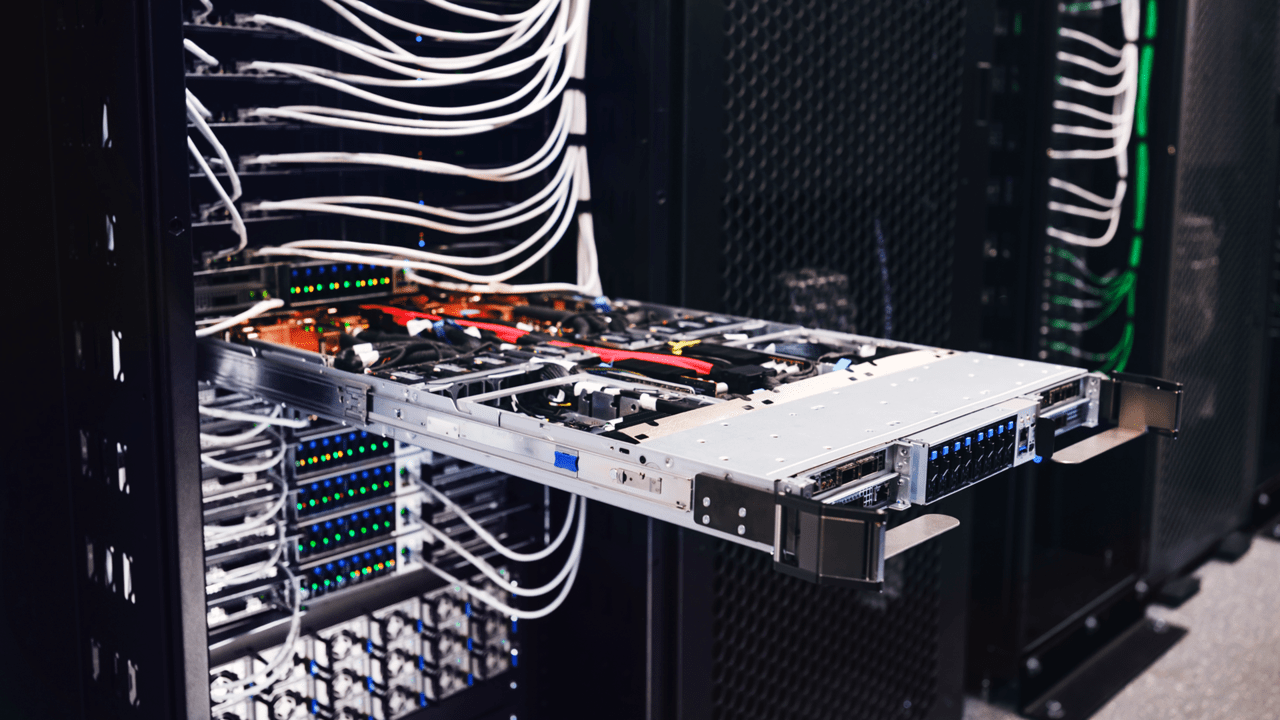
Japanese NAND flash maker Kioxia is working with Nvidia to test technology that uses SSDs as auxiliary memory for AI servers.
On November 26, Kioxia announced that it is conducting a proof of concept by installing its SSDs in an Nvidia server system to expand the memory available to GPUs to petabyte scale. One petabyte is equivalent to 1,000 terabytes.
◆ The capacity limits of HBM
In AI servers, GPUs handle computation. They retrieve the data needed for processing from HBM, a type of memory located close to the GPU. HBM stacks multiple layers of DRAM to increase data transfer speeds. Its high performance comes at a high price, and its capacity is limited. SK hynix and Samsung Electronics lead the HBM market.
The volume of data AI must process is growing rapidly. Data that exceeds HBM capacity has to be split into smaller units for processing. This requires repeated transfers between memory and storage—like repeatedly folding and unfolding a large map on a small desk.
The Nvidia GB200 NVL72 has about 13.4TB of HBM. It is a rack-scale AI server system that links 72 GPUs together.
◆ Expanding memory with SSDs
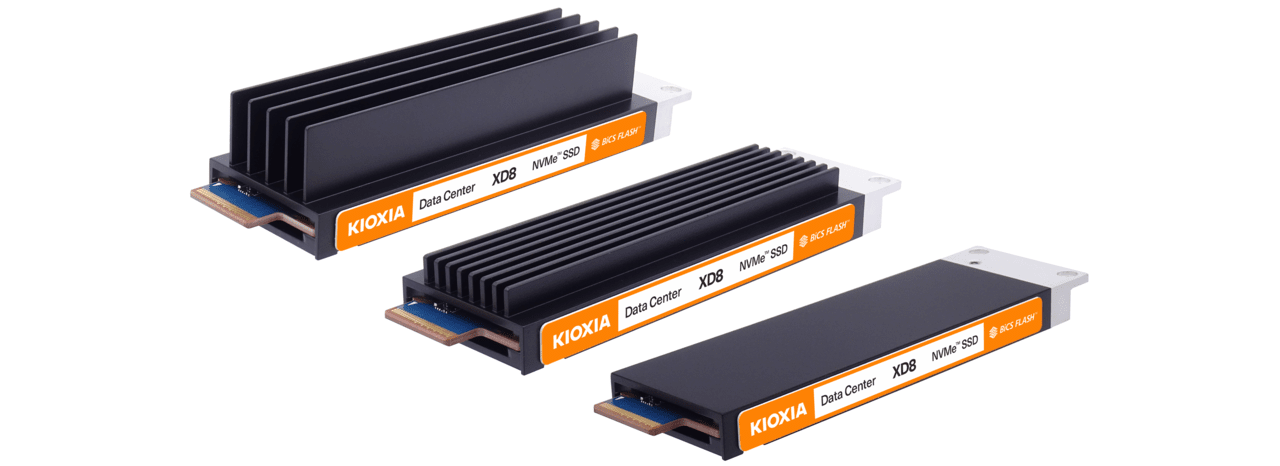
The technology being tested by the two companies stores large volumes of data that are difficult to process in HBM on SSDs, which GPUs can access directly when needed. Eight SSDs were installed in each of the 18 servers that make up the GB200 NVL72. The drives were 7.68TB models from Kioxia’s XD8 series. Together, the 144 SSDs provide about 1.1PB of capacity, giving each server roughly 61TB of additional storage.
The key is a technology that allows GPUs to read data directly from SSDs. Normally, data in storage passes through memory before reaching a GPU. In this demonstration, Nvidia’s software library, SCADA, connects the GPUs and SSDs. It can retrieve data from an SSD in 512-byte units. The technology is part of Nvidia’s “Storage Next” vision for next-generation storage.
Kioxia said the system could potentially process a database containing up to 2 trillion vectors. Vectors are numerical arrays that AI uses to represent information such as text, images and video. AI search and recommendation services work by finding similar vectors. As the volume of information grows, so does the size of vector databases. Kioxia identified large-scale vector databases and graph neural network training as key potential applications.
SSDs would complement HBM. Frequently used data for computation would be stored in fast HBM, while data exceeding HBM’s capacity would be kept on SSDs and retrieved when needed. Kioxia chief engineer Koichi Fukuda stressed that AI systems need both high-speed computing performance and enough memory capacity to handle large datasets.
◆ Targeting AI data centers
Kioxia specializes in NAND flash and does not produce HBM. The Nikkei reported that Kioxia is seeking to expand its AI data center customer base by assigning some HBM-like functions to SSDs. It also noted that Kioxia has been less exposed than competitors to the growth in AI demand because it has been relatively weak in data center product sales.
According to market research firm Counterpoint Research, Samsung Electronics led the global NAND flash market in revenue in the second quarter of this year, with a 28% share. Kioxia ranked fourth with 14%, the same share as China’s Yangtze Memory Technologies (YMTC). In the HBM market during the same period, SK hynix had a 50% share, Samsung Electronics 33% and Micron 18%.
Kioxia also unveiled its next-generation GP2 SSD on the same day. The drive is designed to allow GPUs to read data directly. Its performance when reading small data items stored in multiple locations is about twice that of its predecessor, the GP1. Kioxia plans to supply evaluation units to some customers by the end of 2027.
The company’s stock also reacted to the news. Kioxia shares closed at 7,762 yen on the Tokyo Stock Exchange on November 26, up 12.57% from the previous trading day. They had fallen about 14% the day before.
◆ Challenges remain before commercialization
The announcement marks a proof-of-concept stage for verifying the potential of using SSDs to expand GPU memory. The companies have not disclosed how well the technology performs in real-world AI computing environments. They have also provided no timeline for commercialization, product pricing or mass-production plans. Kioxia’s announcement did not include a separate comment from Nvidia.
Samsung Electronics and SK hynix both produce HBM and NAND flash. It is also unclear how extensively other NAND flash makers will participate in Nvidia’s Storage Next initiative.
The key question going forward is how much performance and cost efficiency SSD-based memory expansion can deliver in real-world AI systems.