
According to a survey released by the IBM Institute for Business Value on September 21 (local time), 60% of employees said they were concerned that AI would weaken their skills.
Seventy-one percent of chief human resources officers (CHROs) identified the ability to oversee, verify and overturn AI-generated results as the most important skill. Only 29% of employees agreed.
Forty-three percent of employees said they would ultimately be held responsible if AI made a mistake. Meanwhile, 41% of HR executives believed employees might not feel safe challenging or overturning AI-generated results.
Although AI is rapidly taking over workers’ tasks, companies are looking for more than the ability to use AI effectively. A survey found that human judgment—the ability to examine whether an AI-generated answer is correct and stop or make a different decision when it is wrong—is becoming increasingly important.
The problem is that there is a significant gap between what employees think and what companies expect.
According to a survey released on September 21 (local time) by the IBM Institute for Business Value (IBV), 71% of CHROs identified the ability to verify AI-generated answers and correct them when necessary as the most important skill employees need. By contrast, only 29% of employees considered independent judgment important.
IBM conducted the survey with Oxford Economics from April through June this year. The participants included 1,500 HR executives across 23 industries in 21 countries and 8,800 full-time employees in 28 countries.
“Using AI is weakening our ability to think”
Employees and HR executives alike were concerned that AI use could weaken people’s abilities, and both groups identified critical thinking as a key skill in the AI era.
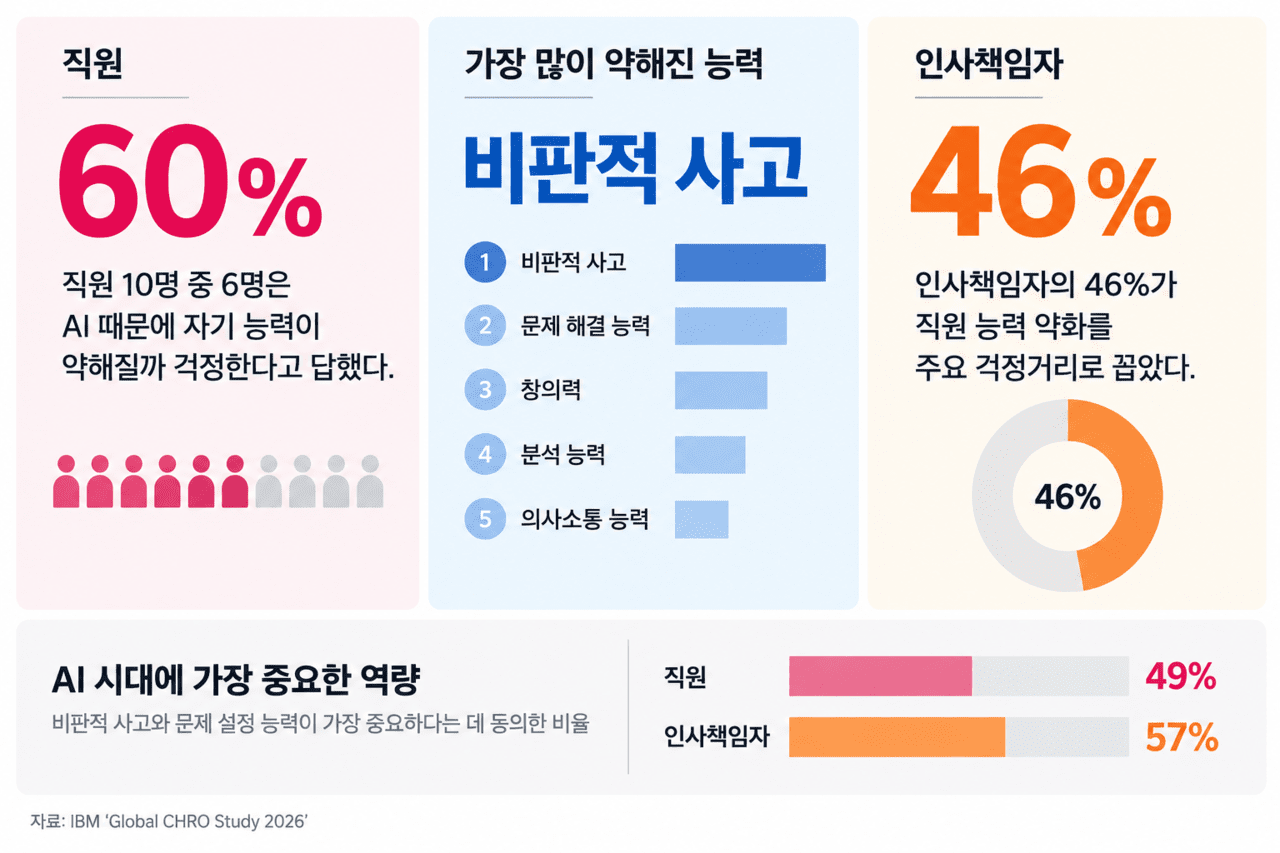
Employees’ biggest concern was that delegating work to AI would cause their own skills to deteriorate.
Sixty percent of employees said they were worried that AI would weaken their work abilities. Of those, three out of four said they already felt that some of their skills had begun to decline, rather than merely expressing concern.
Critical thinking was cited most frequently. The concern is that repeatedly accepting AI-generated answers could weaken people’s ability to examine problems for themselves and find solutions.
Companies were experiencing the same problem. Forty-six percent of HR executives identified employee skill deterioration resulting from AI use as a major concern. High percentages of both employees and HR executives—49% and 57%, respectively—said critical thinking and the ability to accurately define problems were important in the AI era.
However, companies expected more from employees. While 71% of HR executives regarded the ability to verify AI’s answers and reject them when necessary as a core skill, only 29% of employees considered judgment important.
The survey also found that using AI and trusting its judgment are separate matters.
At companies that clearly defined the stages of a work process where human judgment was required, 62% of HR executives said confidence in employees’ AI-based decision-making was increasing. By contrast, at companies without such standards, 57% said employee confidence was declining.
Even when AI is wrong, employees ultimately bear the responsibility
As AI becomes more deeply embedded in the workplace, a new problem has emerged: it is unclear who should be held responsible when AI produces an incorrect answer.
Forty-three percent of employees said they would ultimately be held responsible if a problem arose while using AI.
That did not mean employees were free to reject AI’s judgment. Forty-one percent of HR executives believed employees might feel pressured to challenge or disregard AI-generated results and make different decisions. Another 36% said the lack of clarity over responsibility itself made it difficult for companies to adopt AI.
Employees’ reactions differed significantly depending on how their companies defined responsibility and authority.
At companies where HR executives jointly participated in determining which decisions had to be made directly by people, 76% of employees felt safe questioning or declining to follow AI recommendations.
At companies where HR departments merely offered opinions, the figure was only 43%.
In other words, requiring employees to verify AI-generated results also means giving them the authority to reject erroneous AI decisions.
AI was supposed to reduce work, but it created new tasks
AI adoption did not necessarily reduce employees’ workloads. Eighty percent of HR executives said that “invisible work” that had not previously existed was emerging after AI was introduced.
These tasks include checking whether AI-generated answers are correct, correcting errors, explaining situations that AI does not understand, and handling unforeseen exceptions. Although AI reduces the time needed to create drafts, it creates new work for people to review and correct those results.
Forty-two percent of employees said AI had actually increased their workload or that their AI-related work was not being properly recognized.
Fewer than half of companies reinvested the time and money saved through AI into their employees. Only 42% of HR executives said their companies primarily invested AI-driven productivity gains in new businesses or employee retraining.
What AI should do versus what people should do
The survey also found that companies with clearly divided human and AI roles performed better than companies that had simply adopted more AI.
Companies that clearly distinguished between tasks performed directly by people, tasks performed by people with AI assistance, and tasks handled by AI reported 18% lower risk and a 20% improvement in the quality of their output compared with companies that did not make those distinctions.
HR departments that had properly established AI management principles, systems and performance-measurement frameworks were nearly twice as likely as other companies to report positive business indicators.
Nickle LaMoreaux, IBM’s chief human resources officer, said, “As AI takes on repetitive and procedural tasks, capabilities that only people possess become even more important.”
The survey shows that a company’s AI competitiveness is not determined solely by how extensively it adopts AI. Companies must also decide how far AI can make decisions, when people should intervene, and who is responsible when problems arise.