
In its “One-Minute News” summary:
▶ According to the European Union’s Copernicus Climate Change Service, from November 18 to 24, the global average temperature was more than 2°C above the average for the same dates in the pre-industrial period (1850–1900).
▶ So far this month, temperatures have been more than 2°C above pre-industrial levels on 10 days. That total in a single month far exceeds the six days recorded across all of 2023 and 2024 combined.
▶ Global average temperatures are rising as strong El Niño conditions add to long-term warming caused by greenhouse gas emissions.
The global average temperature remained more than 2°C above pre-industrial levels for a full week—the first time this has happened in recorded history.
According to the EU’s climate monitoring agency, the Copernicus Climate Change Service, from November 18 to 24 the global average temperature was more than 2°C above the average for the same dates in the pre-industrial period, defined as 1850–1900. Climate research uses the average temperature from 1850 to 1900 as its pre-industrial baseline.
A month with 10 days above 2°C
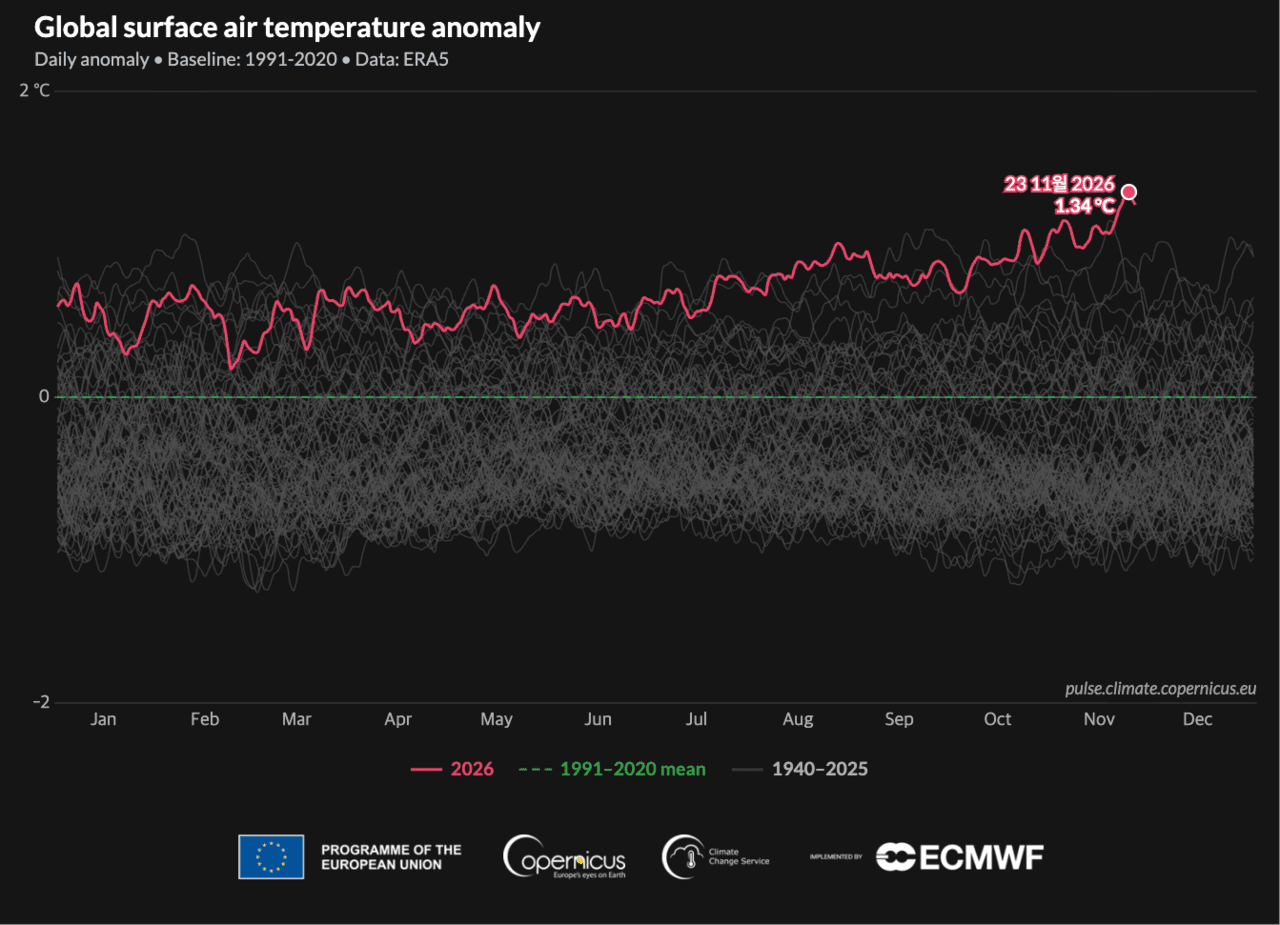
Before this month, there had been only six days when the daily average temperature was more than 2°C above pre-industrial levels: two days in November 2023 and four days in February 2024.
This November, temperatures exceeded that threshold on the 3rd, 4th and 13th, and then every day from the 18th through the 24th—for a total of 10 days. On November 23, the temperature was 2.25°C above pre-industrial levels, the largest daily anomaly on record. It was also 1.34°C above the recent climate normal—the 1991–2020 average.
The figures are preliminary. Copernicus expects any changes in the final data to be no greater than 0.02°C.
Absolute global temperatures are generally highest in July and August. This record marks the largest-ever temperature increase relative to the pre-industrial average for the same time of year.
The 2°C threshold in the Paris Agreement
Adopted in 2015, the Paris Agreement sets out a goal of keeping the rise in global average temperature well below 2°C above pre-industrial levels and pursuing efforts to limit it to 1.5°C. Progress toward that goal is assessed using long-term average temperatures.
Samantha Burgess, the Copernicus Climate Change Service’s deputy director, said recent daily temperature records should be distinguished from the Paris Agreement’s long-term goals. She described them as “a clear preview of where our climate is heading.”
The international community has pursued the 1.5°C limit to minimize the damage caused by climate change. A United Nations report released in October found that it would be difficult to avoid the global average temperature temporarily exceeding 1.5°C.
Strong El Niño adds to global warming
The recent temperature rise is driven by long-term warming from accumulated greenhouse gas emissions, combined with El Niño. Strong El Niño conditions are amplifying the increase in an already elevated global average temperature.
El Niño is a phenomenon in which sea surface temperatures in the central and eastern equatorial Pacific rise above average. It affects heat exchange between the ocean and atmosphere and atmospheric circulation, pushing up global average temperatures. It occurs every few years and weakens after a period of time.
The World Meteorological Organization (WMO) expects the current El Niño to become exceptionally strong. According to China’s Xinhua News Agency, the WMO has raised the possibility that the strongest El Niño on record could emerge by December.
As El Niño weakens, its temporary upward pressure on temperatures may ease. But the long-term warming caused by greenhouse gases accumulated in the atmosphere will continue. Burgess also emphasized the need to cut greenhouse gas emissions.
2026 expected to be the second-hottest year on record
Copernicus says 2026 is very likely to be the second-hottest year on record. There is a 20% chance it will match or surpass 2024, the hottest year on record.
It is also likely to be only the second year in which the annual average temperature rise exceeds 1.5°C above pre-industrial levels. Carlo Buontempo, director of the Copernicus Climate Change Service, warned that there is a considerable chance an annual average temperature rise above 2°C could occur before 2030.
International negotiations to reduce greenhouse gas emissions have made little clear progress. The 31st United Nations Climate Change Conference (COP31), which concluded on November 22 in Antalya, Türkiye, did not produce any major political agreements. Some oil-producing countries opposed including references to fossil fuels in the final document.