At an event in Los Angeles on Oct. 28 (local time), Apple unveiled the “MacBook Pro with ProLED XDR display,” its first MacBook with a touchscreen. The U.S. began taking preorders that day; in South Korea, preorders open at 10 a.m. on Oct. 30, with sales starting Nov. 6.
In brief:
▶ At an event in Los Angeles on Oct. 28 (local time), Apple unveiled its first MacBook Pro controlled by touch.
▶ The 14-inch and 16-inch models feature tandem OLED “ProLED XDR” displays and use the M5 Pro and M5 Max chips released in March.
▶ The notch has been replaced with Dynamic Island. The 14-inch model weighs 1.38 kg—220 grams less than before—while the 16-inch model weighs 1.82 kg, a reduction of 320 grams.
▶ In South Korea, preorders open at 10 a.m. on Oct. 30, and the laptops go on sale Nov. 6.
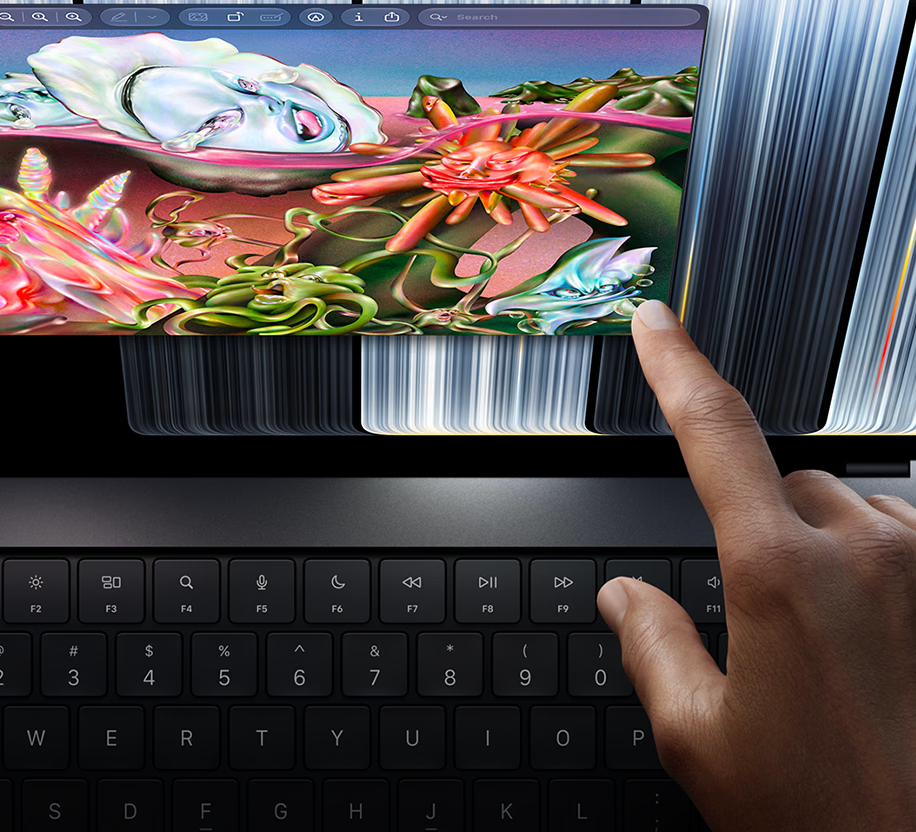
Apple has abandoned its two-decade-old principle of keeping touchscreens off the Mac.
At its “Apple Experience LA” event in Los Angeles on Oct. 28 (local time), Apple unveiled its first MacBook Pro that users can operate by touching the screen. The product is called the “MacBook Pro with ProLED XDR display.”
The United States began taking preorders that day. In South Korea, preorders open at 10 a.m. on Oct. 30, and the laptop will go on sale Nov. 6.
◆ Touch built into the panel, with 220 grams shaved off
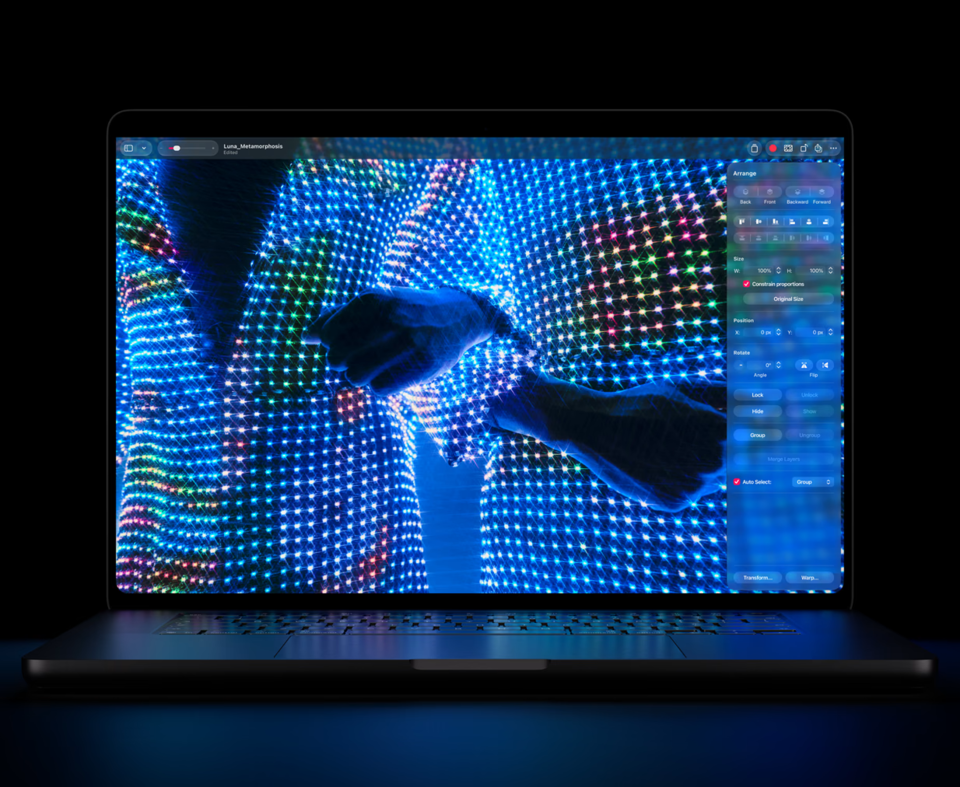
The biggest change is the screen. Apple has replaced mini-LED with tandem OLED, which stacks two light-emitting layers. Rather than placing a touch sensor on top of the screen, Apple integrated it into the panel to reduce the delay between a finger touching the display and the screen responding.
The display offers peak brightness of 2,000 nits, a contrast ratio of 10 million to one, and an adaptive refresh rate of up to 120Hz. Thinner bezels make the usable screen larger, measuring 14.2 inches and 16.3 inches. The notch, which housed the camera, has been replaced by Dynamic Island, like on the iPhone, to show notifications and ongoing activities. The glowing Apple logo has also returned to the lid.
The body is thinner and lighter. The 14-inch model weighs 1.38 kg, 220 grams less than its predecessor, while the 16-inch model weighs 1.82 kg, a reduction of 320 grams. Battery life is up to 24 hours.
The chips are not new. The laptops use the M5 Pro and M5 Max, released in March, with up to 128GB of unified memory and up to 16TB of storage. Apple said they can run large language models (LLMs) with hundreds of billions of parameters directly on the device.
The laptops retain macOS, with an interface updated for touch. In a demonstration video, Apple showed users swiping through and zooming in on photos and videos with their fingers. The company said on-screen elements are designed to change depending on whether the user is interacting with a finger or a trackpad.
Prices have also risen. The 14-inch model with an M5 Pro starts at $2,899 in the United States and 4.79 million won in South Korea. The 16-inch M5 Pro model starts at $3,399 in the United States and 5.59 million won in South Korea. Both prices are $400 higher than those of the previous MacBook Pro models with mini-LED displays.
According to MacRumors, Apple has stopped selling its existing MacBook Pro models with mini-LED displays alongside the launch of the new models. That same week, Apple also unveiled a 14-inch MacBook Pro with an M6 chip, an iMac, and a new iPad mini. Official prices in South Korea start at 3.29 million won for the 14-inch MacBook Pro, 2.49 million won for the iMac, and 1.149 million won for the iPad mini.
◆ “I didn’t see a reason to change”

Since the first MacBook in 2006, Apple has resisted adding touchscreens to its laptops. In 2010, Steve Jobs said that reaching out to touch a vertically positioned screen would tire the arm. Craig Federighi, Apple’s software chief, gave the same reason in 2018.
Even CEO Ternus, when he was head of hardware, said in a 2021 interview with The Wall Street Journal: “With the iPad, we’re making the world’s best touch computer, and the Mac is completely optimized for indirect input. We didn’t really see a reason to change.”
Ternus led the Mac’s transition from Intel processors to Apple’s own chips alongside Johny Srouji, Apple’s chip chief. The company highlighted that work in its announcement of the CEO transition. The touchscreen MacBook Pro is the third major new product introduced under Ternus. In September, Apple launched its first foldable iPhone, the iPhone Duo, and HomeView, a speaker with a screen.
◆ In a year when the PC market shrank 20% and memory prices surged
The launch comes amid difficult market conditions. According to IDC, global PC shipments fell 20% in the third quarter from a year earlier, while Apple’s shipments declined 11%. Full-year laptop shipments are forecast to fall 11%.
AI data centers have been consuming memory supplies, pushing up laptop prices and weakening demand. Apple has not been spared. Former CEO Tim Cook said this summer that the memory-price situation was “unsustainable,” and Apple raised prices on nearly all Mac models this year.
The Mac mini released in August went up by $300. CNBC, the U.S. business news network, said Apple may have added a touchscreen to raise the average selling price of the MacBook Pro amid these headwinds.
The Mac business is smaller than the iPhone business, but it is becoming more strategically important to Apple. In the most recent quarter, Mac revenue was $10.35 billion (about 14.3 trillion won), just under 10% of Apple’s total revenue. But the Mac is the only platform on which developers can build iPhone apps, and Apple has recently argued that its chips and memory architecture make Macs especially well suited to running AI on-device rather than in the cloud.
Meta’s AI model development team bought hundreds of Mac minis this year to test agents. Earlier this month, Apple and Meta announced that large models approaching the frontier level could be run across multiple Macs linked by high-speed cables.
◆ Touchscreens have never been a reason to buy a laptop
Whether touch will boost sales is another question. Ryan Reith, IDC’s vice president for device tracking, told CNBC that Windows laptops have had touchscreens for years, but touch has been just one of many features—not a reason that determines a purchase.
According to IDC data, touchscreens account for 17% of global laptop shipments this year, and their average selling price is slightly lower than that of laptops without touchscreens.
Samsung Display is reportedly supplying the OLED panels. According to industry sources, it has exclusive supply of the touch OLED panels for the new MacBook Pro from its 8.6th-generation OLED production line in Asan, South Chungcheong Province. Samsung Display announced in July that mass production had begun at the line, while Apple has not disclosed its panel supplier.