
AI companies are changing how they evaluate developers. On Oct. 27 (local time), Anthropic engineering manager Felix Rieseberg wrote on X, “Coding interviews are dead. At least on my team at Anthropic,” adding that he had seen enough to conclude they “are no longer a useful signal.”
The point is that traditional coding interviews can no longer identify who will perform well on the job in an era when AI writes code.

Rieseberg leads development of Claude Cowork and Claude Code Desktop at Anthropic, and previously served as a core maintainer of Electron, a framework for building desktop apps.
Coding problems and assembly questions—Claude does them better
Rieseberg explained his reasoning in a blog post. Asking candidates to solve coding problems or demonstrate knowledge of programming languages such as assembly is “pointless,” he wrote, because “Claude does both better than people.”
Coding challenges were once a “weak but useful” measure of a person’s potential, he said. But the people delivering the most value on his team today are not the ones who excel at those tests.
“I’ve seen engineers who haven’t been here long outperform people who are much more experienced and better at coding,” he wrote. “Desperation beats experience.”
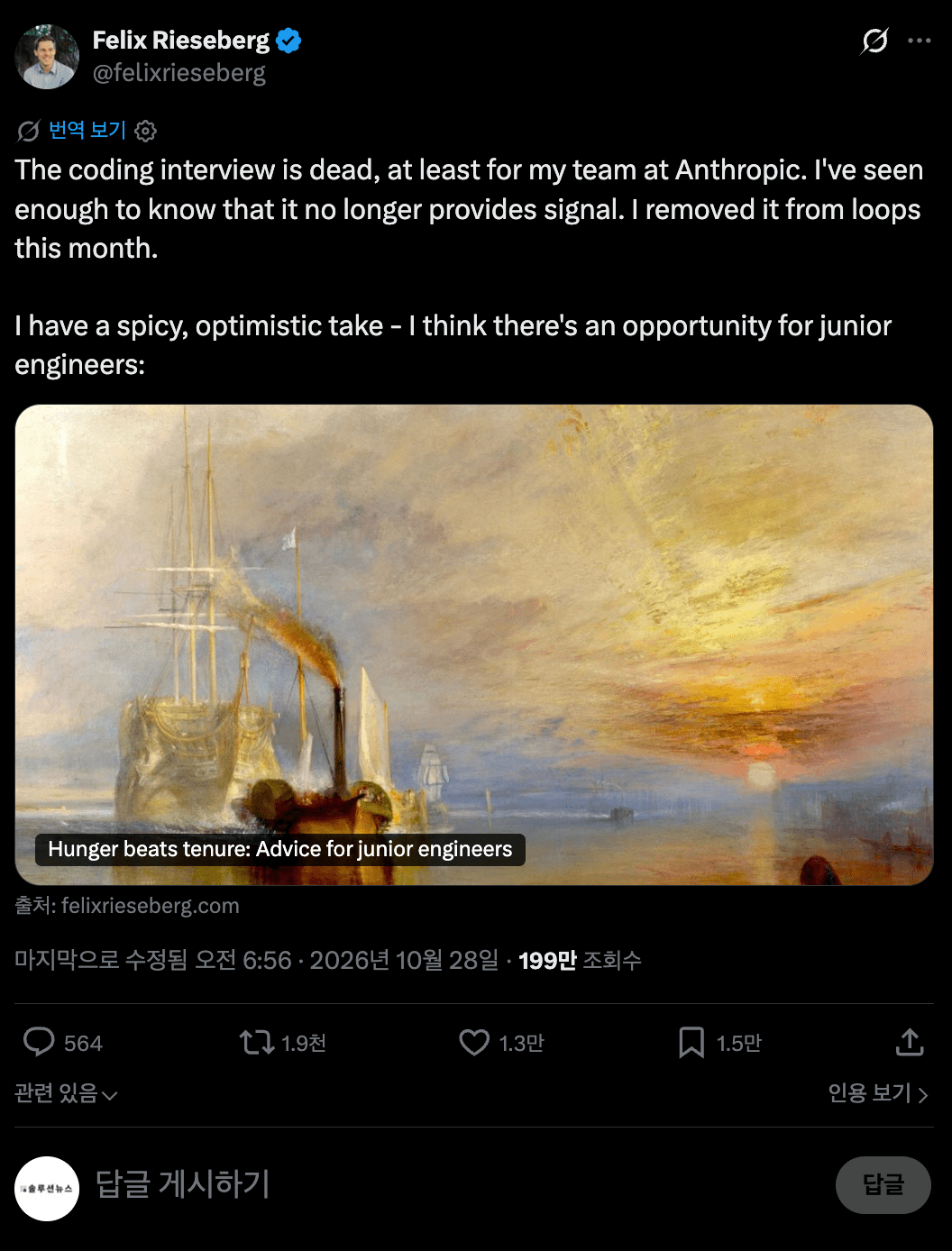
At Anthropic, AI already writes most of the code. That means the skills coding interviews traditionally tested—writing algorithms by hand and memorizing programming language syntax—are becoming less central to the work. Rieseberg acknowledged, however, that he has not yet found an answer to how to evaluate people who use AI effectively to produce results. For now, he reviews résumés and portfolios for small prototypes that demonstrate “taste, empathy and principled thinking.”
For junior developers: “Build something over the weekend instead of clearing a backlog”
As AI coding tools become more widespread, concerns are growing that entry-level developer jobs are disappearing. AI has taken over tasks through which junior developers once learned the work, such as fixing bugs and building simple features.
In his blog post, Rieseberg offered advice for people in an organization who have neither seniority nor influence. Rather than simply working through a backlog of tickets, he said, they should first identify the business problem the company is trying to solve.
He suggested choosing one idea that could make substantial progress on that problem and building a working prototype over the weekend. Instead of combining several good ideas into one ambitious product, he said, present one compelling idea clearly.
He also described an outsider’s perspective as an advantage. New engineers, he said, are more likely to notice frustrating user experiences and question assumptions that people inside the company take for granted. He cited two Anthropic engineers who had joined not long before and built a graphical interface for Claude Code over a weekend; the first public version appeared about eight days later.
Google lets candidates use Gemini; Amazon says to focus on “results”
The shift in hiring criteria is spreading across the tech industry. According to Business Insider, Google is expanding software engineering interviews that allow applicants to use Gemini and assess their ability to work with AI and write prompts.
Instead of asking candidates to write code themselves, the approach evaluates their ability to read and verify code alongside AI. On Oct. 27, Amazon told engineers to prioritize the results they deliver for customers and the business, rather than how much they use AI.
Amazon has called the current moment the era of the “Renaissance developer,” in which human judgment and AI are combined to build products faster. Like Anthropic, the company is focused not on how much AI people use, but on what they create with it.
“Taste, empathy and principled thinking”—the qualities Rieseberg identified—are increasingly cited by AI researchers and tech executives as essential skills in the AI era. The diagnosis is that AI will handle the coding, while people will remain responsible for deciding what to build and understanding the people who use it. Anthropic has not issued a company-wide comment on Rieseberg’s personal post, and it has not been confirmed whether this approach applies to hiring across the company.