
Key points
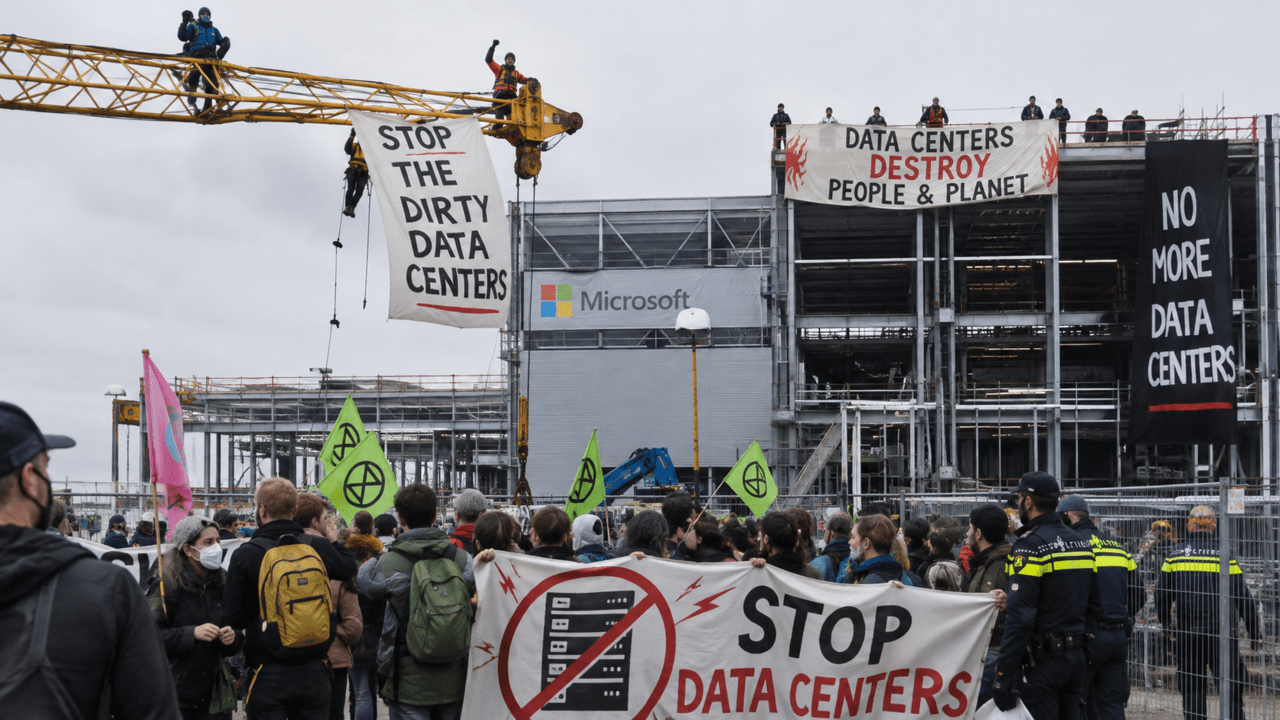
▶ On November 6, more than 100 activists entered the construction site of a Microsoft data center in Amsterdam and climbed cranes in protest.
▶ On the same day, more than 100 organizations in 15 European countries launched coordinated action under the banner “Stop Dirty Data Centers,” calling for a halt to new large-scale data center construction.
▶ The EU is pursuing legislation to triple data center capacity in order to compete in AI, while making public trust a precondition.
▶ Solutions include requiring operators to cover the full cost of power infrastructure, supplying recovered waste heat to local heating systems, disclosing tenants and usage in advance, and making measurable contributions to local communities conditions of approval.
What happened
On November 6 local time, about 100 activists opposed to a Microsoft (MS) data center entered its construction site in Amsterdam, the Netherlands, and staged a protest. Reuters and Bloomberg reported that they unfurled banners bearing slogans such as “Down with data centers” and climbed cranes. Police seized cutting tools and climbing equipment.
That same day, coordinated action under the name “Stop Dirty Data Centers” began across Europe. According to Euronews and The Guardian, more than 100 organizations in 15 countries held two days of protests on November 6 and 7, including a demonstration outside government offices in London, a protest outside the Polish parliament, a march in Dublin, and a demonstration outside an MS facility in Denmark. Organizers are demanding an immediate halt to new large-scale data center construction.
The timing is notable. The protests came just after candidates who opposed data center construction or campaigned on regulating it won a series of races in the U.S. midterm elections held on November 4. Owen Espley, coordinator of the pan-European protests, said, “The results of the U.S. midterms reflect concerns shared on both sides of the Atlantic.”
What it means
The slogans at these protests go beyond environmental concerns. Organizers have focused on electricity bills, water, land, housing, jobs, and the cost of living. Germany’s Öko-Institut has forecast that carbon dioxide emissions from AI data centers will be six times higher in 2030 than in 2023, but the people taking to the streets are more concerned with their immediate bills than with carbon emissions.
The burden is evident in the figures. Data centers account for about 22% of Ireland’s national electricity consumption. The Netherlands has around 200 data centers planned, under construction, or in operation, and data centers used 4.6% of the country’s total electricity in 2024. Amsterdam is reported to have suspended new data center construction and expansion last year.
This presents a new challenge for the AI industry. Until now, data center locations have been determined by electricity prices, land availability, and the speed of permitting. Local residents’ consent has now become a factor that can shape project timelines. Google’s project in Finland is under investigation over site preparation, while MS canceled a project in the UK after infrastructure problems caused delays.
Different perspectives
The European Commission supports cautious expansion. Henna Virkkunen, the EU’s Executive Vice-President for Tech Sovereignty, Security and Democracy, told Reuters in an interview on November 5 that Europe needs more data centers for AI. She added, however, that people must be able to trust that they will not face sharp increases in electricity bills, power outages, or environmental damage. In response to competition with the United States and China in AI, the EU is pursuing legislation to triple data center capacity within five to seven years.
Industry groups cite both business viability and freedom of expression. MS said it understands the strong feelings surrounding data centers and respects peaceful expression, but cannot accept illegal activity. Germany’s IT industry association Bitkom has previously issued a legal opinion arguing that data centers should be eligible for reduced electricity rates, like energy-intensive industries. The industry is seeking relief from costs in order to remain competitive.
Civil society groups are calling for the opposite. Organizers say large-scale projects should be paused until clear rules are in place. Amsterdam protester Sam van der Beek told Reuters, “These data centers are destroying our world.” The Dutch government, meanwhile, has argued that data centers are needed for business growth, public services, and security.
Implications
The key point is that opposition to data centers has become an election issue. In Ohio’s gubernatorial election, a candidate who had promised a conditional moratorium requiring data centers to cover all their electricity costs won. The governor of Pennsylvania, who tightened data center regulations over the summer, also won reelection. European protesters’ direct references to these results were a strategic choice.
South Korea is no exception. Policies are in place to encourage new data centers to move outside the capital region, where electricity supply is concentrated, and local opposition to transmission lines and substations has been ongoing.
The European experience shows how power grid issues can produce political consequences when they spill over into electricity bills and housing concerns. Projects that fail to account for residents’ consent as a cost during site selection can face much greater costs once construction begins.
Solutions
The starting point is making clear who bears the costs. Suspicions that the costs of electricity, water, and transmission grid expansion for data centers are being passed on to local residents are at the root of the backlash. Clearly establishing a rate structure that requires operators to cover the full cost of related power infrastructure—as proposed by the winning candidate in Ohio—could reduce much of the conflict. Some U.S. utilities are reportedly addressing the issue by applying separate rates and long-term contract requirements to large electricity users.
There are steps companies can take first. In the Nordic countries, supplying data center waste heat to local district heating systems has become an established model. Incorporating waste heat recovery and direct procurement of renewable energy at the design stage could change the perception of data centers as facilities that only consume electricity. Transparency is also the responsibility of companies. When construction proceeds without disclosing tenants or facility size, as at the Amsterdam site, suspicions grow. Transparency was ultimately what local civil society groups demanded from the city of Amsterdam and the province of North Holland.
Governments and regulators need to establish standards. The European Commission is preparing a data center sustainability rating system that assesses energy efficiency, water use, clean energy share, and waste heat recovery. Its introduction has been delayed by disagreements among member states over whether nuclear power should count as clean energy, and only 36% of data centers have reported their energy use. For the rating system to work, reporting requirements must first be mandatory. South Korea has also introduced an assessment of the impact on the power grid, but the system will earn public trust only if residents can access the assessment results and electricity use plans.
It is also necessary to develop structured ways for local communities to share in the benefits. In the United States, proposals have emerged to provide a “dividend” to areas that host data centers. Rather than relying on vague promises of tax revenue and jobs, measurable forms of compensation—such as electricity bill discounts, contributions to local funds, and investment in public facilities—could be made conditions of project approval. The moratorium demanded by European protesters is not a call to permanently block construction, but to establish rules first. Once those rules are in place, construction can resume.