
Key points
▶ On October 23, NASA unveiled detailed plans for Artemis III. The agency plans to launch three rockets from Florida within a two-week period.
▶ Blue Origin’s New Glenn will place a test version of its Blue Moon Mark 2 lunar lander into an approximately 440-kilometer-high orbit around Earth. NASA’s SLS rocket will then launch Orion carrying four astronauts, followed by SpaceX’s Starship.
▶ On the third day of the flight, the astronauts will dock with Blue Moon and spend two days inside the lander checking its pressure, life-support systems and controls. On the eighth day, they will dock with Starship for just two hours and will not enter it.
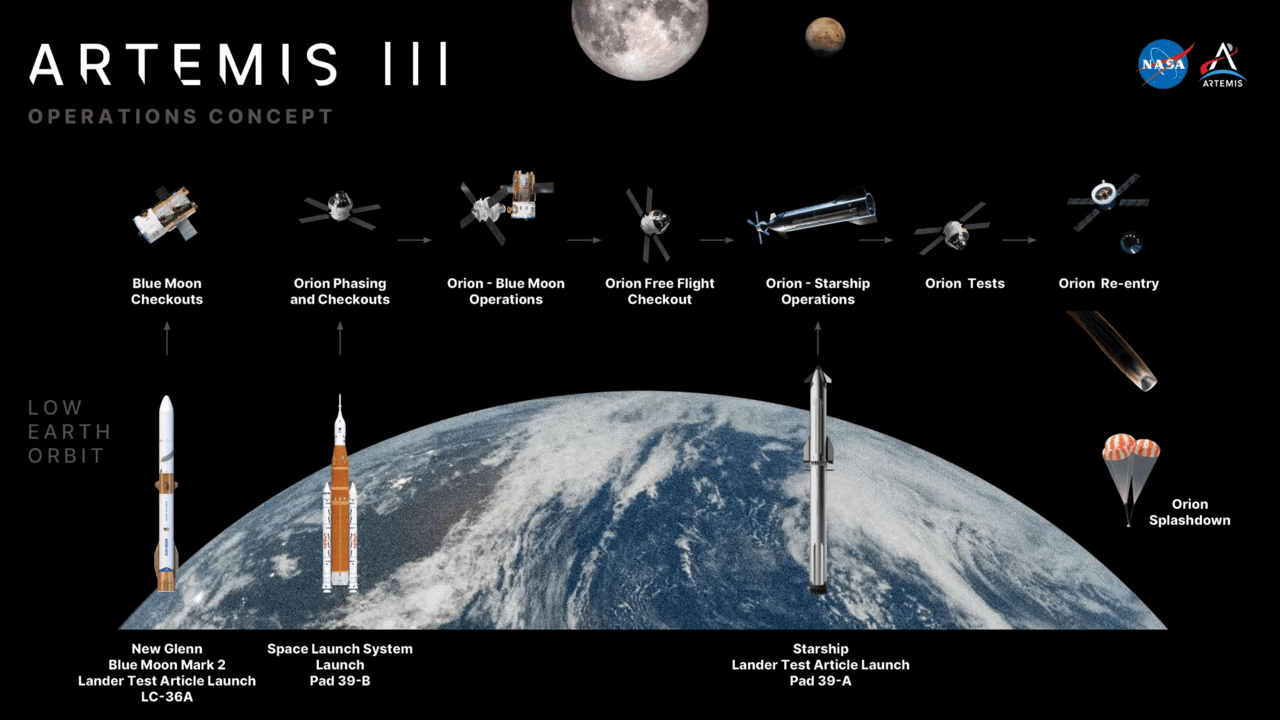
The plan for a final dress rehearsal before sending people to the Moon has been announced. On October 23 (local time), NASA held a press conference lasting more than two hours at Kennedy Space Center and unveiled its operational plan for Artemis III.
The plan calls for three rockets to launch in succession within two weeks, bringing three spacecraft together in orbit around Earth.
Three rockets, three spacecraft
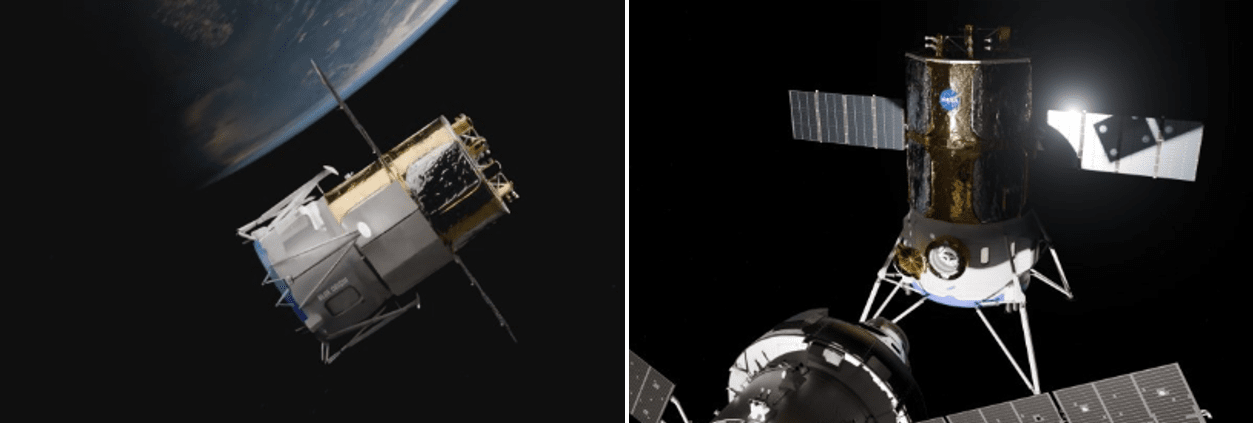
The sequence has been set. Blue Origin’s New Glenn rocket will first place a test version of its Blue Moon Mark 2 lunar lander into low Earth orbit at an altitude of about 440 kilometers. The New Glenn launch pad was damaged in an explosion during a ground test in May, and Blue Origin aims to have it repaired by the end of the year.
Next will be NASA’s own SLS rocket. Aboard the Orion crew capsule at its top will be NASA astronauts Randy Bresnik, Frank Rubio and Andre Douglas, along with European Space Agency astronaut Luca Parmitano.
Orion will enter an elongated orbit with a low point of 29 kilometers and a high point of 1,806 kilometers, then move into a circular orbit at an altitude of about 555 kilometers. NASA says this altitude is suitable for managing the spacecraft’s temperature.
SpaceX’s Starship will launch last. It will be a Version 3 vehicle, which first flew in May, fitted with a docking mechanism at its nose. It will launch after the Blue Moon inspection is complete and rendezvous with Orion.
One lander will be entered; the other will only be docked with
The astronauts’ schedule is as follows: They will check Orion’s equipment on days one and two, then dock with Blue Moon on day three. Over the next two days, they will open the hatch and enter the lander.
They will test whether the cabin pressure is maintained properly and whether the life-support system and flight-control software work. They will also practice emergency procedures and learn how to operate both spacecraft at the same time. Once the checks are complete, they will return to Orion, detach from Blue Moon and prepare for the next rendezvous.

On the eighth day, they will dock with Starship. The docking will last only two hours, and the astronauts will not enter the vehicle. They will measure the forces involved as Orion attaches to and separates from Starship, as well as how the two spacecraft move while connected.
NASA said the goal is to demonstrate how Orion can work with two commercial landers that have completely different designs during a single mission. Afterward, the crew will remain in orbit for another six to nine days, trying out newly developed Orion survival suits for deep-space missions and conducting health checks and scientific experiments. The suits were not tested during Artemis II in April. The mission is expected to last 14 days, or up to 17 days at most, and will end with a parachute-assisted splashdown at sea.
Will it orbit Earth instead of going to the Moon?
Artemis III was originally a lunar landing mission. It was supposed to send people back to the Moon for the first time in 54 years, since Apollo 17 in 1972. NASA overhauled the plan on February 27.
“We need to get back to basics,” NASA Administrator Jared Isaacman said, calling it a mistake to move directly to a landing attempt after Artemis II, which will orbit the Moon and return.
The change came after NASA’s Aerospace Safety Advisory Panel recommended restructuring the mission, warning that the original Artemis III plan involved too many first-time tasks and posed too much risk. Artemis III was therefore changed into an Earth-orbit test in which the crew will rendezvous with the landers, while the landing was postponed to Artemis IV in 2028. In April, the four astronauts aboard Artemis II orbited the Moon for 10 days and returned safely.
NASA has not yet decided which lander will be the first to touch down on the Moon. If Blue Moon is selected, Orion will meet the lander in lunar orbit. If Starship is chosen, it will first dock with Orion in Earth orbit and then carry it to the Moon.
Isaacman said he had no intention of abandoning either path to the lunar surface unless the data and schedule made it unavoidable. NASA said both companies are preparing for a 2028 landing, with procuring lander components posing the biggest challenge.
No launch date has been set. NASA is targeting summer 2027, which would leave two opportunities for an Artemis IV landing in 2028. However, according to NASA Watch, Isaacman acknowledged in a memo to all employees last month that Artemis III was running about 90 days behind schedule.
For three rockets to launch within two weeks, everything must fall into place: repairs to the New Glenn launch pad, additional flights of Starship Version 3, and completion of the Blue Moon test vehicle.