One-minute news
▶ Bloomberg reporter Mark Gurman reported in his “Power On” newsletter on the 25th (local time) that Apple will unveil 14-inch and 16-inch MacBook Pro models with OLED touchscreens on the 28th.
▶ Apple is expected to hold a “Pro and Tell” hands-on event for invited journalists in Los Angeles at 10 a.m. that day (2 a.m. on the 29th in Korea), and announce the products in a press release rather than at a keynote.
▶ The new MacBook Pro will look similar to the current model but weigh less. The notch at the top of the display will be replaced by an iPhone-style Dynamic Island.
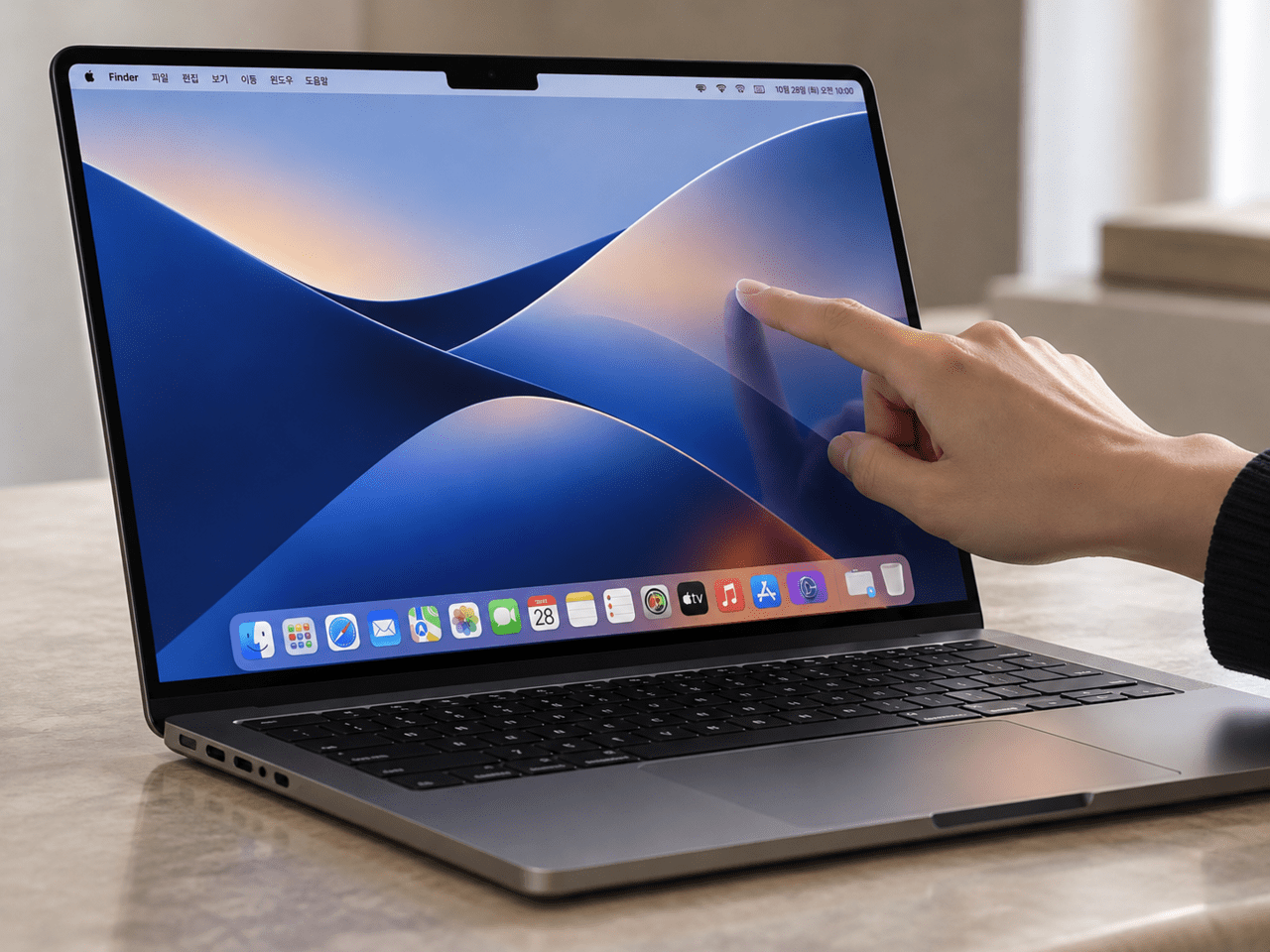
Apple is expected to unveil its first MacBook Pro that can be operated by touch. Bloomberg reporter Mark Gurman reported in his “Power On” newsletter on the 25th (local time) that Apple will unveil 14-inch and 16-inch MacBook Pro models with OLED touchscreens on the 28th.
Apple will host an event for invited journalists called “Pro and Tell” in Los Angeles at 10 a.m. on the 28th (2 a.m. on the 29th in Korea).
Apple Senior Vice President of Marketing Greg Joswiak announced the event in a social media post on the 19th, writing, “Can’t wait for Pro and Tell next week.” Rather than giving a keynote, Apple is expected to announce the products in a press release, after which invited journalists will be able to try them out. Gurman reported that shipments will begin on November 6.
◆ Similar design, lighter weight, and no notch
According to Gurman, the new MacBook Pro will look much like the current model but will be lighter. The notch cut out at the top of the display for the camera will be replaced by an iPhone-style Dynamic Island, which displays alerts and status information around the camera opening.
The chips will not be new. The laptops will use the same M5 Pro and M5 Max chips that Apple announced on March 3 and released on March 11. The display will switch from the current mini-LED Liquid Retina XDR technology to OLED.
Mini-LED displays use a dense array of small LEDs behind an LCD panel to produce light. With OLED, each pixel emits its own light, allowing for deeper blacks and thinner panels.
Apple resisted adding touchscreens to the Mac for many years. At an October 2010 event introducing new Macs, Steve Jobs dismissed the idea of touching a vertically positioned screen, saying that even brief use would tire users’ arms.
A thin touch-sensitive strip above the keyboard, called the Touch Bar, was introduced in 2016 but disappeared from the MacBook Pro in 2023. The touchscreen MacBook Pro would reverse that policy after 15 years.
◆ The screen changes when you use your fingers
The operating system will also change. Gurman reported that the next version of macOS, “Golden Gate,” will feature a “dynamic interface” designed for touch input.
“The system takes previous interactions into account and presents controls based on whether the user has been touching the screen or using the trackpad,” he said. “Menus appear around your finger when you touch a button, and the Dock and menu bar are optimized for touch.”
Apple plans to position touch as an additional input method to use when needed, rather than a replacement for the keyboard and trackpad. In other words, the Mac will not become an iPad; instead, the interface will adapt when touched, for example by enlarging buttons.
◆ Prices could rise by as much as $500 from the 14-inch model’s $2,499 starting price
Prices are expected to increase. In the United States, current MacBook Pro models with the M5 Pro and M5 Max start at $2,499 for the 14-inch model (about 3.46 million won) and $2,999 for the 16-inch model (about 4.15 million won). Gurman said the OLED models could cost up to $500 (about 690,000 won) more at the starting price.
Current prices already reflect two increases this year. When Apple introduced the M5 Pro model in March, it raised the starting price by $200 compared with the M4 Pro model. On June 25, it raised prices for Macs and iPads again, citing higher memory and storage costs.
An Apple spokesperson told Bloomberg at the time, “We’ve reached a point where we need to start raising prices across a number of products.” In South Korea, the 14-inch M5 Pro model launched in March at 3.49 million won, while the 16-inch model was priced at 4.29 million won. There is precedent for an OLED-related price increase: when Apple switched the iPad Pro to OLED in 2024, it raised the starting price by $200.
Mini-LED MacBook Pro models will remain on sale for the time being. Gurman said they will eventually be discontinued, but will stay in the lineup for now, creating a two-tier range, with touchscreen OLED models at the top and mini-LED models below.
◆ Samsung Display to make panels at its 8.6-generation line in Asan
The move could create a supply opportunity for a South Korean company. The Elec reported in July, citing industry sources, that Samsung Display would be the sole supplier of OLED touch panels for the new MacBook Pro. Apple reportedly excluded LG Display and China’s BOE from panel development over concerns about yield, efficiency, and available production capacity.
The 14-inch and 16-inch panels will be manufactured at Samsung Display’s 8.6-generation OLED line in Asan, South Chungcheong Province. Mass production is expected to begin around August, with initial volume estimated at 2.5 million panels. “8.6-generation” refers to the size of the glass substrate; compared with the existing sixth-generation substrate, the larger sheet allows more laptop panels to be produced at once.
The MacBook Pro OLED panels are reportedly “tandem OLED,” the same technology used in the iPad Pro. This structure stacks two light-emitting layers to improve brightness and lifespan. The touch sensors are also said to be integrated into the panel rather than added as a separate film.
If Samsung Display becomes the exclusive supplier of panels for Apple’s laptops, it would give South Korea’s OLED industry an opportunity to expand its supply relationship with Apple’s premium products from iPhones to laptops. Apple has not officially confirmed its suppliers.