
Key points
▶ Anthropic said in a recent engineering blog post that it built its own code-management system, Scion, and replaced Git, the standard developer tool, in just five months.
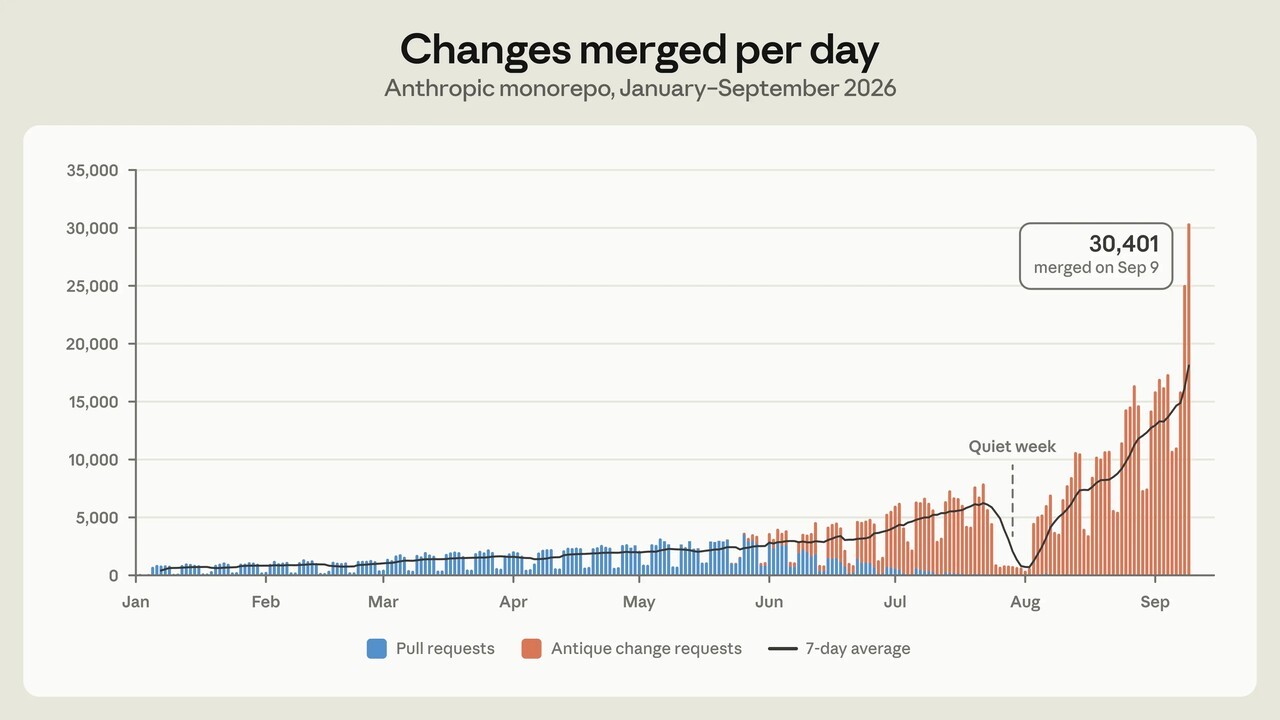
▶ The reason was the volume of code. The number of code changes Anthropic merged each day rose from an average of 2,500 in May to more than 30,000 in September. As Claude began writing code in place of people, tools designed for human-speed workflows could no longer keep up.
▶ The company has accumulated 100 GB of code-change history and downloads code 25 million times a day. Even hundreds of Git replica servers were not enough. Scion assumes that users are always connected: the servers handle the computation and send users only the files they need.
Anthropic said in a recent engineering blog post that it built its own code-management system, Scion, and replaced Git, the standard developer tool, across the company in just five months.
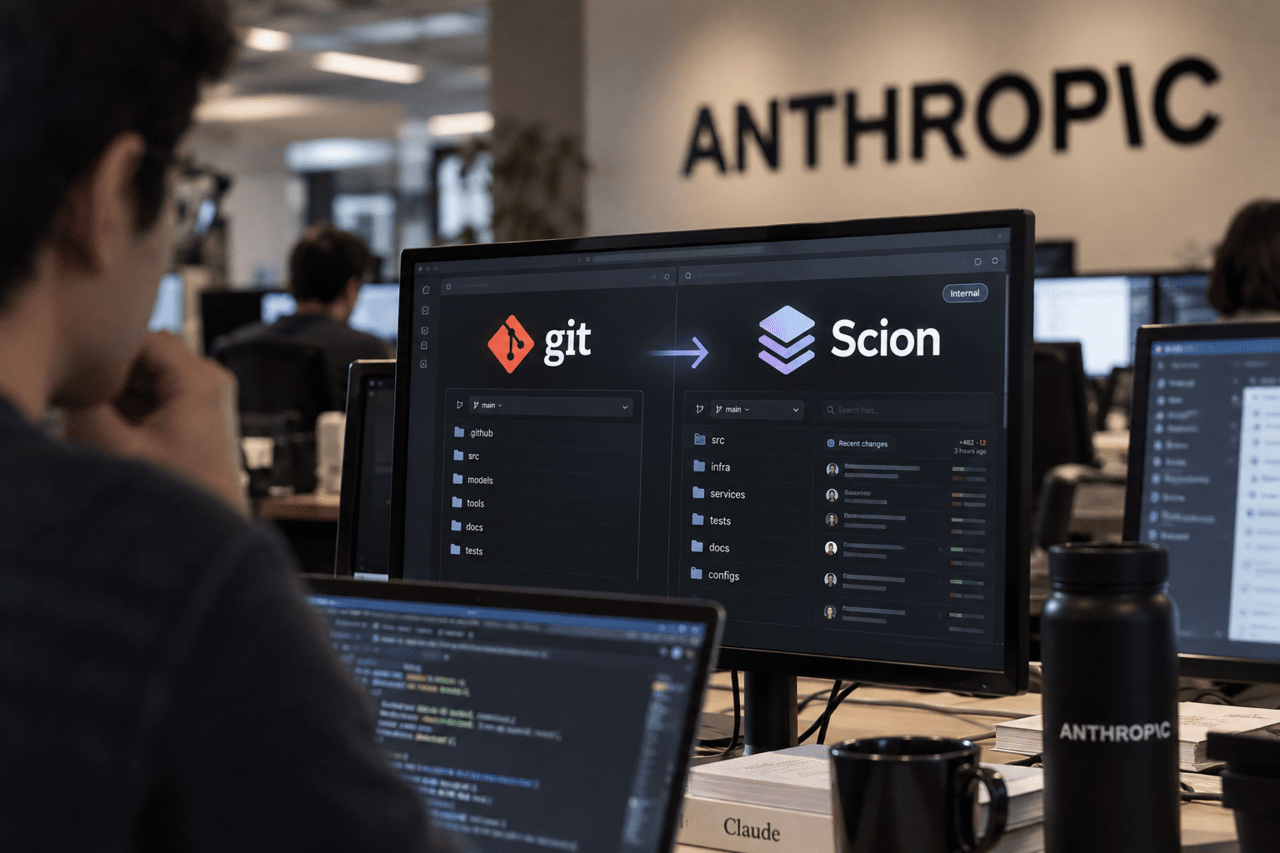
Anthropic has abandoned Git, the standard tool used by developers around the world.
The company said on October 13 (local time) that it had built its own code-management system, Scion, and moved all of its company code to it in five months. There was a reason: tools built for people could not keep pace with AI’s speed at writing code.
Git is a code-management tool developed in 2005 by Linus Torvalds, creator of Linux. It records who changed which lines and when, and brings together code changes made by multiple people.
Most developers worldwide use Git, and services such as GitHub and GitLab are built on it. Anthropic concluded that Git was no longer suited to the scale of its operations.
◆ A 12-fold increase in four months, with 30,000 merges a day
Anthropic said coding itself was no longer the bottleneck. Claude runs research experiments on its own, modifies complex programs and builds new services from scratch. The bottleneck had shifted to development infrastructure designed around human speed: code repositories, builds and automated tests.
Anthropic keeps all of its company code in a single repository. The average number of code changes merged into it each day was about 2,500 in May. By September, it had exceeded 30,000—a 12-fold increase in four months. Anthropic said demand for merging code was effectively unlimited, and every time it removed one bottleneck, more code immediately poured in.
The repository had also grown too large to handle. The history of code changes alone amounted to nearly 100 GB on the main branch, while a compressed copy of the current code exceeded 25 GB. Automated tests downloaded code 25 million times a day.
Those figures excluded developer workspaces, AI agent workspaces and research jobs. If code were downloaded in the conventional Git way, 600 petabytes would be transferred each day. Anthropic managed to cope by running hundreds of Git replica servers, but operations became increasingly difficult as the number of merges grew.
◆ Git is for individual developers; Scion is built for AI
With Git, every copy is a complete repository. Users can read the change history and calculate differences between versions even without an internet connection. That design suits developers who work independently on laptops they can take anywhere.
But nearly all users of Anthropic’s repository are AI agents and automated processes, and they are always connected to servers. A design built for offline use had become an obstacle.
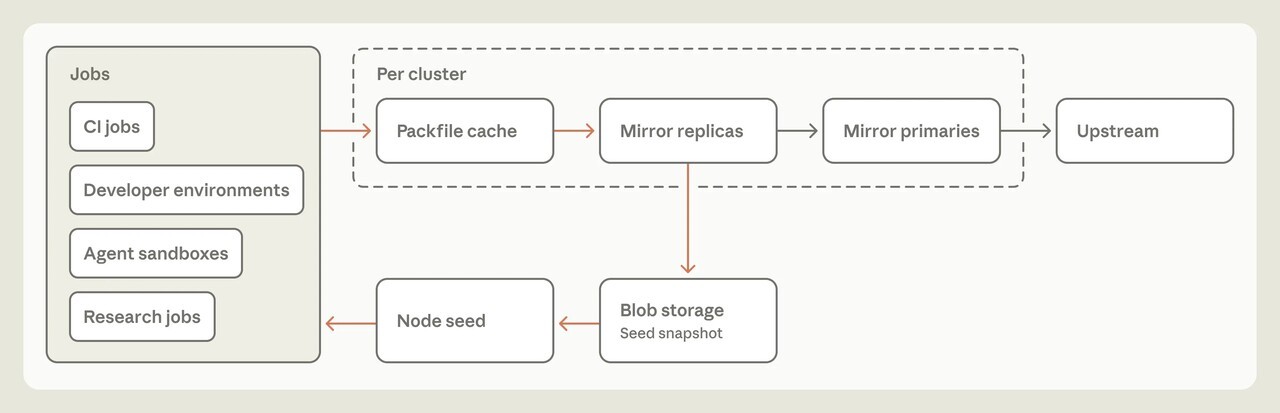
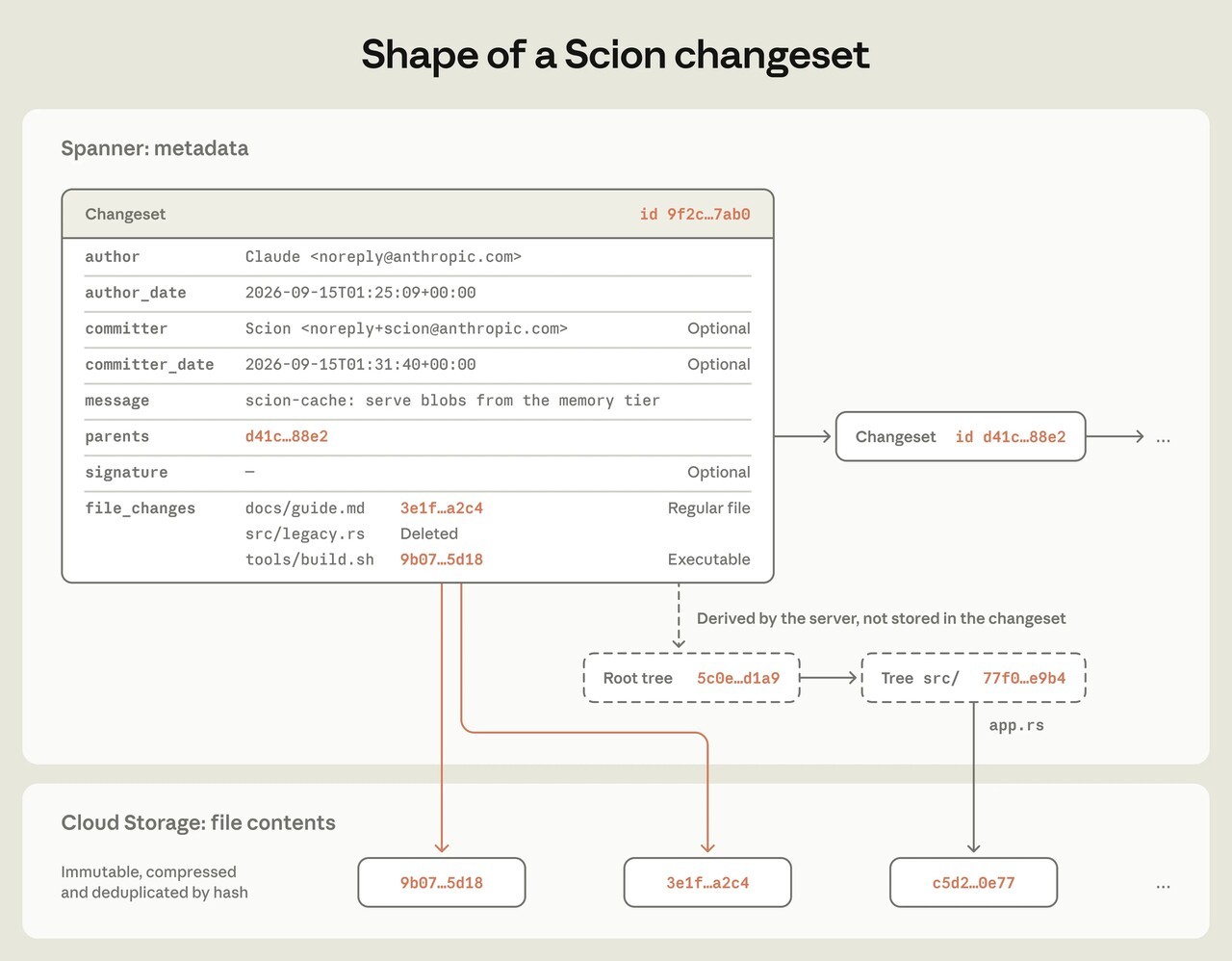
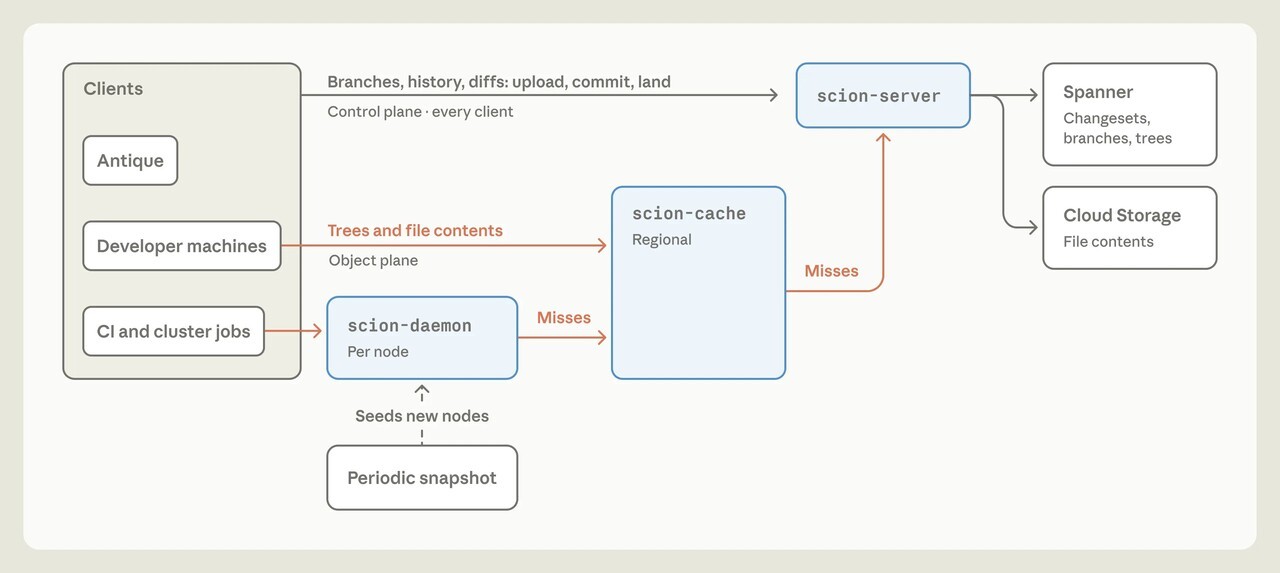
Scion reverses that assumption. It assumes that users can always reach a server, which handles all the heavy work, including retrieving change histories, recording new changes and merging code. Users download only the files they need, store them locally and monitor them for updates. There is no complete copy of the repository, even on the servers. Data is distributed across multiple servers, and each component can be scaled independently.
The system was designed so that the cost of recording a code change is proportional to the amount changed, rather than the size of the entire repository. That allows the servers to handle 30,000 changes a day. Automated tests do not download all the code; they ask the server, “What’s the difference between these two versions?” and receive the answer. If they need files, they download only the relevant directories.
Google’s Piper and Meta’s Sapling were earlier systems designed for extremely large repositories. Anthropic said it drew on their experience.
◆ Server resources cut to one-two-hundredth; downloads reduced from minutes to seconds
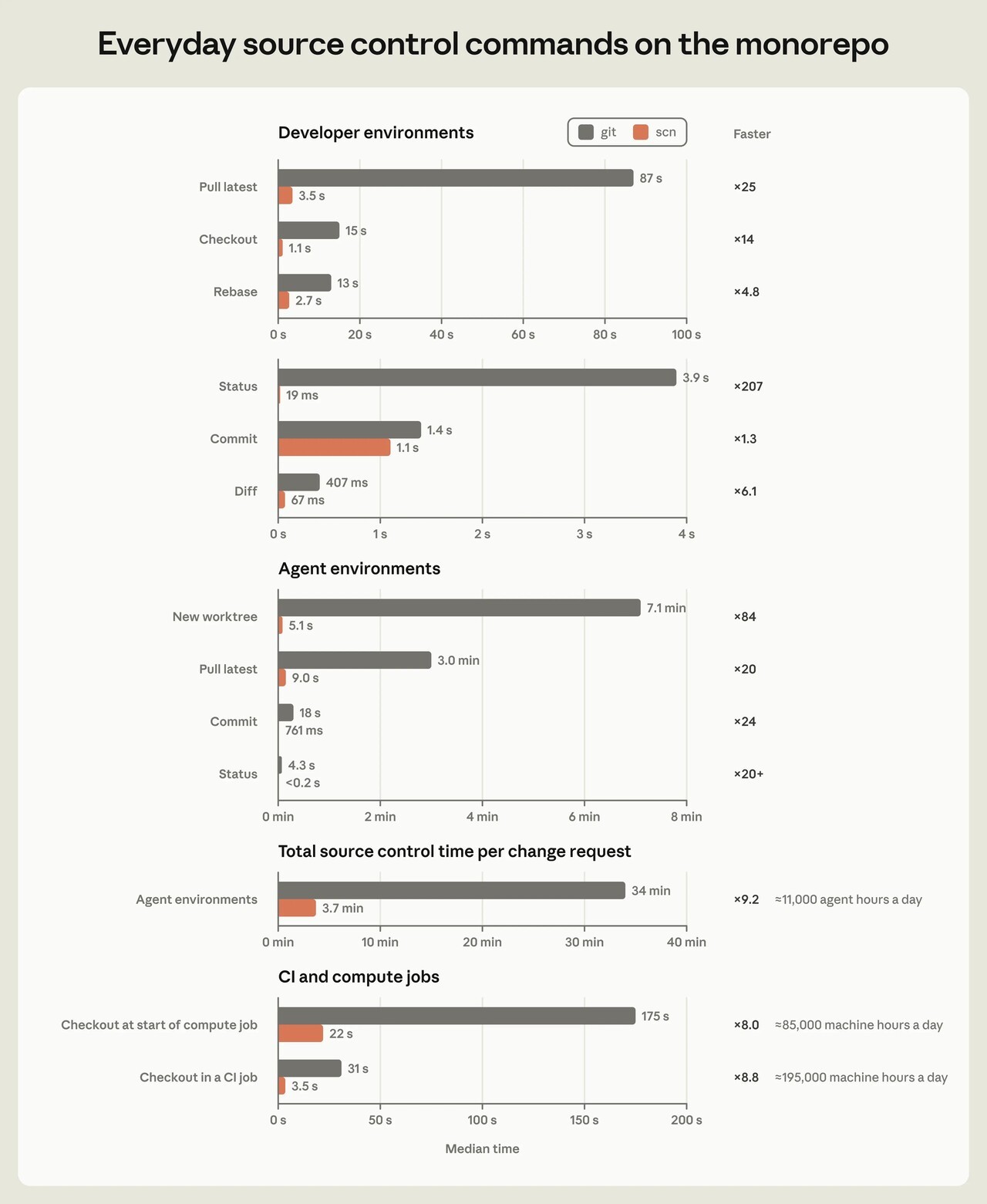
Scion uses one-two-hundredth the CPU and memory resources of Anthropic’s previous Git replica-server system. The time required for automated tests and research jobs to download code fell from minutes to seconds.
Anthropic also freed up 25% of its automated-test server capacity. At each stage, caches directly handle more than 99% of requests.
Alongside Scion, seven people built the code-review tool Antique, code search and an access-control system over the same period. Anthropic said that, in the past, this kind of work would have taken many more engineers several years.
◆ AI writes code better than people
Anthropic said Claude was both the source of the problem and the solution. Claude generated code faster than Git could handle, but the company also used Claude to build a new system quickly.
There is a concrete example. Anthropic needed a program to migrate code from Git to Scion. The development team wrote one by hand early this year and thought it was good. Then they gave an early version of Claude Mythos, which had just begun to be used internally, a simple instruction: “Try rewriting this.”
The result used one-twentieth as much memory and ran four times faster. It also followed rules that were not written in the documentation, such as the order in which data needed to be transferred.
Engineers who built Scion all acknowledged that Claude wrote code better than they did. That did not mean developers had nothing left to do. People set the big-picture direction: how different systems should fit together, which designs to choose and what scale to support.
Anthropic said developers still review all code modified by Claude. But instead of reading it line by line as they once did, they focus on why it was changed and whether the direction is right.
Claude’s faster coding also led to more testing. Anthropic said Scion was among the most thoroughly tested pieces of code it had built. Claude found performance improvements that might take experts days or weeks to discover—and found more the next day.
Anthropic also assigned Claude to monitor its systems. The team created several channels in its internal messaging app, Slack, and assigned one Claude to each channel.
Each Claude is responsible for just one component. It spends all day watching that component’s status charts and logs, and raises an alert if anything looks unusual. Anthropic calls these agents “superfans,” likening them to experienced engineers with nothing to do but refresh charts. The company said they detect subtle anomalies missed by conventional automated alerts.
◆ “Other companies will face this within 6 to 12 months”
Anthropic said it has no plans to offer Scion to other companies. It is not intended to replace Git.
Companies that do not have tens of thousands of engineers or AI generating large volumes of code have little reason to use it. Adopting it would also require replacing their code-review, search and automated-testing tools. Anthropic said it worried that trying to build something for everyone could result in a tool useful to no one.
Anthropic acknowledged that its situation is unusual. The company spends an amount on running Claude internally that no other company would be willing to pay. It said its aim is not only to speed up development, but also to test how far Claude can go.
Even so, Anthropic expects other companies using AI to write code to hit the same wall within six months to a year. It would be wasteful for every company to work through the problem from scratch, it said.
That is why Anthropic said it would share lessons from building Scion that could also be applied to Git. It said it would work with GitHub, GitLab and the open-source community to address the challenges.
Anthropic said it is possible to change how Git works on the server side while continuing to use Git. Git on a developer’s computer and Git on a company’s server do not have to work in exactly the same way.
The company also proposed that GitHub and GitLab make it standard to answer server-side questions such as “Who changed this code?” and “What’s the difference between these two versions?” At present, answering such questions requires downloading the entire codebase.
Companies generally run tests before merging code, while other developers’ changes wait in line until the tests are finished.
Anthropic said that kind of queue became impossible when 30,000 changes were being merged each day, because hundreds or thousands of changes could be merged while a single test was running. It therefore shifted testing from before a merge to after the merge and just before deployment.
That means code changes submitted at the same time can conflict, Anthropic said, but Claude fixes them before people even notice the conflicts.