The Internet Newspaper Ethics Commission (Inshin Yoonwi) has launched a youth reporter training initiative focused on journalism about suicide prevention and respect for life. In partnership with the Korea Foundation for Suicide Prevention, it is gathering college newspaper reporters.

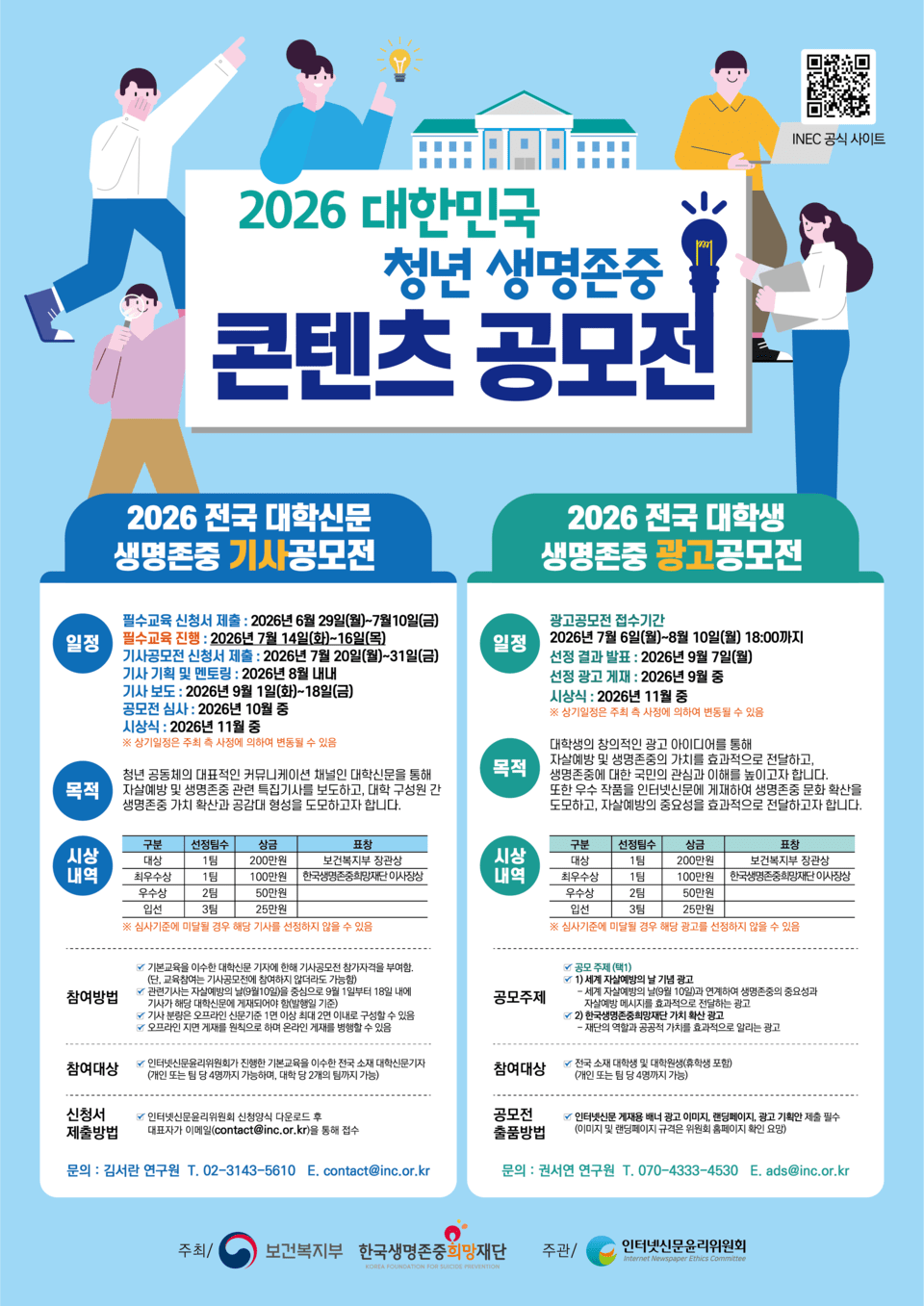
The commission said it is accepting applications for the “2026 College Newspaper Life-Respect Journalism School” from today through July 10. The training will be held for three days starting July 14 in a meeting room at the foundation in Jung-gu, Seoul. The program consists of nine lectures and 12 hours of instruction. Any college newspaper reporter may attend free of charge.
What stands out is the structure of the curriculum. It combines life-respect themes with practical journalism training in one course. It does not stop at reporting ethics; it also includes field skills such as fact-checking and AI journalism. Outside media experts and the foundation’s suicide-prevention specialists will teach the classes.
The journalism school is the starting point for a larger plan. It was designed as the first program of the “2026 Korea Youth Life-Respect Content Contest.” The structure links education to article and ad production, and then to actual publication and dissemination.
Before reporting habits become fixed, ethics are being instilled.
Behind the initiative lies a sobering reality in Korea. According to Statistics Korea’s 2024 cause-of-death data, 14,872 people died by suicide that year. That averages 40.6 deaths per day. Per 100,000 people, the rate was 29.1, the highest since 2011.
The international comparison is even harsher. After adjusting for age structure, the standardized rate is 26.2 per 100,000, 2.4 times the OECD average of 10.8. Since 2003, Korea has never given up its position as the highest in the OECD.
The shadow is deeper among younger generations. From teenagers to people in their 40s, suicide is the leading cause of death. Analysts say this reflects the combined pressure of academic and employment competition and social isolation. That is why the program chose young people, the future producers of media, as its target audience.
The choice to focus on university newspapers is also deliberate. College newspaper reporters later disperse into the media and content industries after graduation. The aim is to instill ethical standards at the earliest possible stage, before reporting habits harden.
A single line of reporting can make the difference between life and death.
Coverage of suicide can cut both ways. Sensational reporting can trigger imitation. In academia, this is known as the Werther effect. By contrast, careful reporting and the provision of prevention information can save lives.
This understanding has been codified into reporting guidelines. The result is “Suicide Prevention Reporting Guidelines 4.0.” Its first principle is to avoid reporting such incidents whenever possible. It also calls for not disclosing specific methods or locations, respecting the deceased and their bereaved families, and providing prevention information. This school will include as a formal class how to write articles in line with these guidelines.
Guidelines 4.0 adds one important new stipulation: one-person media such as blogs and social networking services must also strictly follow the rules. In an era when content spreads uncontrollably, this clearly defines the responsibility of creators. College newspaper reporters are the generation that will soon enter this one-person media ecosystem.
It is also noteworthy that AI journalism has been included in the training. Generative AI has accelerated the speed of article production. At the same time, it has increased the risk of spreading unverified information in a convincing form. In sensitive matters directly linked to life, the spread of false information can cause serious harm. Fact-checking capability is where it intersects with life-respect reporting.
The education is not meant to end as a one-time event. College newspaper reporters who complete the school will be able to participate in the “2026 National College Newspaper Life-Respect Article Contest.” They will write feature articles on suicide prevention and respect for life, to be published in college newspapers in September. To qualify, participants must have completed at least one lecture on life-respect topics.
A separate advertising contest will also be held for university and graduate students. Completion of the school is not required. It will accept works themed around World Suicide Prevention Day and the foundation. Selected entries will actually be published in internet newspapers participating in the commission on that day.
The two contests will each select seven teams in total, including the grand prize, the Minister of Health and Welfare Award, and the top prize, the Foundation Chairman’s Award. The final winning teams will take the stage at the integrated awards ceremony for the “2026 Korea Youth Life-Respect Content Contest” in November.
“We will help young people’s own articles and advertisements spread to the public through college newspapers and internet newspapers,” said Jang Se-chan, secretary-general of the commission. The goal is to cultivate a culture of respect for life and a responsible media environment together.
The key question is sustainability. The stigma of being No. 1 will not disappear through a single campaign. A virtuous cycle in which young reporters trained in reporting ethics enter the field and their work helps protect other lives. It remains to be seen whether this school will become the starting point for that cycle.
If you have difficult worries, such as depression, or if someone around you is going through similar hardships, you can receive 24-hour counseling from a suicide prevention hotline at 109.