
Artificial intelligence competition is shifting from performance to price. Google has unveiled its new model, “Gemini 3.7 Flash,” raising performance while cutting usage fees in half. It is a successor released just three weeks after the previous 3.6 Flash model.
Gemini 3.7 Flash is a model focused on coding and agent tasks. An agent refers to an AI that can carry out multiple steps on its own once a person sets a goal. It can search for information, create documents, and even fix programs by itself.
Flash is Google Gemini’s practical, value-oriented line, emphasizing speed and price. Lighter than top-tier performance models, it is the most widely used in real-world services because it is cheaper. Google introduced the new model as “the smartest worker model.”
What improved, and by how much
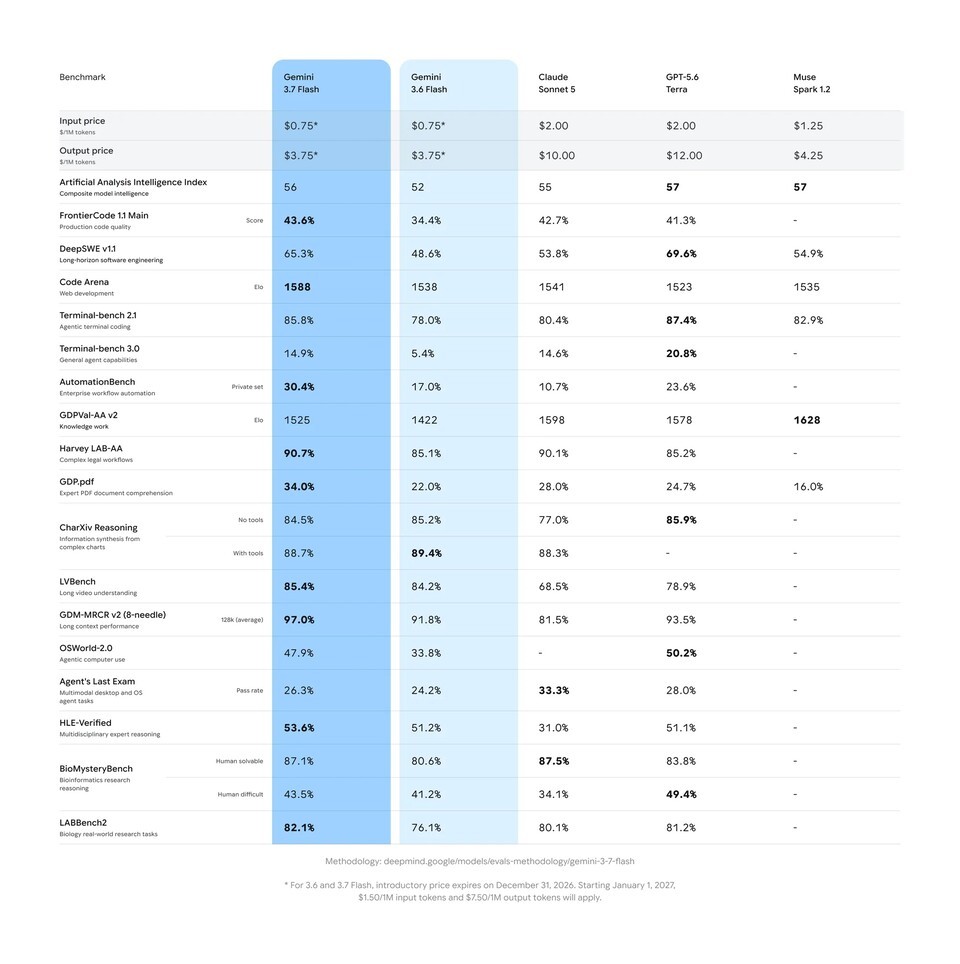
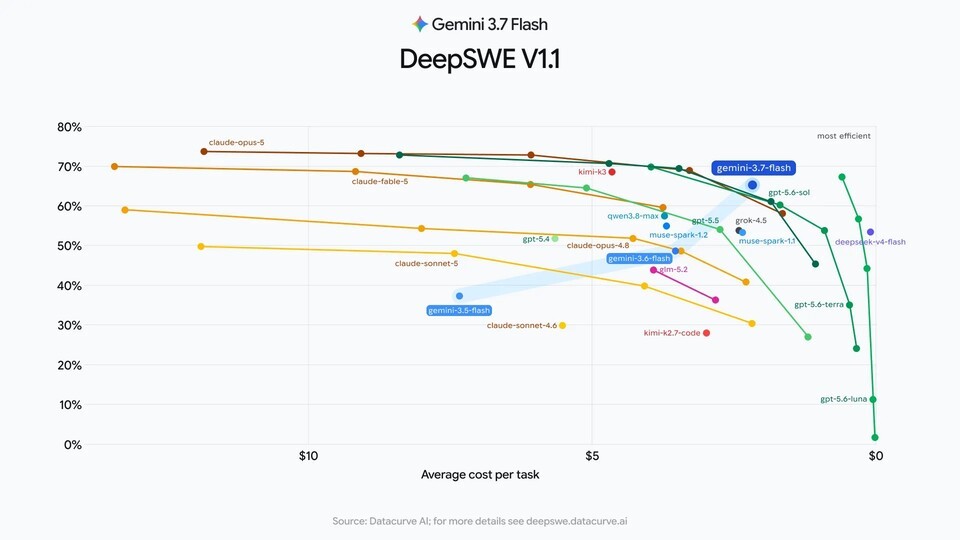
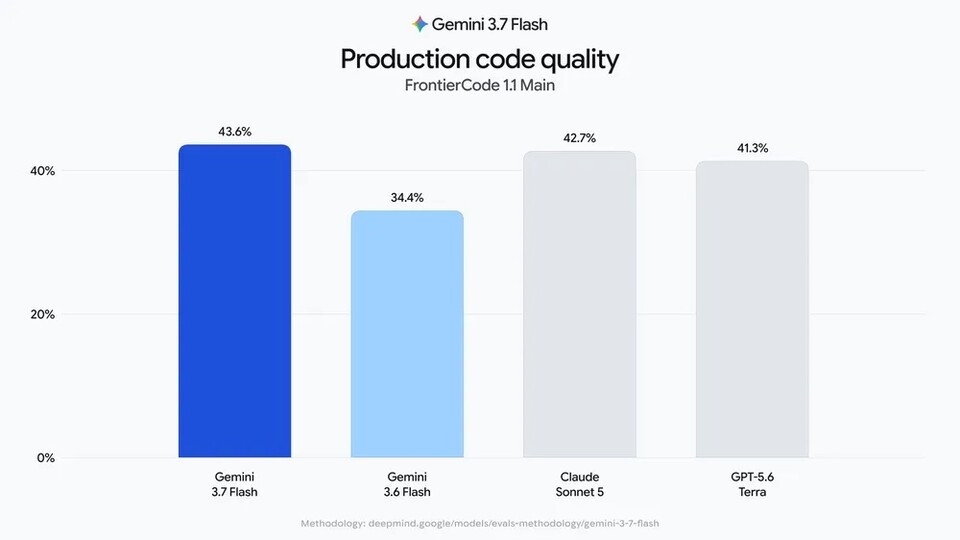
The biggest improvement is in coding ability. In a benchmark that measures software bug-fixing capability (DeepSWE), it scored 65.3 points, up from 49.0 in the previous model. In FrontierCode, a test that evaluates practical code generation, it scored 43.6 points, ahead of the previous model’s 34.4.
Its ability to create web pages such as homepages also improved. In rankings based on users choosing the better result produced by two models, it scored 50 points higher than the previous version. This means it became more accurate at creating screens that closely resemble a drawing or design draft.
Scores also rose in specialized fields requiring expertise, such as finance, law, and life sciences. In an evaluation of how well it can read and understand complex documents, it scored 34.0 points, widening the gap from the previous model’s 22.0. In a test measuring how well it handles real company work, it jumped from 17.0 to 30.4. It is still far from perfect, but the pace of improvement is steep.
The usage examples Google released show the change in concrete terms. A 3D game was demonstrated in which characters and items are generated and attached instantly from text descriptions alone. Another example showed a homepage opening screen completed with just one instruction. Google also presented a demo of turning a several-hundred-page annual report into a web document with animated charts.
The higher rate of getting the right result on the first try is also important in development settings. If AI-generated code is wrong, a person has to tell it to fix it again. Reducing this back-and-forth lowers both development time and costs. Google said the new model has improved in finding its own workaround when it hits a blockage and asking follow-up questions when instructions are vague.
The half-price gamble
The most eye-catching part of this announcement is the price. The usage fee is $0.75 per 1 million input tokens and $3.75 per 1 million output tokens through the end of the year. That is half the previous launch price. A token is the unit AI uses to read and write text; 1 million tokens amount to the length of several novels.
AI model fees are directly tied to service costs. Whether it is a translation app or a customer service chatbot, services that use AI pay model providers every time users make a request. If model prices are cut in half, companies can either run twice as many requests for the same money or lower their service prices.
For domestic companies without their own models, this creates an opportunity. The cheaper it is to borrow a good model, the more room there is to compete through ideas and service planning. On the other hand, it puts pressure on companies that develop models themselves. They now have to compete on both performance and price at the same time.
The release cycle is also getting shorter. Only three weeks passed between the previous model and this one. That shows how quickly developers’ feedback is being reflected in the next model. Industry-wide, the model replacement cycle is narrowing from quarterly to weekly.
AI models improve as they are used more, because more material accumulates for refinement. If a company attracts developers to its ecosystem first, services start to settle on top of that model. Once a service is built on one model, moving to another becomes cumbersome. The thinking is that expanding the user base, even at the cost of short-term profit, is the better long-term business.
How will everyday users change?
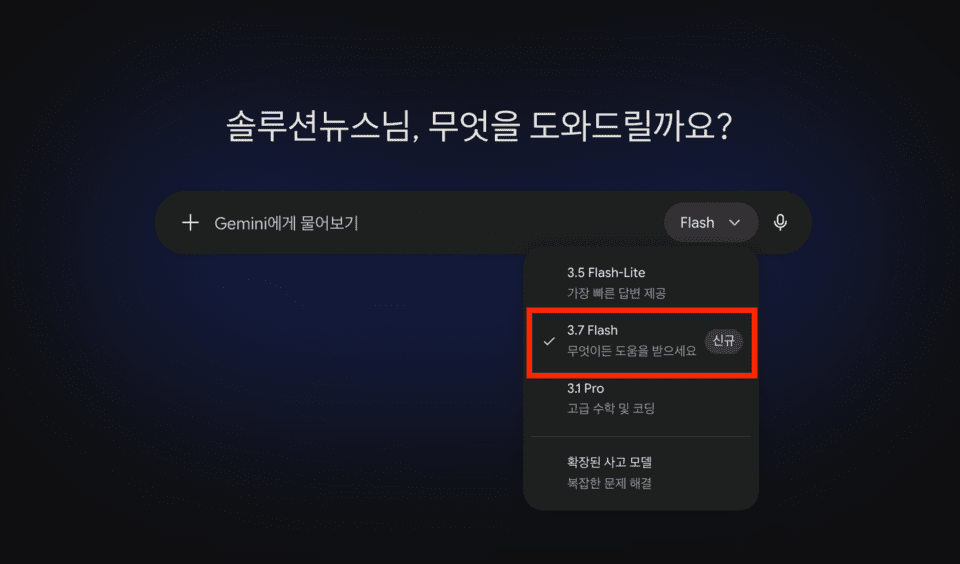
Availability varies by user group. Developers can use it starting on the release day through Google’s AI development tools. Businesses can adopt it through Google’s enterprise AI services. In the Gemini app, it began rolling out first to Pro and Ultra subscribers. Free users will continue using the previous 3.6 Flash for now.
For subscribers, the personal assistant feature “Spark” switched to the new model starting that day. Spark is a function that carries out tasks the user has instructed it to handle around the clock. It gathers scattered files, drafts emails, and updates progress documents. No separate setup is required, and it is available in more than 160 countries.
The key improvement to Spark is better handling of Google Docs and Sheets and other workplace tools. Tasks that require moving among multiple apps were especially prone to AI mistakes. If tool-handling accuracy improves, the burden on people checking results one by one is reduced.
Google said it has strengthened safeguards against misuse in biochemistry, nuclear-related abuse, and hacking. As performance improves, the risk of malicious use also grows, so the level of safety protection is becoming a factor to consider when choosing a model.
The half-price offer is only temporary, applying through the end of the year. After that, the pricing has not been set. If a service is built based only on the cheap launch price and then fees rise, cost planning could be disrupted. The benchmark scores are also based on the categories Google chose, so whether it fits real work is something each user must test for themselves.
For companies planning to adopt AI, now is the time to weigh options. In a period of rapidly falling model prices, it is better to design services so they can switch models easily rather than tying them too tightly to one model.