
Samsung Electronics and 11 affiliates signed a mutual-growth agreement with first-, second-, and third-tier suppliers at the Suwon campus in Suwon, Gyeonggi Province, on the 29th.
The agreement calls for support in the three areas of funding, technology, and manpower. The core measures include a 350 billion won mutual-growth and ESG fund, the free opening of more than 2,500 patents, and about 300 free training programs a year.
The move expands support beyond first-tier suppliers to second- and third-tier suppliers, reflecting the view that supplier competitiveness now directly determines the competitiveness of large companies as supply-chain competition increasingly takes place at the ecosystem level.
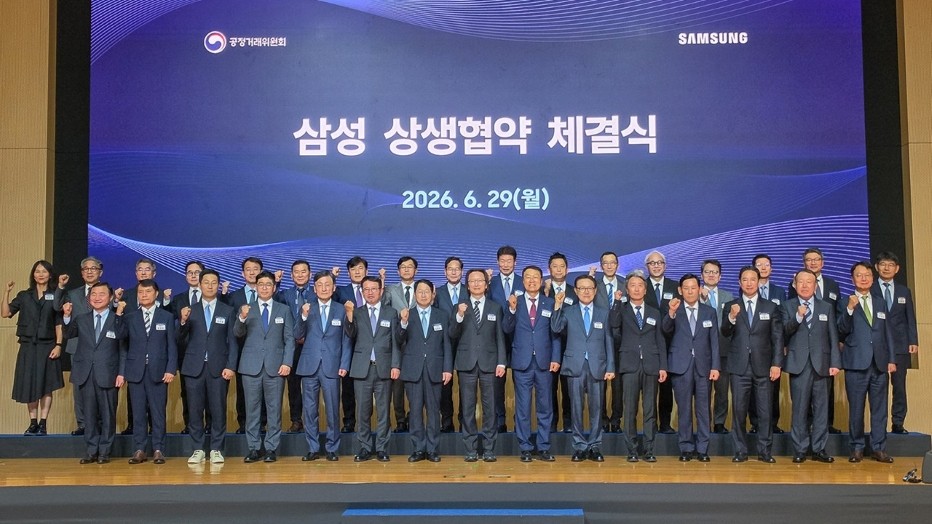
Samsung is expanding the scope of supplier support to second- and third-tier companies. On the 29th, Samsung Electronics and 11 affiliates signed an agreement to build a mutual-growth ecosystem with first-, second-, and third-tier suppliers at Samsung Electronics’ Suwon campus in Suwon, Gyeonggi Province. Roughly 6,700 suppliers in Samsung’s supply chain are eligible for support.
The agreement goes beyond simple business relationships and covers support for suppliers across funding, technology, and manpower. Its defining feature is the expansion of support, which had previously focused on first-tier suppliers, to second- and third-tier suppliers as well.
Samsung Electronics President Roh Tae-moon said, “The reason Samsung exists today is thanks to the blood, sweat, passion, and effort of many partner companies. As one shared destiny community that grows together, we will work to establish a higher level of partnership and ensure the warmth of mutual growth reaches second- and third-tier suppliers.”
◆ Support expands from first-tier to second- and third-tier suppliers
One reason large companies are stepping up support for suppliers is the changing industrial structure. Samsung’s core businesses, including semiconductors, displays, and batteries, depend on supplier technology and production stability. Strengthening suppliers ultimately leads to stronger finished-product competitiveness.
Analysts say competition has shifted from individual companies to entire ecosystems. Expanding support beyond first-tier suppliers to second- and third-tier suppliers reflects that recognition.
About 150 people attended the signing ceremony, including Fair Trade Commission Chairman Joo Byung-gi, representatives of the 11 affiliates, and major supplier executives. Chairman Joo said, “Samsung’s efforts for mutual growth will serve as a starting point for opening a virtuous cycle so that support flows without blockage to small and medium-sized suppliers.”
Kim Young-jae, chairman of the Mutual Growth Council, said, “I hope this becomes an opportunity for the government, large companies, and small and medium-sized enterprises to join hands and further strengthen the spirit of shared growth.”
◆ Support in three areas: funding, technology, and manpower
Support is divided into three areas: funding, technology, and manpower. In the funding area, Samsung operates 350 billion won in mutual-growth funds and ESG funds. It provides low-interest loans for suppliers’ operating capital, facility investment, and R&D funding.
Since November 2024, Samsung Display has also established a 100 billion won ESG fund and provides interest-free loans for workplace environmental and safety improvements and energy-saving investments. Samsung Electronics was the first Korean company to pay supplier transactions entirely in cash in 2005.
In the technology area, Samsung has been opening its patents free of charge since 2015. By last year, about 2,500 patents had been transferred to suppliers and small businesses. Together with the Ministry of SMEs and Startups, it is running a joint investment-type technology development project worth a total of 50 billion won. It also supports up to 1 million won per year in escrow costs so first- and second-tier suppliers can store technical data and trade secrets.
In the manpower area, Samsung operates supplier job fairs and a mutual-growth cooperation academy. It also provides separate consulting in AI, ESG, and automation, and helps strengthen supplier capabilities through about 300 free training programs annually.
◆ The challenge is ensuring effectiveness
In May, Samsung included “support for second- and third-tier suppliers and the establishment of an industrial accident fund” in its 500 billion won social contribution plan, and it will advance this plan in connection with the latest agreement.
Samsung Electronics became the first Korean company to receive the top rating for 14 consecutive years in the shared growth index evaluation by the Korea Commission for Corporate Partnership in October last year.
The challenge is whether support will truly reach second- and third-tier suppliers. The key issue is whether the funds and training will reach even smaller lower-tier suppliers and how their effectiveness will be monitored. The participating affiliates also said they would widen communication channels with suppliers and continuously review how well the support programs work.
The scope of cooperation between large companies and suppliers is expanding from first-tier partners to the entire supply chain. Whether this agreement leads to genuine shared growth will likely be judged by the changes that second- and third-tier suppliers actually feel.