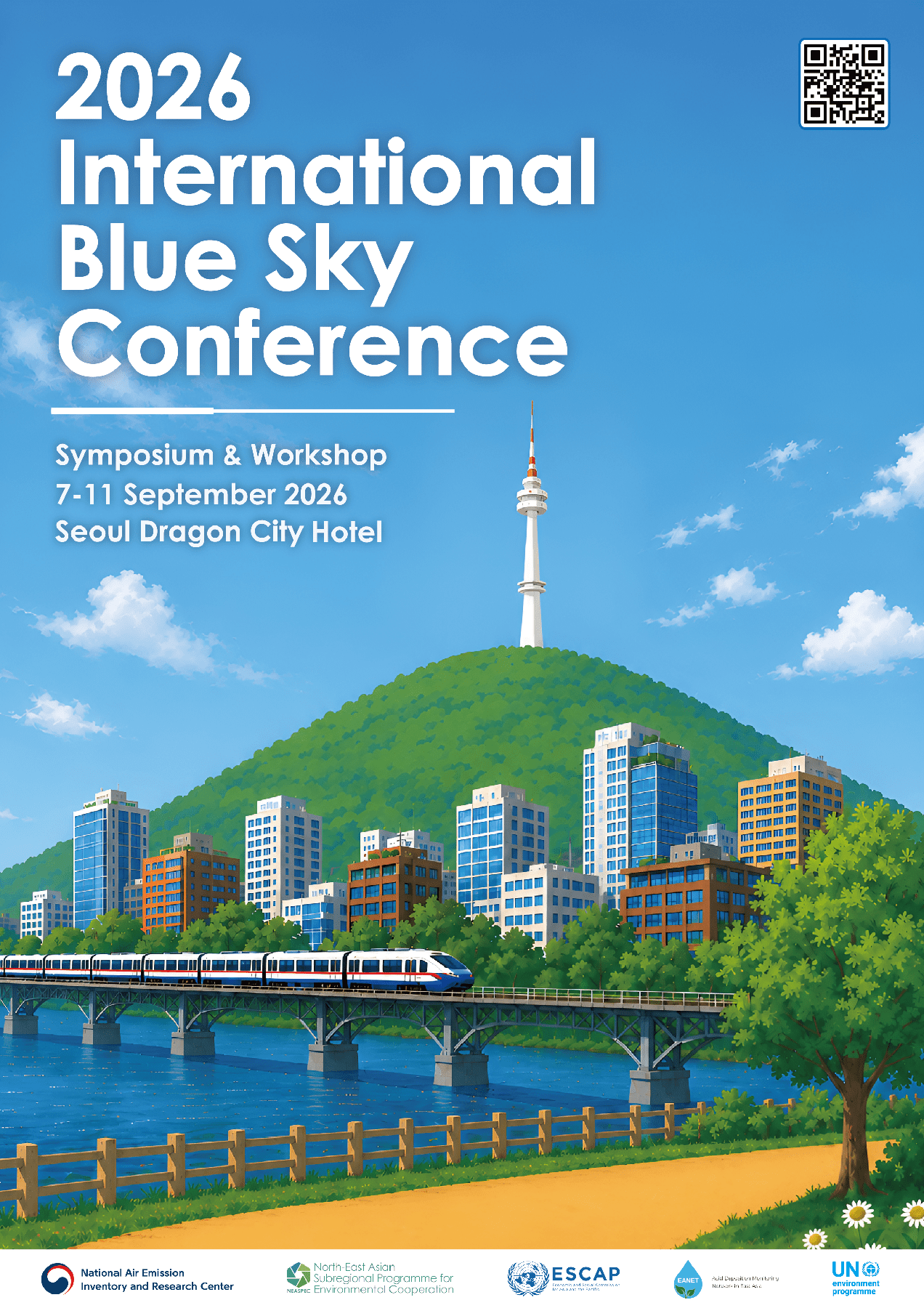
The National Air Quality Information Center under the Ministry of Climate, Energy and Environment will hold the “2026 International Blue Sky Conference” at Seoul Dragon City in Yongsan-gu, Seoul, from September 7 to 11. The event marks Blue Sky Day, which falls on September 7 each year. This year is its seventh edition.
Blue Sky Day is a UN observance proposed by South Korea. In November 2019, the UN General Assembly adopted a resolution designating September 7 as the International Day of Clean Air for blue skies, and the day has been observed since 2020. It is the first UN observance initiated by South Korea.
Since 2023, the National Air Quality Information Center has held international academic conferences together with the Northeast Asia office of the UN Economic and Social Commission for Asia and the Pacific (UN ESCAP). This year, the UN Environment Programme (UNEP) has joined for the first time, making it a tripartite co-host. The one-day symposium has expanded into a five-day event, including a training course for air quality management practitioners from across Asia.
On September 7, the Blue Sky Symposium will be held under the theme “Integrated Air Quality Management of Fine Dust and Ozone.” More than 200 policymakers and experts from China’s Ministry of Ecology and Environment and the Chinese Academy of Environmental Sciences, Japan’s Asian Center for Air Pollution Research, the World Health Organization (WHO), the UN Environment Programme, and others will attend, along with officials from Korea, China, Japan, and Malaysia.
Although fine dust and ozone are different pollutants, they share common causes. Nitrogen oxides and volatile organic compounds emitted by vehicles and factories can create ozone when exposed to sunlight, and can also react in the atmosphere to form ultrafine particles. Because reducing one can sometimes increase the other, the symposium will address the need for a management strategy that considers both together.
The symposium will be divided into three sessions. The first will cover integrated air quality management strategies that take into account the relationship between fine dust and ozone. The second will share case studies and research methods using artificial intelligence (AI) for analyzing ultrafine particles and ozone. The third will discuss ways to connect scientific research findings to actual air environment policy.
The symposium will be livestreamed on the National Air Quality Information Center’s official YouTube channel (@airgokr) starting at 9 a.m. on September 7.
From September 8 to 11, an “emissions inventory workshop” will follow. An emissions inventory is a list that organizes which pollutants are emitted, where, and in what amounts. Such a list is necessary to decide which sources should be reduced first and to measure policy effectiveness. Twenty-four air quality officials from 12 Asian countries, including Bangladesh, China, India, Indonesia, Mongolia, the Philippines, and Thailand, will participate.
On the first day, September 8, Junichi Kurokawa, head of the data management division at Japan’s Asian Center for Air Pollution Research (ACAP), will present on the development and use of East Asian emissions inventories. René Giffet, legal officer in the UN Environment Programme’s legal department, will explain the legal basis supporting emissions estimation systems. Yuchul, head of the emissions survey team at the National Air Quality Information Center, will introduce Korea’s history and use cases in national air pollutant emissions estimation.
On September 9, participants will be taught how to analyze the causes of air pollution and evaluate policy effects using the Air Emission Management System, the transport-sector emissions estimation system, and the air impact forecasting system operated by the National Air Quality Information Center. Professor Woo Jeong-heon of Seoul National University will explain regional emissions inventory development and policy support.
On September 10, participants will tour the control center of the Korea Environment Corporation in Incheon, the Advanced Monitoring Center of the National Institute of Environmental Research, and the Air Quality Forecast Center.
The National Air Quality Information Center was designated a technical center for the Northeast Asia Clean Air Partnership (NEACAP) in 2024. NEACAP is the air-sector consultative body within the Northeast Asian Environmental Cooperation Program, which was initiated by South Korea in 1992. South Korea, North Korea, Japan, China, Russia, and Mongolia participate, and the partnership has a Science and Technology Policy Committee and technical centers under it.
The center said that by co-hosting the emissions inventory workshop with the UN Environment Programme this year, it would pass on the emissions estimation system and forecasting tools developed in Korea to countries across Asia.
Oh Heun-jin, head of the National Air Quality Information Center, said, “I hope this event serves as a venue to share scientific solutions for managing ultrafine dust and ozone together, as well as new research methods using artificial intelligence. We will actively share Korea’s accumulated experience and technology in emissions estimation and analysis with Asian countries to expand the foundation for regional cooperation to improve air quality.”