
An icy object orbiting beyond Jupiter has been observed undergoing a transformation into a comet.
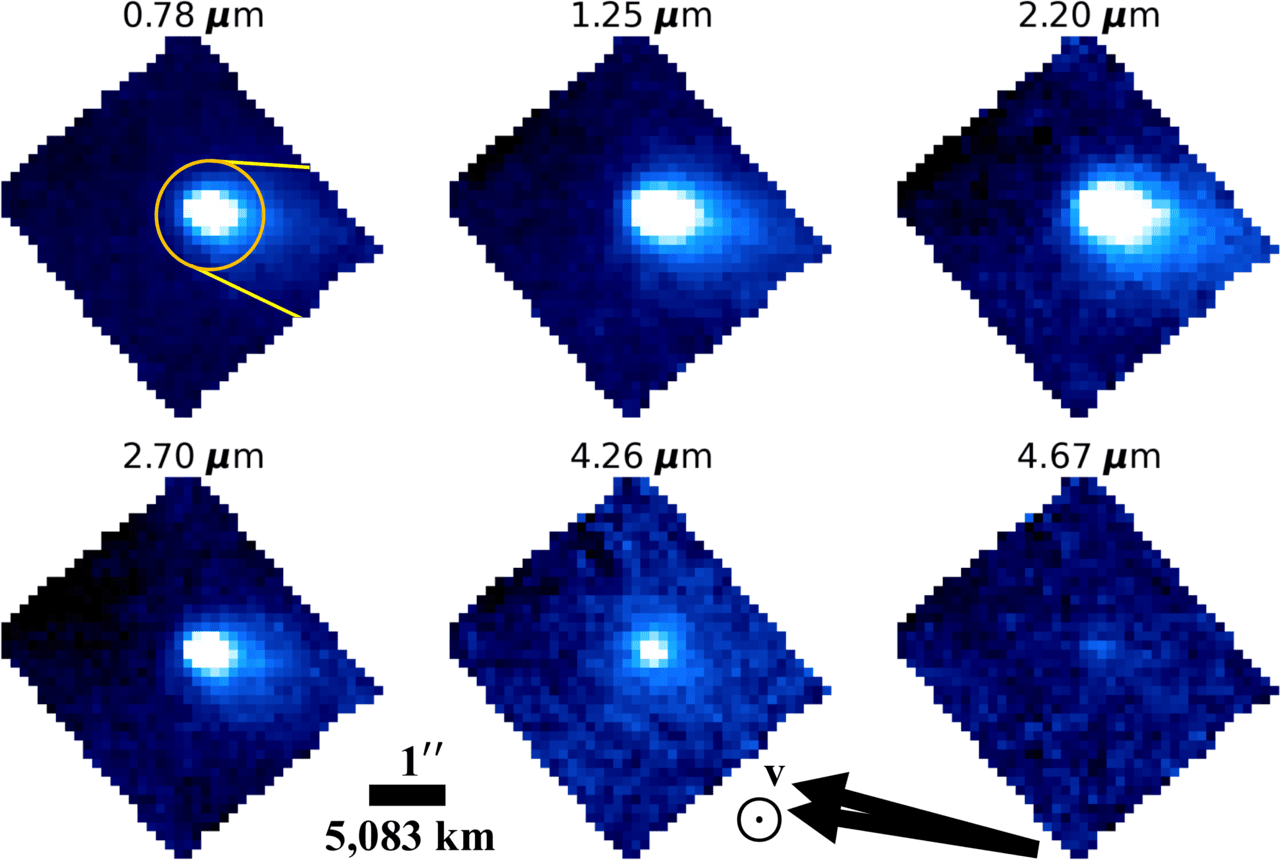
Researchers led by Charles Schambeau, an associate research professor at the Florida Space Institute at the University of Central Florida (UCF), said in a university release on the 1st (local time) that they had detected gas and dust outflow from the small body 450P/LONEOS. The team used NASA’s James Webb Space Telescope and the Gemini North Telescope in Hawaii. The paper was published in volume 7, issue 6 of the Planetary Science Journal of the American Astronomical Society in June.
450P was discovered in January 2004 by the Lowell Observatory Near-Earth-Object Search (LONEOS). The object’s name comes from that program. Its nucleus radius is about 1.8 kilometers. It orbits between Jupiter and Neptune every 22.4 years.
◆ What is a centaur object
In astronomy, small icy bodies that orbit between Jupiter and Neptune are called centaur objects. They behave unlike asteroids, sometimes venting gas like comets. The name comes from the half-man, half-horse creatures of Greek myth.
These objects are thought to have come from the Kuiper Belt beyond Neptune. The Kuiper Belt is a region of icy bodies outside the Solar System where Pluto belongs. Objects nudged inward by the gravity of giant planets become centaur objects.
The orbit of a centaur object intersects with at least one of the giant planets: Jupiter, Saturn, Uranus, or Neptune. As a result, their orbits are unstable on timescales of millions of years. Giant planets push them toward the Sun or eject them from the Solar System.
There is a hypothesis that objects pushed toward the Sun become Jupiter-family comets. Jupiter-family comets are comets with orbital periods of less than 20 years that are influenced by Jupiter’s gravity. “Centaur objects are thought to have come from farther out in the Solar System and to be transitional bodies that gradually evolve into Jupiter-family comets,” Schambeau said in the release.
◆ A 1992 close pass by Saturn changed its orbit
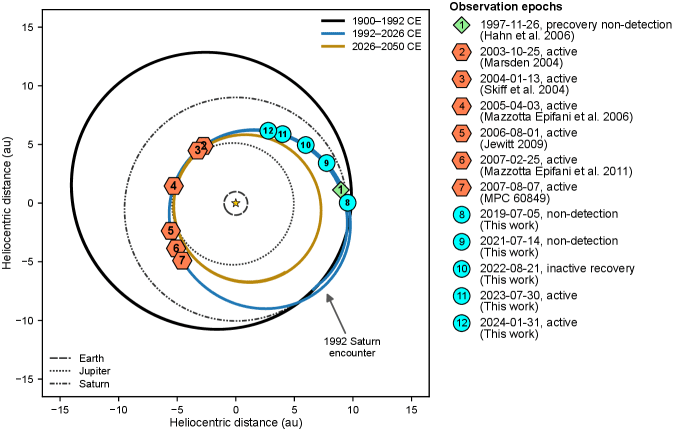
The trigger for 450P’s activity was Saturn. After tracing its orbit backward, researchers found that the object came within 4.6 million kilometers of Saturn in 1992. That is about 12 times the distance between Earth and the Moon.
This encounter greatly reduced its orbit. Its perihelion, the point closest to the Sun, is now 5.4 astronomical units, or about 810 million kilometers. One astronomical unit is roughly 150 million kilometers, the distance between Earth and the Sun. Jupiter’s orbit is 5.2 astronomical units.
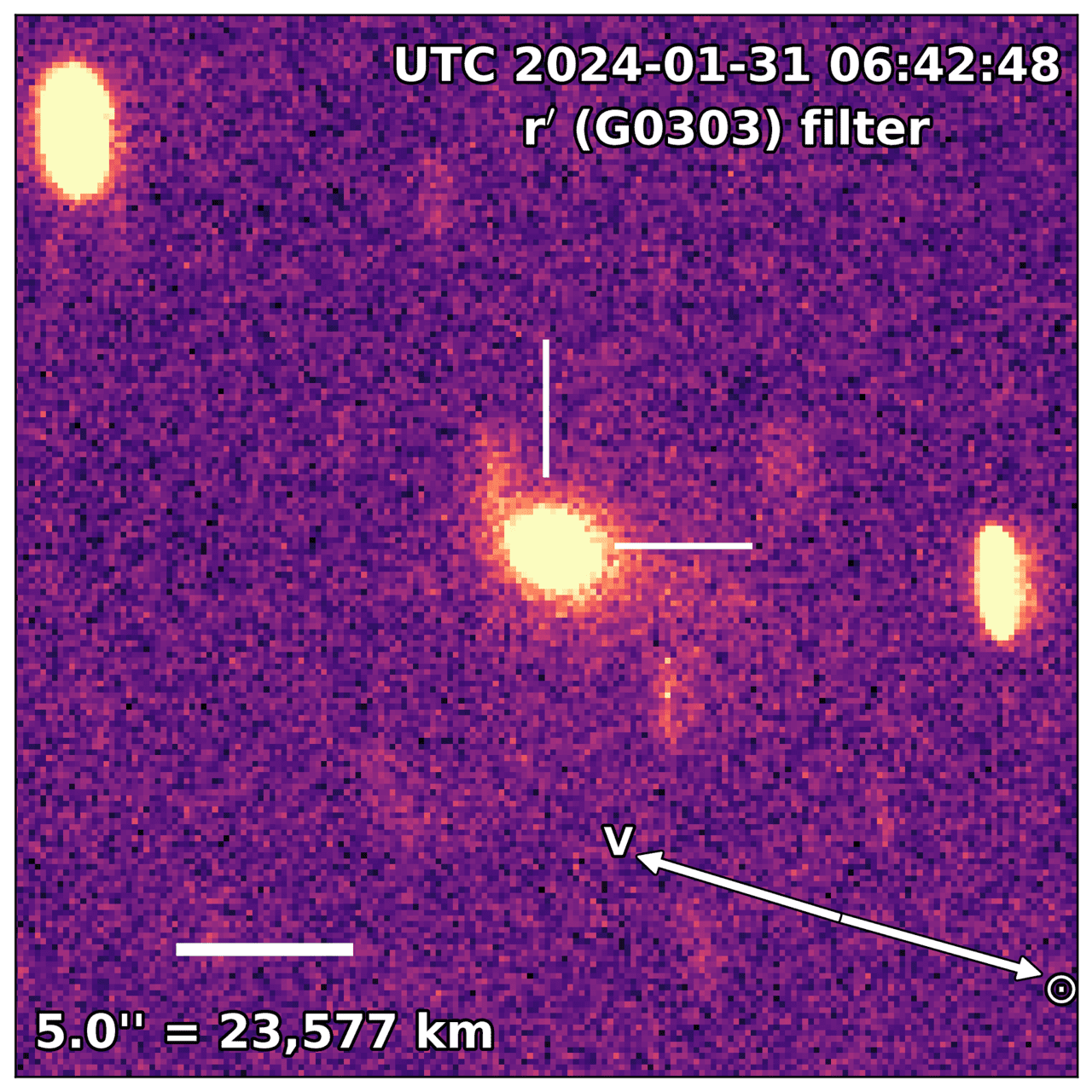
Researchers observed 450P from 2019 to 2024. During that period, the object moved closer to the Sun from 7.83 astronomical units to 7.24 astronomical units. In images from the Gemini North Telescope in 2022, no coma was visible. Later observations showed a gas and dust cloud around the nucleus.
“As solar heating increases, the nucleus surface and subsurface layers warm up,” Schambeau explained. “When those layers warm, volatile ice or trapped gas escapes and carries surface dust with it, forming a coma.”
◆ Carbon dioxide, not water, created the coma
The James Webb Space Telescope analyzed the composition of the coma and detected carbon dioxide gas. Water vapor and carbon monoxide were below detection limits.
Cometary activity occurs through sublimation, in which ice turns directly into gas without becoming liquid. Water ice must get relatively close to the Sun to sublimate. Carbon dioxide ice, commonly known as dry ice, turns into gas at much lower temperatures.
“At the distance where 450P is located, the nucleus is too cold for water-ice sublimation to be the main driver of activity,” Schambeau said. “The detection of carbon dioxide is an important clue to what is powering the coma.”
The Webb telescope also detected traces of crystalline water ice particles. Ice seen on Earth is crystalline, with molecules arranged in an orderly pattern. Ice in objects beyond the Solar System is mostly amorphous, with a disordered molecular structure. Amorphous ice contains many pores that trap gas. When heated, it transforms into crystalline ice and releases the trapped gas.
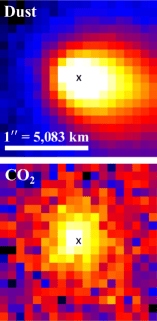
In the paper, the researchers concluded that crystallization occurring between minus 133 degrees Celsius and minus 113 degrees Celsius (140 to 160 K) likely triggered the release of carbon dioxide. “The presence of crystalline ice suggests that some of the ice in the coma did not remain unchanged since formation, but experienced heating or physical alteration,” Schambeau said.
“Studying objects like 450P helps connect the stages of small-body evolution,” he said. “By examining activity, surface properties, and volatile composition, we can understand how comet nuclei change as they migrate into the inner Solar System and how long they preserve primordial ice.”
450P will pass perihelion in July 2027. Its orbital period of 22.4 years exceeds the 20-year threshold for Jupiter-family comets, so it has not yet been classified as one.