
The Financial Times reports that former CEO Jensen Huang is discussing a possible return just four days after announcing his resignation. Silicon Valley figures and some shareholders are urging him to come back, while the U.S. government is calling on Nvidia to pursue a management overhaul by appointing an outsider.
Key points
▶ Former Nvidia CEO Jensen Huang is reportedly discussing the possibility of returning to the company just four days after announcing his resignation.
▶ The Financial Times reported on November 15, citing multiple sources, that Huang had discussed a possible return as CEO with people close to him.
▶ Prominent Silicon Valley figures are reportedly planning to form an organization to support his return and seek backing from the White House.
▶ An online petition calling for Huang’s return has drawn more than 150,000 signatures. Participants include Tesla and SpaceX CEO Elon Musk and Epic Games CEO Tim Sweeney.
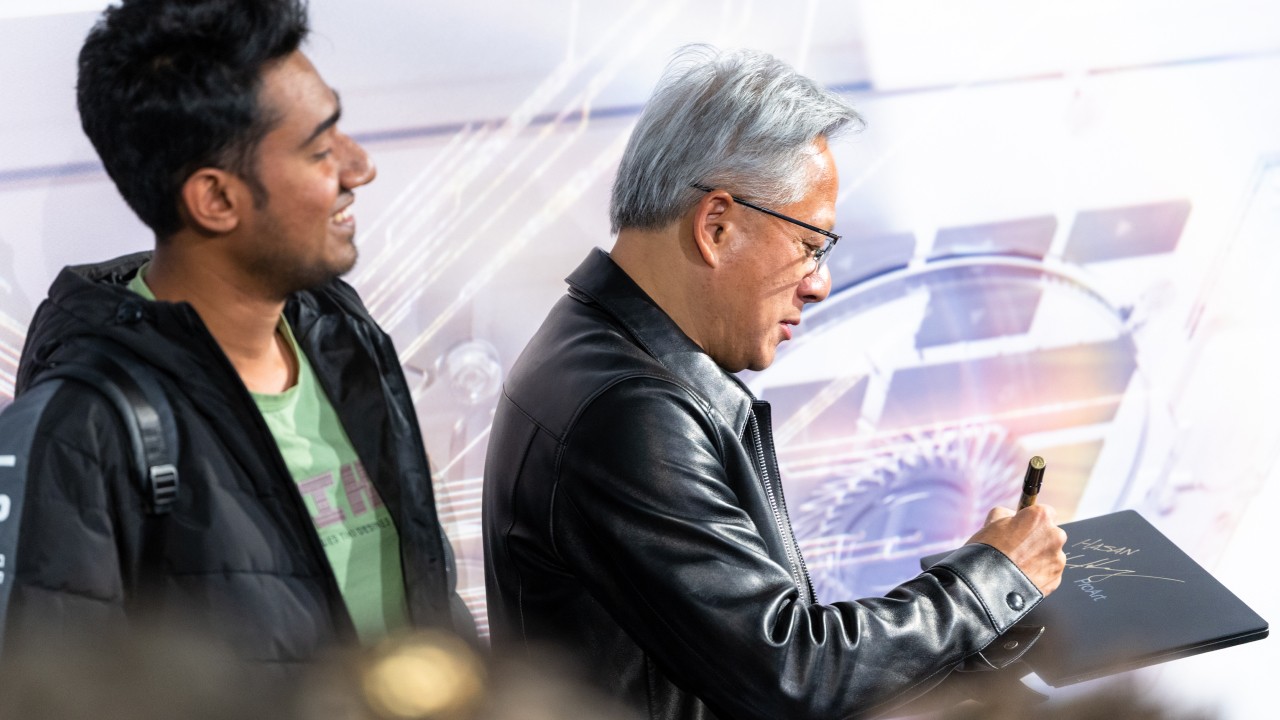
Former Nvidia CEO Jensen Huang is reportedly discussing a return to the company just four days after announcing his resignation. As prominent Silicon Valley figures and some shareholders call for his return, the U.S. government has urged Nvidia to pursue a management overhaul by finding a successor from outside the company.
The Financial Times reported on November 15, citing multiple sources, that Huang had discussed the possibility of returning as Nvidia CEO with people close to him.
According to the report, one of Huang’s associates said they were organizing a so-called “war room” made up of executives from major Silicon Valley companies. The group plans to persuade the board and secure White House support for Huang’s return.
The associate said Huang also supported efforts to bring him back. Huang and Nvidia have not issued an official statement on the reported discussions.
More than 150,000 sign petition for his return; prominent Silicon Valley figures join
Huang’s resignation as Nvidia CEO and director was officially announced on November 12. A filing with the U.S. Securities and Exchange Commission (SEC) stated that the board had accepted his resignation on November 11.
Huang co-founded Nvidia in 1993 and led the company for 33 years. Following his resignation, Chief Financial Officer Colette Kress became interim CEO, and the board began the process of selecting a successor.
Calls for Huang to return have been growing among technology industry figures and investors.
More than 150,000 people have signed the online petition “Stand with Jensen.” It calls on Nvidia’s board to reinstate Huang while an independent investigation is conducted, or explain why his return would not be in the company’s best interests.
Signatories include prominent Silicon Valley figures such as Tesla and SpaceX CEO Elon Musk, Epic Games CEO Tim Sweeney, and Y Combinator CEO Garry Tan. People identifying themselves as current or former Nvidia employees have also signed.
Major investors have also urged the board to proceed cautiously in selecting a successor. Brad Gerstner, CEO of Altimeter Capital, and Gavin Baker, founder of Atreides Management, sent a letter to the board urging it to consider all options, including Huang’s return.
They reportedly said the board should not rush to appoint a new CEO and should include the possibility of Huang’s return in its deliberations.
Bessent: “The board should look outside the company for a CEO”
In contrast to calls for Huang’s return, the U.S. government has raised the need for a leadership change involving an external candidate.
U.S. Treasury Secretary Scott Bessent said on November 15 during an appearance on Fox News’ “Sunday Morning Futures” that Nvidia’s board should look outside the company for its next CEO.
Bessent called for an outside hire, saying a sweeping overhaul was necessary in light of what had happened inside Nvidia.
He also raised the issue of Nvidia’s compliance with U.S. export controls on semiconductor sales to China, saying it was necessary to determine whether the company had properly followed the restrictions.
Bessent gave Nvidia’s board and its outside legal counsel ten days to respond about the company’s internal controls for complying with export restrictions.
The U.S. government’s concerns have broadened beyond controversy over Huang’s private life to include Nvidia’s export-control practices and corporate governance.
Investigation also underway into allegations involving semiconductor exports to China
Huang’s resignation came amid controversy over his private life as well as national security concerns related to China. He came under scrutiny after reports about his relationship with a person whom U.S. intelligence officials suspect may have ties to Chinese intelligence agencies.
The person has been identified as Alice Huang, a former executive at Singapore-based Megaspeed. Allegations have also emerged in the United States that Nvidia chips may have reached China through Megaspeed.
Nvidia’s board had already decided to appoint outside legal experts to conduct an independent investigation into the allegations.
U.S. lawmakers are also pursuing an investigation into the flow of Nvidia’s advanced chips to China and the company’s compliance with export controls. Some lawmakers have requested explanations from Nvidia executives and the submission of relevant documents.
To date, it has not been established that Huang cooperated with Chinese intelligence agencies or that Nvidia deliberately violated export-control rules. Megaspeed has also said it would cooperate with any appropriate U.S. government investigation.
ARM CEO also mentioned as a candidate
Nvidia’s board officially said after Huang’s resignation that it would consider both internal and external candidates.
The Financial Times previously reported that Nvidia’s board had approached Rene Haas, CEO of British chip-design firm ARM, about the selection of the company’s next CEO. The search for a successor among external candidates is proceeding separately from discussions about Huang’s possible return.
Nvidia plans to maintain its existing business operations and product-development plans under interim CEO Kress. When Huang’s resignation was announced, newly appointed board chair Harvey Jones expressed confidence in Kress and the management team, emphasizing that the company would meet its commitments to customers and keep product development on schedule.
Nvidia is scheduled to report results for the third quarter of fiscal 2027 on November 17 in the United States, which will be early on November 18 in Korea.
Alongside demand for AI semiconductors and the outlook for its data-center business, attention is expected to focus on what the company says about its leadership structure following Huang’s resignation.
Nvidia is a major customer for South Korean semiconductor companies, including Samsung Electronics and SK hynix, for high-bandwidth memory (HBM). The domestic semiconductor industry will also be watching whether product-development and supply-chain plans remain unchanged following the leadership transition.