
One-minute news
▶ Google unveiled its new artificial intelligence (AI) model, Gemini 4 Neon, on Nov. 18 (local time).
▶ The model sits between Carbon, designed for difficult tasks, and Hydrogen, built for fast, everyday work.
▶ Neon is priced at $3 per million input tokens and $15 per million output tokens, and can process up to one million tokens at once. Google partner Glean said its own tests found Neon delivered results equal to or better than Carbon’s at three times the speed and 60% of the cost.
Google unveiled Gemini 4 Neon on Nov. 18 (local time), a new artificial intelligence (AI) model designed to handle complex software development, corporate work and scientific research quickly.
Google DeepMind said Neon offers faster performance and greater cost efficiency while retaining reasoning capabilities close to those of its top-tier models. The model is now available through APIs for developers and services for businesses, and is also being rolled out to Google AI Pro and Ultra subscribers.
Rather than focusing on answering questions like a chatbot, Neon is designed to act as an AI agent that carries out real tasks through multiple steps. It can analyze lengthy documents, modify program code and use several tools to complete work from start to finish.
◆ Neon sits between Carbon and Hydrogen
Google divides its Gemini 4 models according to their intended uses. Carbon is aimed at complex, time-consuming projects, while Hydrogen handles quick responses and everyday tasks. Neon, the newly unveiled model, is designed for work that requires strong reasoning as well as speed and cost efficiency.
For businesses using AI, operating costs matter as much as model performance. Using the most expensive model every time to analyze thousands of customer inquiries or repeatedly process large volumes of documents can create a significant financial burden.
Neon is designed to handle such tasks at relatively low cost. Google said it offers performance close to that of its top-tier models for complex coding, analysis and scientific research.
Partners have also reported improvements in speed. Glean, an enterprise AI search company, said its own tests found that Neon delivered results equal to or better than Carbon’s at three times the speed and 60% of the cost.
◆ $3 per million input tokens
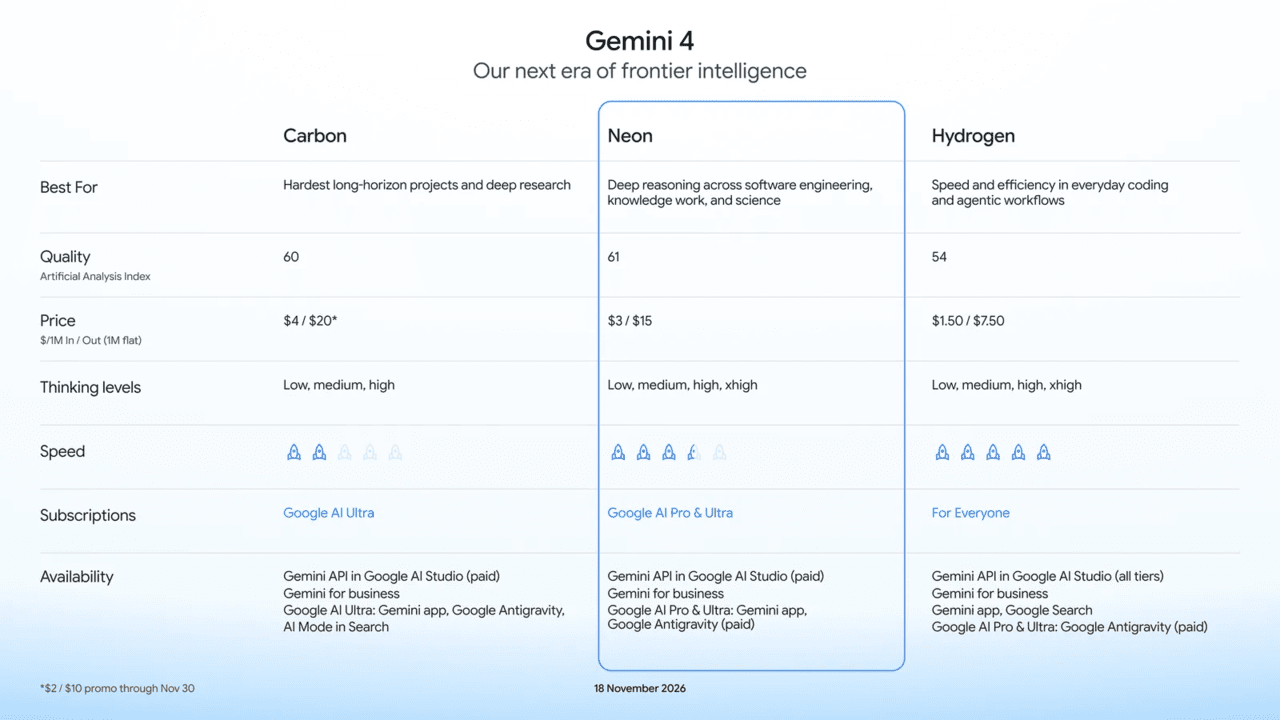
Neon’s API costs $3 per million input tokens and $15 per million output tokens. Inputs include questions and documents sent to the AI, while outputs are the answers and results it generates.
A token is a basic unit AI uses to process text. Tokens do not correspond exactly to characters or words, and the number required varies depending on the language and content.
Cached input, which applies when the same input is reused, costs $0.15 per million tokens—95% less than the standard input rate. This can help businesses cut costs when repeatedly consulting the same rulebook or technical documents.
When comparing Neon with Carbon, it is important to distinguish between standard and promotional prices. Through Nov. 30, Carbon is available at a discounted rate of $2 per million input tokens and $10 per million output tokens. Comparing the current per-token prices, Neon is 50% more expensive than Carbon. Carbon’s standard rates are $4 for input and $20 for output per million tokens. After the discount ends, Neon will be 25% cheaper than Carbon for both input and output.
Google’s claim of cost efficiency is based not only on the price per token but also on the total cost of completing a task. This is because the number of tokens generated and the time taken can vary between models performing the same task.
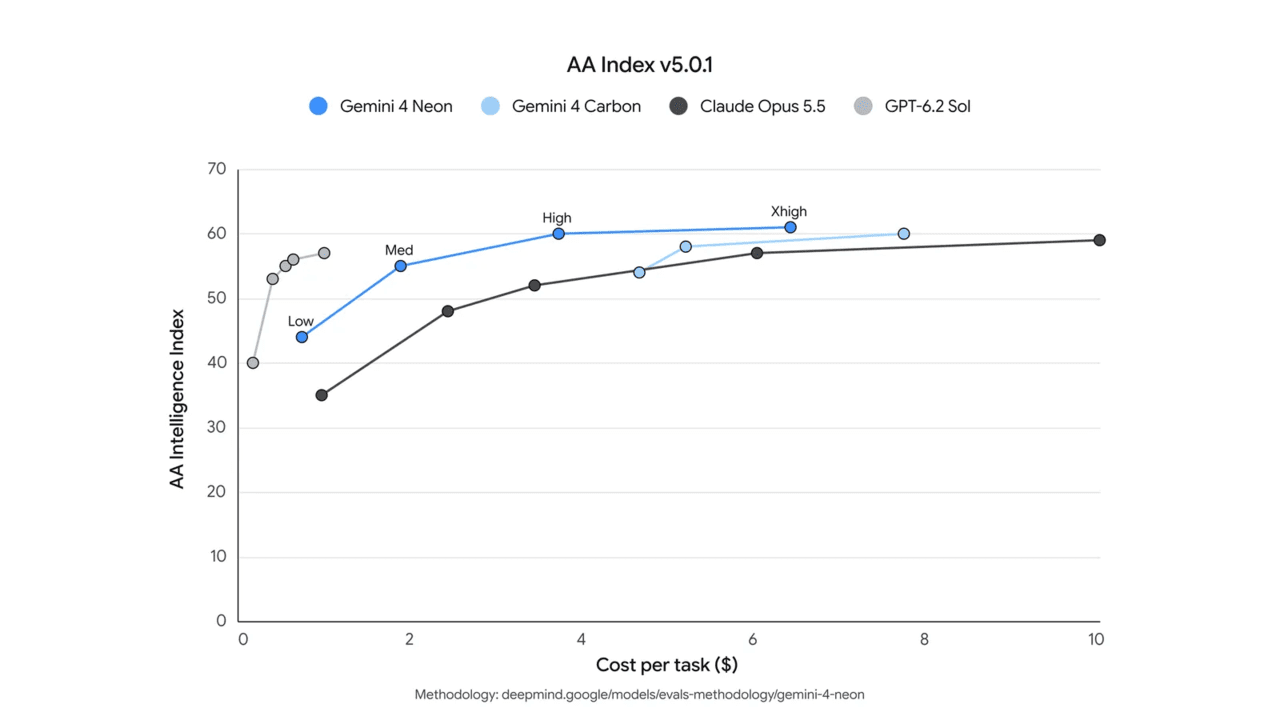
An analysis published on Nov. 18 by Artificial Analysis also found that Neon reduced the cost and time required per task compared with Carbon. At the highest reasoning level, Neon used an average of $6.44 per task, while Carbon cost $7.76 at its standard rate. Tasks took about 21 minutes with Neon and about 36 minutes with Carbon.
Neon can process up to one million input tokens at once. This is known as the “context window”—the amount of material, such as lengthy documents, code, images, audio and video, that can be provided for a single task.
For example, a business could submit accounting spreadsheets, PDF contracts and sales charts together and ask the model to check whether the figures match. This can reduce the need to split materials into multiple submissions.
◆ Four adjustable reasoning levels
Neon offers four reasoning levels that determine how deeply the AI analyzes a problem before generating an answer: low, medium, high and extra high (xhigh).
The low setting is suited to relatively simple tasks, while the higher settings are for reviewing multiple conditions or solving complex problems. Increasing the reasoning level generally requires more computation and tokens, which can increase processing time and cost.
The default setting is “high.” Google said that at this level, Neon’s cost per task is 32% lower than Carbon’s. The top setting, “extra high,” is intended for complex software development, scientific research and multistep analysis.
According to Google, at the default reasoning level Neon’s cost per task was about 50% to 80% lower than that of leading competitors’ top models. Even at the highest reasoning level, Google said, Neon’s costs were at least 36% lower than those of the models it compared.
◆ No. 3 in overall intelligence, No. 1 in coding agents
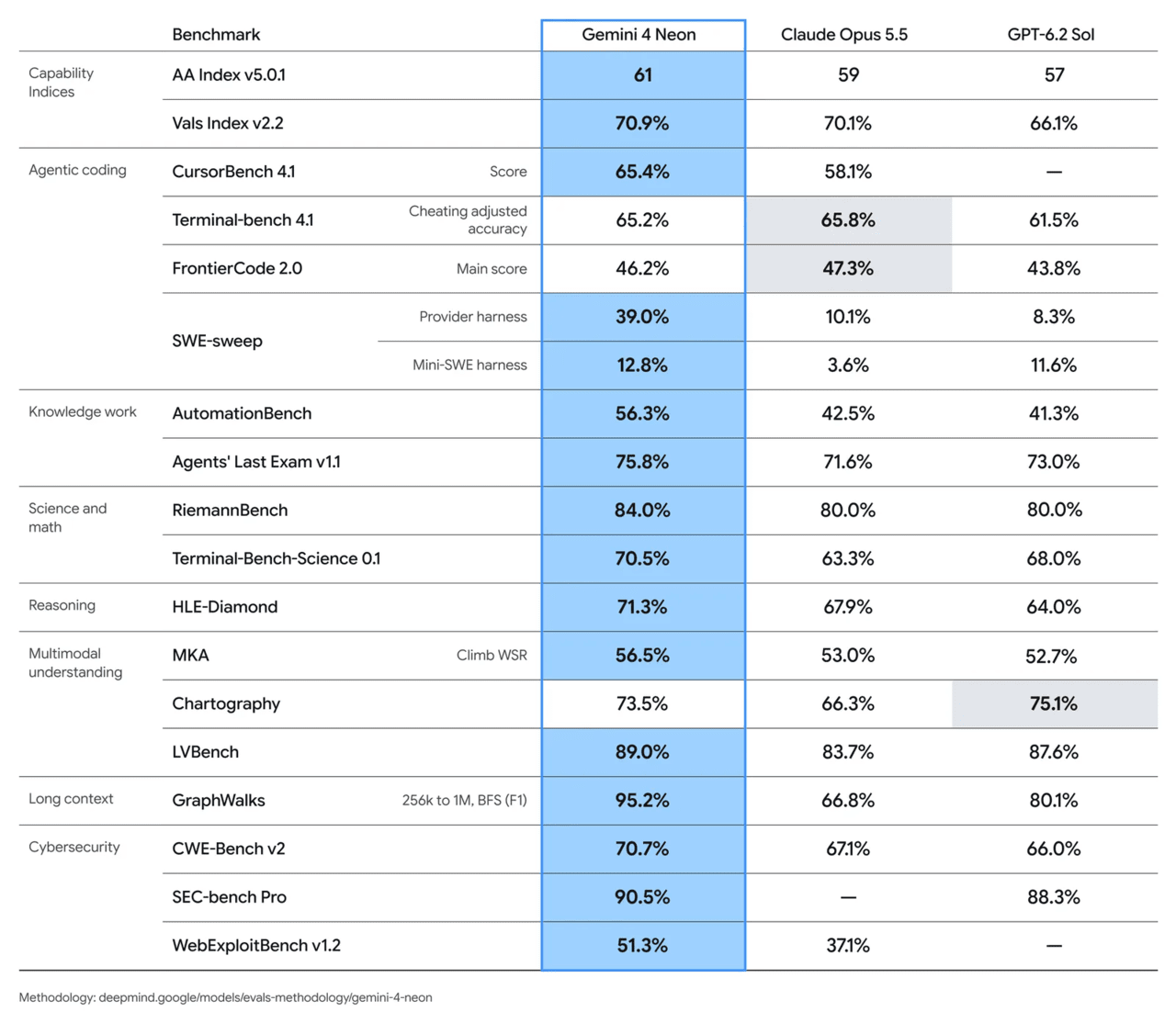
Neon ranked among the top performers in several major AI evaluations. It scored 61 on Artificial Analysis’ Intelligence Index at the highest reasoning level, placing it third overall among models—one point ahead of Carbon.
According to Google, Neon scored 58.6 and ranked first on the same organization’s Coding Agent Index. The evaluation measures an AI’s ability to use real development tools to modify programs and solve problems.
Neon also earned high marks in evaluations of workplace tasks. It placed second, with a score of 70.9%, on the Vals Index, which measures performance in specialized work such as law and finance. It ranked first in separate tests of legal research and tax work.
Neon ranked first on AutomationBench, operated by workplace automation company Zapier, with a score of 56.3%. The benchmark evaluates the ability to connect multiple programs and carry out real-world workflows.
In Vending-Bench 2, a long-term simulation of running a vending-machine business, Neon ranked first with $16,843 in profit. The evaluation measures an AI’s ability to manage decisions involving inventory, pricing and purchases over an extended period.
Neon scored 1,336 and placed second on Agent Arena, which evaluates more than 4,200 real AI-agent tasks. It also ranked second in its ability to incorporate changes to a user’s instructions during a task.
Neon scored 73.5% on Chartography, a specialized chart-interpretation test; 84.0% on the mathematical reasoning evaluation RiemannBench; and 70.5% on a terminal-task test in the sciences.
◆ Editing multiple files and directing AI agents
Google identified software development as one of Neon’s main use cases. The model can find and fix errors across multiple files or clean up existing code. Google said it was designed to make targeted changes and avoid unnecessary edits.
Neon scored 65.2% on Terminal-Bench 4.1, which evaluates terminal skills. It scored 46.2% at the default reasoning level on FrontierCode 2.0, a benchmark for complex coding tasks.
Results on the code-editing test SWE-Sweep varied considerably depending on the execution environment. Neon scored 12.8% with the standard evaluation tool, but its score rose to 39.0% in Google’s Antigravity development environment. This shows that performance can vary depending on the tools connected to an AI model and how tasks are executed.
Neon can also direct other AI agents. In Google Antigravity, it can break complex work into multiple steps and assign them in parallel to subordinate agents using the Hydrogen model. For example, when developing a large-scale program, Neon can determine the overall structure and sequence of tasks while Hydrogen agents build individual features.
Google said it had improved Neon’s ability to avoid rereading files it had already checked during long tasks and to share progress. It has also strengthened the model’s ability to maintain a workflow when summarizing earlier information in lengthy conversations.
◆ From a ski simulator to a 100,000-cell spreadsheet
Google also released demonstrations of Neon’s ability to handle complex tasks. In Antigravity, Neon created a first-person ski simulator using real terrain data from Chamonix and the Mont Blanc area in France. Using WebGL2, a web graphics technology, it generated 10,200 lines of graphics code and a ski physics system that calculates 120 times per second.
The simulator also included tracks left in the snow, avalanches and spatial audio. Google said it was created without pre-made graphics assets.
In another demonstration, Neon transformed a single photograph into a Google spreadsheet made up of 100,000 cells. Instead of inserting the image file, it used more than 500,000 formulas to create outlines, depth and lighting effects.
Google said these examples show that Neon can be used not only to generate code but also for lengthy tasks that combine multiple tools.
◆ Google unveils dedicated model for finding and fixing security vulnerabilities
Google also unveiled Gemini 4 Neon for Cyber, a model specialized in cybersecurity. It focuses on finding software vulnerabilities, verifying whether they can be exploited in real attacks and fixing the affected code.
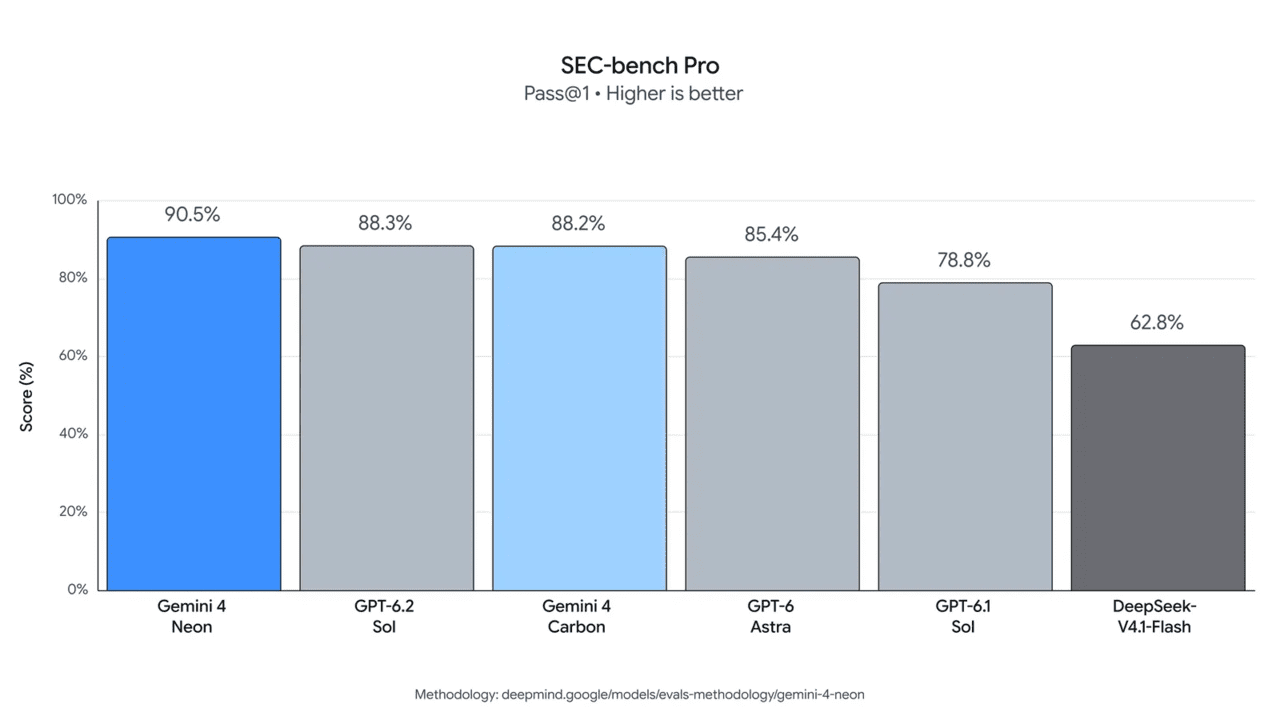
According to Google, the model scored 90.5% on SEC-Bench Pro, a vulnerability-detection test. Its cost per task was about half that of the large models used for comparison.
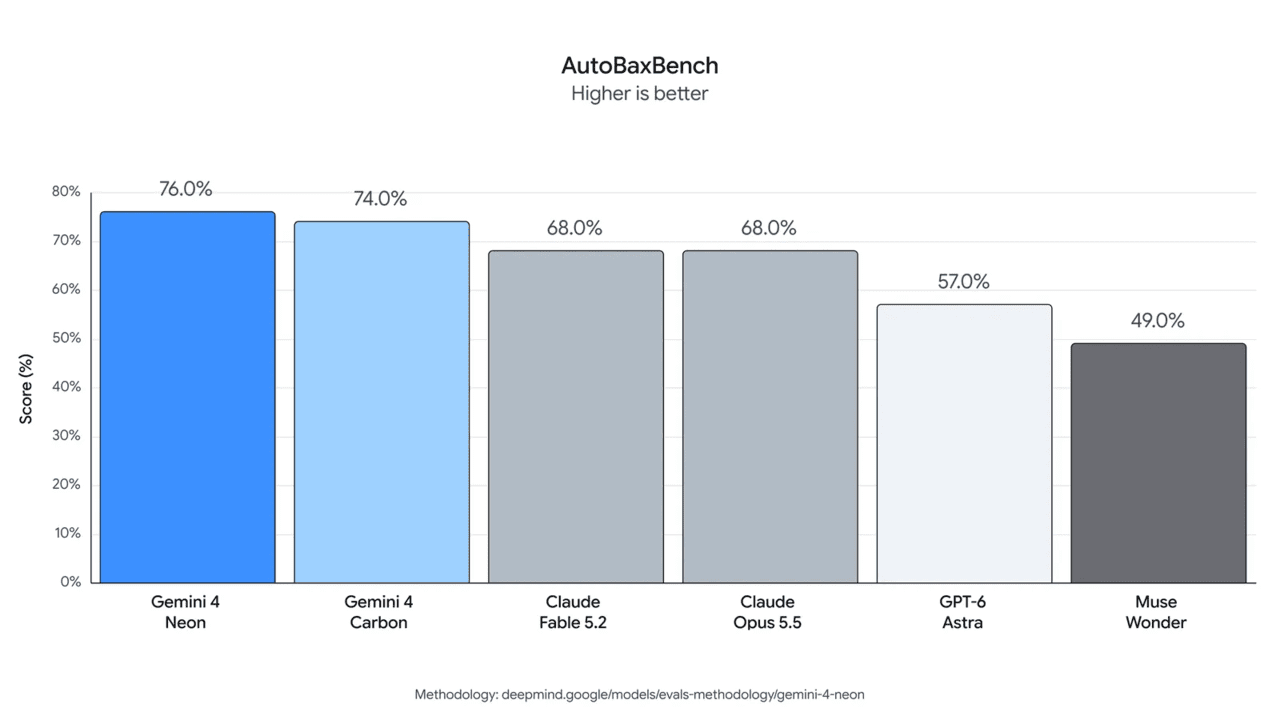
Neon scored 51.26% on WebExploitBench 1.2, which evaluates the ability to exploit vulnerabilities in web applications. On AutoBaxBench, which assesses the ability to write secure code from the outset, it scored 76% at the most difficult level.
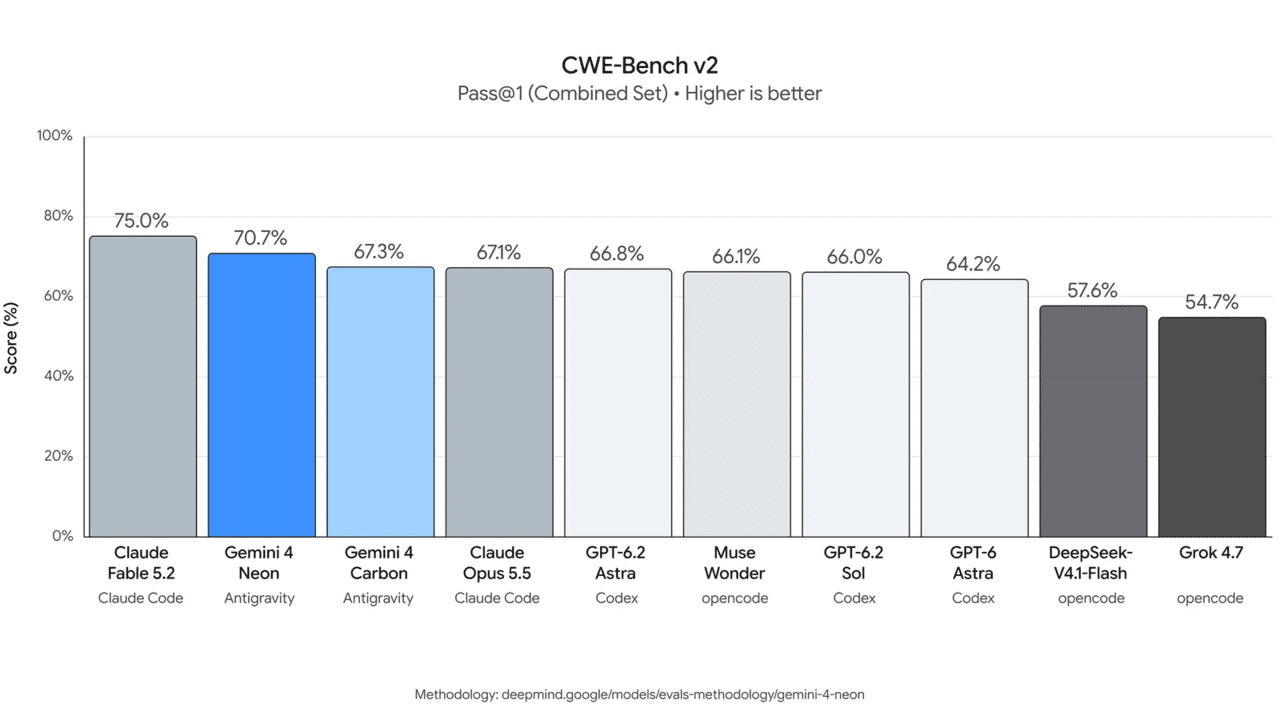
Neon scored 70.7% on CWE-Bench v2, which tests whether a model can fix the root causes of vulnerabilities. Google said this was a 3.4% improvement over Carbon. The company will not make the model available to the general public. It plans to roll it out through its Project Fairwind program for vetted cyber defense organizations.
The ability to find security vulnerabilities and determine whether they can be exploited can be used for attacks as well as defense. Google has therefore restricted access to the model.
◆ Initially available to developers, businesses and paid subscribers
Neon is available through the paid Gemini API in Google AI Studio and Android Studio. Businesses can use it through Gemini for Business and Google Antigravity.
Individual users with Google AI Pro or Ultra subscriptions can select Neon from the model menu in the Gemini app. It is also available to subscribers of both plans in Google Antigravity.
Google said Neon is suited to tasks that involve comparing and analyzing multiple documents. Examples include reviewing utility bills to identify the cause of a price increase or cross-checking multiple receipts to prepare materials for a refund request.
Google has not announced when Neon will be available to free users. The cybersecurity-focused model will initially be available to organizations that qualify for the Project Fairwind program.
Google plans to use Neon to offer reasoning capabilities on par with its top-tier models at greater speed and lower cost. As AI agents capable of handling complex tasks become more prevalent in business operations and software development, actual processing costs and the ability to complete tasks—not just model performance—are emerging as key competitive factors.