
The Ministry of Foreign Affairs held the “2026 MIKTA Young Leaders Camp” from the 8th to the 10th, inviting 30 undergraduate and graduate students from MIKTA member countries. Six participants each came from Korea, Mexico, Indonesia, Türkiye, and Australia. The program included expert lectures, a mock foreign ministers’ meeting, an exchange session with MIKTA diplomats stationed in Korea, and fieldwork.
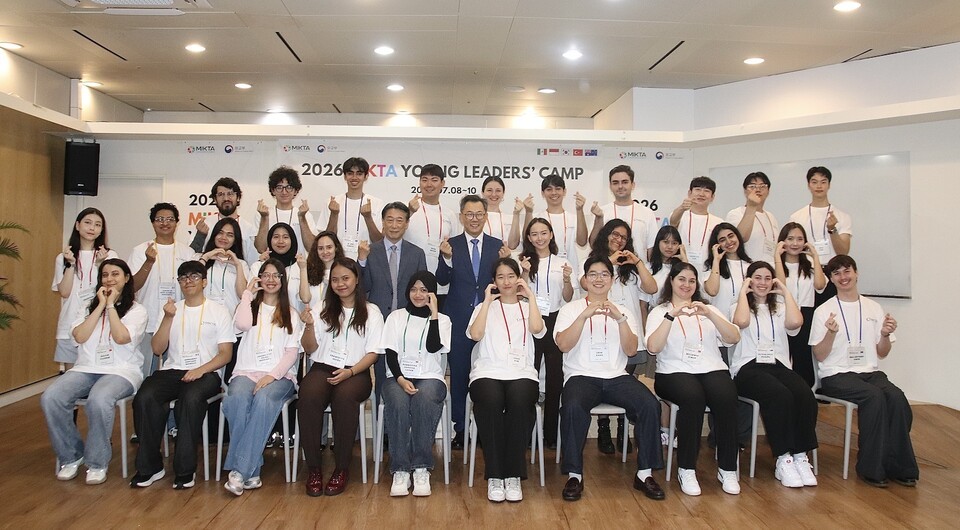
MIKTA may be an unfamiliar name, but its composition reveals its character. The name is formed from the initial letters of Mexico, Indonesia, Korea, Türkiye, and Australia.
The five countries launched the consultative body in September 2013 on the sidelines of the 68th United Nations General Assembly. They differ in continent, culture, and security environment. What they share is one thing: they are not major powers, but middle powers with a certain level of capability and responsibility on the international stage.
The fact that their regions do not overlap has instead become a strength. It allows them to avoid being confined to a particular regional perspective and to serve as a bridge between developed and developing countries. At the MIKTA leaders’ meeting held in November last year on the sidelines of the G20 summit in South Africa, the five leaders also assessed that MIKTA has served as a bridge between developed and developing countries, and agreed on the importance of restoring multilateralism amid geopolitical tensions and global economic uncertainty.
In an era of intensifying U.S.-China rivalry and increasingly difficult consensus within international organizations, the body has been sustained for 13 years by the recognition that middle powers need a channel through which to pool their voices.
This year’s camp theme was climate action. In February, Korea handed over the chairmanship it had held for a year to Australia, which designated climate action as one of its key priorities for the year. The camp theme was aligned with that agenda.
On the 8th, the first day, Jang Wook-jin, Coordinator for Global Multilateral Diplomacy at the Ministry of Foreign Affairs, said in his opening remarks that young people’s perspectives are essential in responding to global issues. Former U.N. Ambassador Oh Joon spoke on “Multilateralism and the Role of Youth,” and Professor Kang Sun-joo of the National Diplomatic Academy gave a lecture titled “MIKTA in the Geopolitical Era.”
On the 9th, the second day, participants took on the roles of foreign ministers from their respective countries and held a mock foreign ministers’ meeting. After negotiating climate-change response measures, they issued a joint declaration. In the process, they directly experienced the coordination required for countries with differing interests to produce even a single line in a joint statement. They also met with MIKTA diplomats stationed in Korea and freely asked and answered questions they had long wanted to raise about diplomatic careers.
On the 10th, the final day, Choi Won-seok, Director-General for International Organizations and Nuclear Affairs at the Ministry of Foreign Affairs, presented the Foreign Minister’s Award to the best team at the closing ceremony. After the ceremony, participants visited the DMZ to see for themselves the history of division and the value of peace. The program began with the shared global issue of climate and ended at the most concrete site on the Korean Peninsula.
This camp is not new; Korea has held it every year since 2016. Over the past 10 years, participants have spread out into diplomacy, academia, and civic society in their respective countries, becoming human assets who know MIKTA.
The effort put into youth exchange is tied to the nature of the body itself. MIKTA is a loose consultative framework without a treaty or a permanent secretariat. Its activities center on joint statements and coordination rather than binding agreements.
Foreign Minister Cho Hyun’s remarks during the handover of the chairmanship in February—that MIKTA “must evolve into a cooperative body that can create practical value and produce concrete results beyond shaping discourse”—also pointed to these limitations. The weaker the institutional framework, the more sustained trust between people determines continuity. In that sense, networks among future generations are the body’s foundation.
Participants said after the camp that it had been an opportunity to think together about climate change, a shared challenge, and to deepen bonds as young people. Whether the friendships formed over the past three days will later become the basis for meeting again at the negotiating table among the five countries remains a question for these young participants to answer.