
As the United States moves to block Chinese robots, Chinese robots have quietly been spreading through logistics warehouses and factories in South Korea.
The U.S. Federal Communications Commission (FCC) added foreign-made advanced robotic devices and power conversion equipment to its import restriction list on the 28th. The targets include humanoid robots, quadruped robots, and mobile robots that move on wheels or tracks. The measure took effect immediately and applies to new models that have not yet received sales approval in the United States.
◆ Robots that transformed British warehouses, but the U.S. saw a security risk
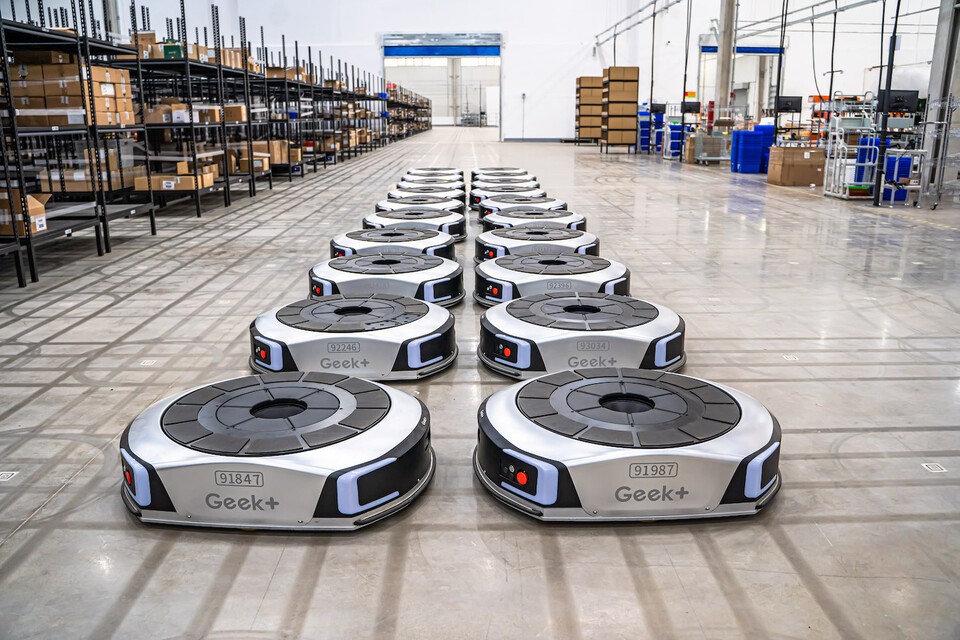
Chinese logistics robots from Geekplus are installed in a warehouse. (Photo=Geekplus) The BBC visited a Geekplus factory in Hefei, Anhui Province, China, and reported on the production process for the company’s warehouse robots.
Geekplus is the world’s No. 1 company in autonomous logistics robots and was listed on the Hong Kong stock exchange last year. In the United Kingdom, Tesco, Asda, and Next use Geekplus robots, and its partner MotionTech has deployed more than 2,000 units across 10 warehouses.
The flat silver robots slide under shelves, lift them whole, and carry them to workers. Unlike older automation that required conveyor belts, deployment is completed simply by attaching QR codes to the floor and installing safety fences. The fact that there is no need to rebuild the facility is cited as a reason for the rapid spread.
The FCC took issue with connectivity. It said robots made overseas could be remotely controlled or used for surveillance and could become a pathway for cyberattacks. An incident earlier this year in which a robot vacuum cleaner was remotely breached, leading to the leakage of camera footage, microphone audio, and home layout information, was cited as evidence. Companies that manufacture in the United States are exempted.
China is estimated to account for about 85% of the global humanoid robot market. The Chinese government pushed back, saying the move was trade politicization under baseless pretexts. Analysts say the timing, ahead of President Xi Jinping’s planned visit to the United States in September, could strain bilateral relations.
◆ There is no review rule in South Korea, and robots see more than just warehouses
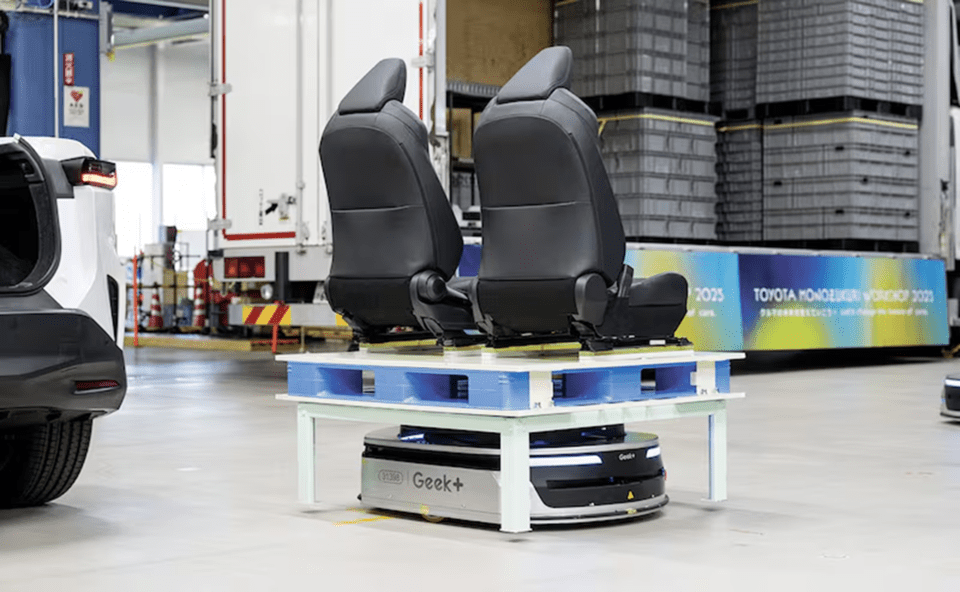
Geekplus logistics robots moving automotive parts. (Photo=Geekplus) After establishing its Korean subsidiary in Seoul in 2022, Geekplus has supplied more than 10,000 robots cumulatively in South Korea.
The 128 robots at CJ Logistics’ Gunpo logistics center reportedly cover 83% of the center’s area and process 30,000 orders a day. Sales at the Korean subsidiary doubled last year, and its applications are expanding to automotive, secondary battery, and semiconductor manufacturing sites.
South Korea has not yet established security certification or public procurement restriction rules for robots. While there has long been discussion about limiting the use of Chinese drones by public institutions, industrial and logistics robots remain only at an early stage of discussion.
Warehouse robots do not handle only the location of goods. Using cameras and distance sensors, they scan the inside of facilities and exchange inventory and shipment data in real time with warehouse management systems. Shipment flows can reveal business sales trends, and records of worker movement become information about workforce operations.
In semiconductor and secondary battery plants, the paths that robots travel contain the layout of equipment and the sequence of processes. It has also been pointed out that devices with communication functions can connect to the outside world through remote firmware update paths.
In the security industry, some say that management systems should come before import bans. The proposal is to set procurement standards for robots entering national critical facilities and public logistics infrastructure, and to include overseas data transfer, remote access authority, and firmware update procedures as certification items.
There is also discussion of inspecting already installed units. The point is not to argue that robots should not be brought in, but to establish rules first for how they should be used.
◆ The paradox of being No. 1 in robot density: the weak point is parts
South Korea is the country that uses the most robots. According to a report released in January this year by the International Trade and Commerce Research Institute of the Korea International Trade Association, robot density—the number of industrial robots per 10,000 workers—stands at 1,012, the highest in the world, and the number of new installations ranks fourth globally.
The problem comes after that. While 71.2% of domestic robot shipments stay in the local market, more than 70% of Japan’s are exported. The localization rate for materials and components remains in the 40% range, leading to a structure in which importing parts rises alongside the production of finished products.
The dependence is clear. Of the permanent magnets used to drive robots, 88.8% of imports come from China, while precision reducers and controllers are mainly imported from Japan and China. A reducer is a component that turns a motor’s fast rotation into slower, more powerful motion, and it determines the precision of robot joints.
Japan took a different path. Reducer maker Harmonic Drive and motor maker Yaskawa Electric control 60% to 70% of the global market, and Japan has absorbed raw material shocks through a recycling system that extracts rare earths from spent motors. Analysts say a vertically integrated supply chain, from raw materials to finished products, underpins export competitiveness.
The path by which China became a robotics powerhouse is different again. Kyle Chan, a researcher at the Brookings Institution, explained that batteries, motors, cameras, sensors, and semiconductors developed for electric vehicles spilled over into the robotics industry, creating an overlapping ecosystem. That is the background behind Chinese EV maker Xpeng unveiling its humanoid robot “Iron” last year.
◆ From batteries and cars to semiconductors, into robots
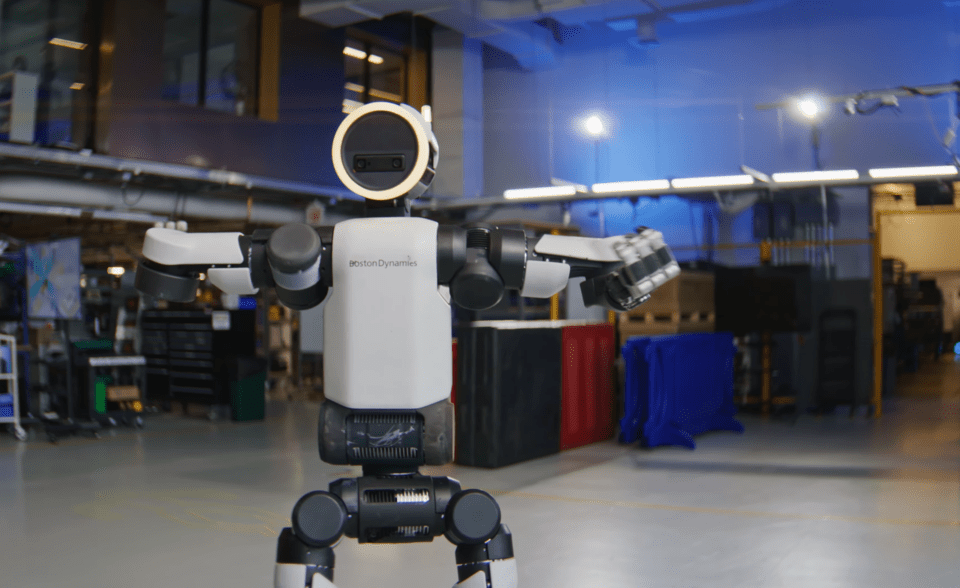
Hyundai Motor Group is also pushing to deploy the humanoid robot Atlas in production facilities. (Photo=Boston Dynamics YouTube) South Korea already has the same assets: a base in secondary batteries, motors, automotive parts, and semiconductor production.
Just as China shifted its EV ecosystem into robotics, South Korea’s industrial sector can also use a similar transition path. Hyundai Motor Group is moving toward mass production of Atlas, and Hyundai Mobis is considering building a robot actuator production line at its U.S. factory.
The Korea International Trade Association has proposed pursuing both supply chain stabilization and leadership in new markets. Companies should accelerate localization of core components through joint R&D between customers and parts suppliers, while increasing exports by bundling system construction and operating services with robots.
Some also argue for finding a breakthrough in software. Areas such as swarm control that allocates the routes of hundreds of robots in real time, integration with warehouse management systems, and site-specific customized design are separate from hardware cost competition.
It is being noted that operational data accumulated in domestic logistics and manufacturing sites could become a strength. The idea is to shift the profit zone to operating software and services rather than competing head-on in low-cost hardware.
Labor issues are also part of the debate. The Trades Union Congress (TUC), representing 6 million union members, said robots should be used not as a tool to cut labor costs but to raise productivity and improve job quality.
It also called for the government to ensure that workers are involved in automation decisions and that investment is made in retraining. The same question is being raised in South Korea’s logistics sector, where labor shortages and automation are converging.
The U.S. move is being read as a signal that robots are now being treated not as consumer appliances but as infrastructure. The question left for South Korea is whether it will bring in a cheap and fast means of automation, what verification such imports should undergo if they are brought in, and what should be made domestically in the gap between the two.