
Corporate social contribution activities are moving beyond simple donations or one-off volunteer work. More companies are encouraging employees and their families to go into the forest themselves, touch ecosystems firsthand, and take part in restoration through experiential programs. An event held in Gwangneung Forest clearly illustrates that trend.
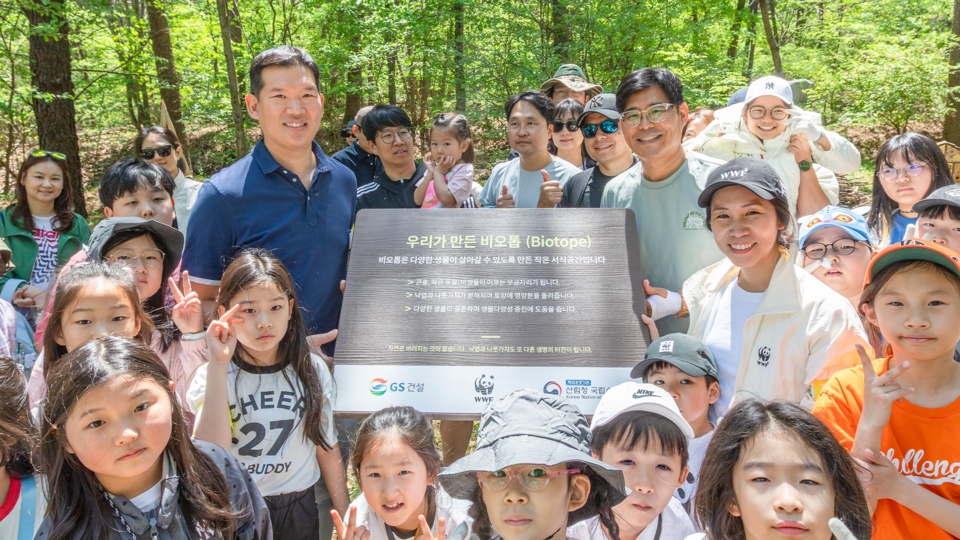
The Korea Forest Service’s National Arboretum held an environmental, experiential social contribution event on the 26th in the Gwangneung Forest area of Pocheon, Gyeonggi Province, together with GS E&C and the World Wide Fund for Nature (WWF). More than 80 employees and family members took part. It was not a simple tour. The day began with a lecture by National Arboretum Director Im Young-seok and continued with biotope creation, forest interpretation, and a visit to the Forest Museum.
The centerpiece of the day’s activity was the biotope. A biotope refers to a small artificially created habitat that allows specific forms of life to survive. Participants gathered dead trees, fallen branches, and leaf litter along the arboretum’s walking trails to create a “micro-habitat” where insects and fungi could take root. It was a hands-on lesson in how dead wood can become the foundation for new life.
Gwangneung Forest, a treasure trove of biodiversity per unit area
The significance of the event’s location was equally weighty. Designated as the royal tomb forest of King Sejo of the Joseon Dynasty, Gwangneung Forest has been preserved for more than 550 years and is a representative climax forest of the temperate northern Korean Peninsula. In 2010, it was designated a Biosphere Reserve by UNESCO’s Man and the Biosphere (MAB) International Coordinating Council. It is Korea’s fourth such site, following Seoraksan, Jeju Island, and the Shinan Dadohae area.
No other place in the country rivals it in species richness per unit area. It is home to more than 940 plant taxa, about 3,900 insect taxa, over 180 bird species, and more than 690 fungi species, for a total of more than 6,100 taxa. Some 20 species designated as natural monuments are found there, including the Gwangneung lady’s slipper orchid, flying squirrel, longhorn beetle, and black woodpecker.
Creating a biotope in this forest carries its own symbolism. It is less about adding something to an already rich ecosystem than about serving as a learning tool that narrows the distance between humans and nature, a distance widened by urbanization. It is a process of directly confirming that a single piece of dead wood can become a spawning ground for insects and a starting point for decomposition by fungi.
The virtuous cycle sought by the ‘B.E.S.T Model’
It is also worth noting that the National Arboretum carried out this event as part of its “B.E.S.T Program.” Derived from the initials of Biodiversity, ESG & Sustainability, and Training, the program aims to go beyond one-off experiences. It is designed so that participants build knowledge through lectures, gain hands-on experience through biotope creation, and then carry that awareness back into their workplaces and daily lives.
This approach is closely tied to the limitations that Korean corporate environmental social contribution efforts have long faced. There have been persistent criticisms that tree-planting events and campaign-style cleanups alone do little to change employee awareness or corporate culture. Encouraging family participation and extending the experience across generations is another defining feature of the program.
WWF’s participation as a partner carries additional significance. WWF is the world’s largest non-profit nature conservation organization. The National Arboretum has expanded its cooperative base with the group through joint projects on protecting endangered species and raising biodiversity awareness, among others. It is a channel that can connect domestic conservation efforts with global standards.
How far can the public-private partnership model expand?
The National Arboretum’s cooperation with companies is not limited to GS E&C. Last month, Hyosung Group signed a memorandum of understanding with the National Arboretum and the Mutual Growth Foundation and decided to increase its budget for biodiversity enhancement and climate crisis response by roughly four times year over year. The agreement includes ecological restoration of the DMZ wasteland and degraded forests, securing seeds for restoration, and building a carbon-neutral cooperation network.
For companies, such cooperation also aligns with the strengthening of ESG disclosure requirements. International standards requiring the measurement and reporting of impacts on natural capital and biodiversity are rapidly taking hold. Rather than simply sending sponsorship funds, companies now need partners that can participate in substantive conservation work and accumulate data from it. Institutions such as the National Arboretum, with their credibility and research capabilities, are seen as well suited to that role.
“It was a meaningful occasion where companies and families experienced nature together in the warm spring weather of Gwangneung Forest and learned the value of forest biodiversity,” said National Arboretum Director Im Young-seok. “We will continue to lead sustainable development in nature and society through ESG practice programs in which the public and companies participate together.”
Just as a single dead tree in Gwangneung Forest can become a home for insects, a small biotope created by companies and citizens can become the starting point for larger conservation efforts. When experiential ESG leads to everyday action, the stage for preservation expands beyond the arboretum’s walls.