
Swift, NASA’s space telescope, is expected to reenter Earth’s atmosphere on the night of Nov. 4. Based on data available at 8 a.m. that day, the Korea Astronomy and Space Science Institute estimated the reentry time at 8:46 p.m. (±2 hours).
Launched in 2004, Swift is a 1.5-ton-class satellite that observed gamma-ray bursts for about 22 years. It ended operations on Oct. 20 and is now orbiting Earth uncontrolled at an altitude of 199–205 kilometers.
The Korea AeroSpace Administration said Swift’s orbit lies within 20.5 degrees north and south latitude, so it cannot fall onto the Korean Peninsula. The agency does not consider the situation grounds for issuing a space-risk alert, but will continue monitoring the satellite until its reentry is complete.
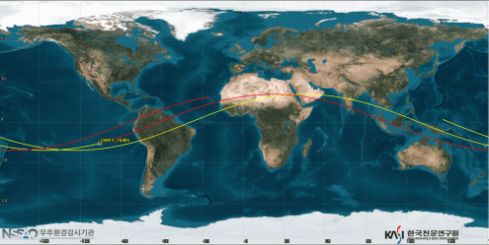
A U.S. space telescope that has observed gamma-ray bursts for about 22 years is expected to reenter Earth’s atmosphere on the night of Nov. 4. The Korea AeroSpace Administration said NASA’s Swift space telescope is descending in altitude while uncontrolled, but is not at risk of falling onto the Korean Peninsula.
Domestic and international agencies forecast reentry on the evening of Nov. 4.
The Korea Astronomy and Space Science Institute, the country’s space-environment monitoring agency, estimated from observation data available at 8 a.m. on Nov. 4 that Swift would reenter the atmosphere around 8:46 p.m., plus or minus two hours.
The U.S. Combined Space Operations Center (CSpOC) forecast reentry at 7:47 p.m. (±5 hours), while the European Space Agency (ESA) put it at 9 p.m. (±4.8 hours). Although the agencies’ estimates varied considerably, their central estimates clustered around the evening.
Swift was launched in November 2004 to observe gamma-ray bursts (GRBs). These powerful emissions of high-energy radiation occur in events such as the collapse of massive stars and collisions between neutron stars. Swift captured these phenomena and was used to study extreme events in the universe.
Weighing about 1.5 tons, Swift ended operations on Oct. 20. Its orbital altitude has since fallen without active control, and recent observations put it at 199–205 kilometers.
Its orbital inclination of 20.5 degrees puts the Korean Peninsula outside the potential impact zone.
Orbital inclination is the angle between a satellite’s orbital plane and Earth’s equatorial plane. It determines the range of latitudes over which the satellite can travel. Swift’s orbital inclination is 20.5 degrees, limiting its ground track to the area between 20.5 degrees south and 20.5 degrees north latitude.
The Korean Peninsula lies north of 33 degrees latitude, outside the range where the satellite could directly reenter.
Accordingly, the Korea AeroSpace Administration determined that the situation does not meet the criteria for the “Attention” level of its space-risk alert system. However, because this is an uncontrolled reentry of a large satellite, the agency plans to monitor changes in its orbit with the Korea Astronomy and Space Science Institute until reentry is complete.
“There is no possibility that the Swift space telescope will fall onto the Korean Peninsula, but we will closely monitor the situation with the relevant agencies until reentry is complete,” said Oh Tae-seok, head of the Korea AeroSpace Administration. “We will continue to strengthen our monitoring and response capabilities to protect the public from space hazards, including falling or colliding space objects.”
It has not yet been announced whether any satellite debris will reach the ground during atmospheric reentry or, if it does, where it might land.