
Key points
▶ On October 27 (local time), U.S. President Donald Trump wrote on Truth Social that the term “AI” or “artificial intelligence” would soon be officially banned from all related documents.
▶ Trump says the term AI is inaccurate and wants it replaced with “Super Intelligence (SI).” On September 29, he signed Executive Order 14434, directing federal agencies to use SI instead of AI in their documents.
▶ The order applies only to administrative documents, not documents incorporated into statutes, and does not require previously issued regulations, contracts, or grant documents to be revised. It uses the existing legal definition of AI in 15 U.S.C. § 9401 as the definition of SI.
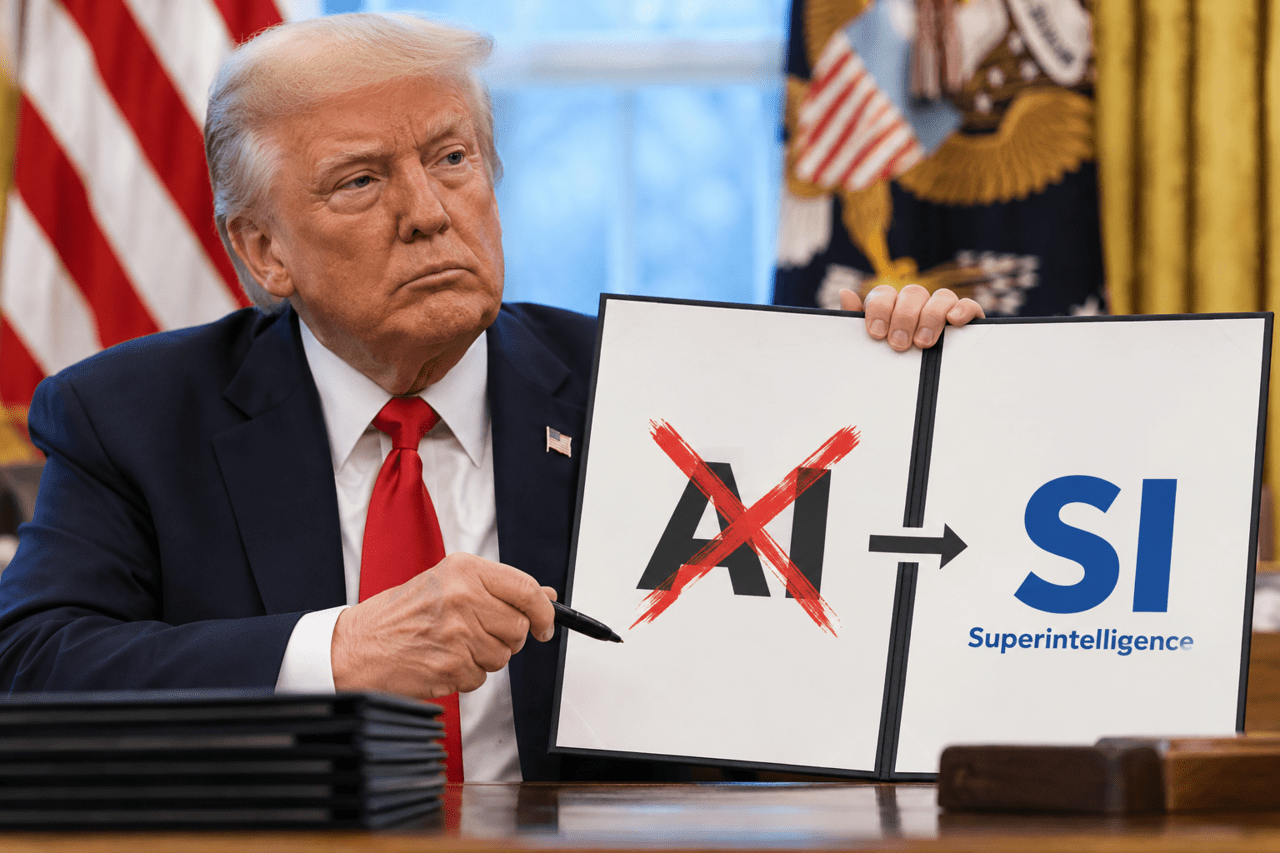
U.S. President Donald Trump has reiterated his intention to eliminate the term “AI.” On October 27 (local time), he wrote on Truth Social: “Because the term AI is inaccurate, we will soon officially prohibit its use in all related documents and elsewhere.”
He wants “Super Intelligence (SI)” used instead of AI. Trump signed an executive order on September 29 directing the federal government to replace AI with SI in its documents, and his post appears to signal an intention to extend the policy to the private sector. However, the executive order contains no provision requiring private companies or the media to use the new term.
What changed and what did not
Executive Order 14434, “Launching the Genesis of the Age of Superintelligence,” directs federal agencies, to the extent permitted by law, to use “Super Intelligence” and “SI” instead of “artificial intelligence” and “AI” in non-statutory documents, including official correspondence, external communications, websites, reports, and policy documents.
The White House explained that today’s technology has advanced far beyond what was envisioned when the term AI was first coined, and that federal terminology should reflect the technology’s capabilities and the opportunities it offers Americans. It said “superintelligence” better captures that potential and the technology’s rapidly advancing capabilities.
What the order does not change is also clear. It specifies that previously issued regulations and presidential actions, as well as contracts, grants, and past documents, do not need to be revised. Rather than creating a new definition of SI, the order applies the existing legal definition of AI in 15 U.S.C. § 9401(3). In other words, only the name changes; the meaning remains the same.
Changing the law is up to Congress, so the order gives the President’s science and technology adviser 60 days to consider whether to amend or replace the legal definition and to propose revisions and follow-up actions. The deadline, measured from the date the order was signed, falls around November 28. For Trump’s proposed “ban” to become law, that process would have to take place.
From a September poll to a UN speech and an executive order
The terminology shift has been underway since September. Trump held a poll on Truth Social asking what term should replace AI. In a speech to the UN General Assembly, he said the word “artificial” made intelligence sound fake and pledged to use SI in all U.S. documents. He then signed the executive order on September 29.
His post on the 27th also took aim at The Wall Street Journal (WSJ). Trump pressured the newspaper to use SI instead of AI. The WSJ opinion newsletter responded with an article titled “Let AI Be AI,” written from the perspective of an AI system, and noted that SI is already an abbreviation for Sports Illustrated and the International System of Units.
Musk followed suit; Anthropic did not
Private companies have taken different approaches. On October 4, SpaceX CEO Elon Musk replied “Yes, we will do that” on X when asked whether SpaceX’s AI division could be renamed “SpaceXSI,” and the name was later changed. The website address remains x.ai.
Salesforce CEO Marc Benioff said he would rename “AIforce” to “SIforce.” Microsoft CEO Satya Nadella used the term SI in an X post but did not change any product or company names. Meta CEO Mark Zuckerberg had already been promoting “personal superintelligence” as part of Meta’s vision since July last year, before Trump’s executive order.
Others have not followed. In a statement issued on October 2, three days after the executive order, Anthropic described itself as an “AI company.” OpenAI also continues to use the existing terminology. Anthropic CEO Dario Amodei, Google CEO Sundar Pichai, and OpenAI President Greg Brockman signed the White House’s “Superintelligence Compact,” but signing it does not mean their companies are changing their terminology. Amazon Web Services’ news blog also retains its “Artificial Intelligence” section.
Academic criticism has focused on the terminology itself. Superintelligence refers to AI that surpasses human intellectual abilities, so using SI to describe AI technology in general conflicts with the established definition of the term, critics say.
According to Reuters and other foreign media, University of Toronto professor emeritus Geoffrey Hinton criticized the move, saying: “They have taken a technical term with a very clear meaning and reused it to mean something else.” It remains unclear what means Trump intends to use to enforce the proposed “ban” in the private sector.