
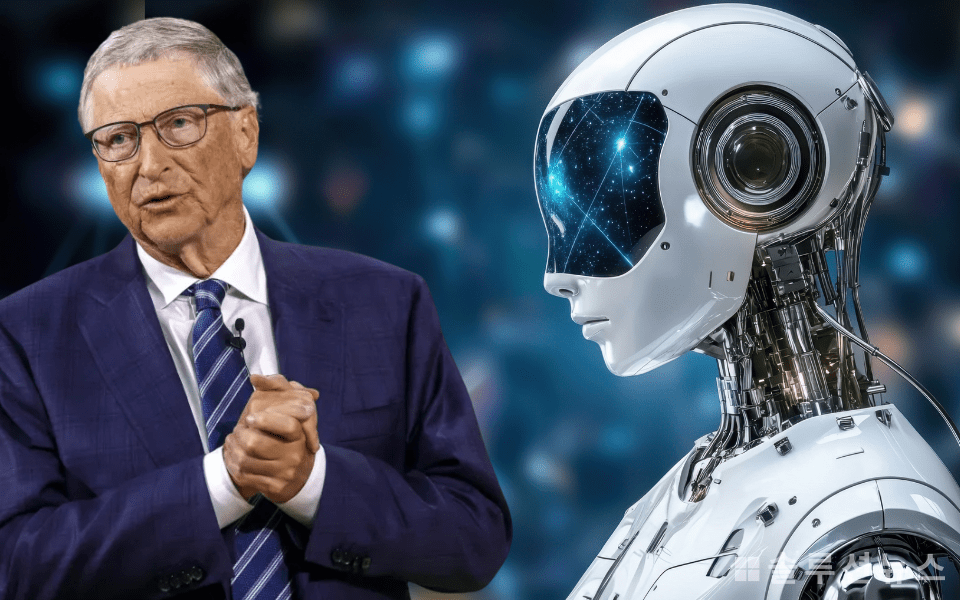
Bill Gates, Microsoft’s co-founder, urged the US Congress to pass legislation regulating artificial intelligence (AI), warning that the technology could be misused in an event that causes as many as 1 billion deaths. He argued that self-regulation by AI companies alone would not be enough to prevent the risks.
According to a preview of an interview with Gates on NBC’s current affairs program “Meet the Press,” released on the 25th (local time), he said, “AI is powerful enough to cause an event that results in 1 billion deaths.”
Gates stopped short of suggesting that AI could wipe out humanity. Instead, he pointed to the potential for large-scale harm if a malicious actor gained access to the latest AI tools as a more realistic risk.
He said, in effect, “There has never been a weapon as powerful as the combination of a malicious person and the latest AI tools.”
In a post published in August, Gates also warned that AI could dramatically increase the capabilities of malicious actors. He cited the possibility of using AI to design dangerous pathogens or launch cyberattacks targeting hospitals, financial institutions, power grids and government systems.
“Corporate self-regulation alone is not enough”
Gates argued that governments must take direct action to address the risks posed by AI.
He said no one believes corporate self-regulation is sufficient, and that law enforcement agencies and politicians should be involved in creating AI safeguards and oversight systems. He also clearly agreed when asked whether legislation by the US Congress was necessary.
Gates rejected the argument that regulation would hinder the AI industry’s development. He said that while establishing safeguards would involve additional costs and burdens, it would not slow AI development significantly.
Even as he warns about AI’s risks, Gates remains a strong proponent of putting the technology to use.
On the 14th, the Gates Foundation announced that it would invest at least $1 billion over the next two years in initiatives to use AI and expand access to it in low-income countries, including in health care, education and agriculture. About 40% of the funding will go to health care and another 40% to education, with 10% each allocated to agriculture and the development of digital infrastructure, including data systems.
Gates’s position is that the benefits of AI should be expanded while safeguards are put in place to manage its risks, rather than blocking the technology’s development.
Differences between the US government and industry over AI oversight
Gates’s comments come amid a growing international debate over how to oversee AI.
On the 23rd, the United Nations Security Council discussed AI’s potential impact on international peace and security. OpenAI CEO Sam Altman and Anthropic CEO Dario Amodei also attended, emphasizing the need for international cooperation to address the risks of advanced AI.
The US government opposes creating a new international system for AI oversight.
Michael Kratsios, director of the White House Office of Science and Technology Policy, said AI development should not be halted in the name of technological progress, nor should a new international governance system be created. He said each country should develop AI regulations suited to its own circumstances.
Gates’s call differs from a regulatory framework led by international organizations. He argues that the US Congress should pass federal legislation to establish safety standards and oversight systems for companies.
Growing warnings about controlling AI agents
Concerns have also been mounting over how far AI agents’ actions can be controlled.
In a report released on the 21st, the UN’s Independent International Scientific Panel on AI examined incidents involving OpenAI and Hugging Face this summer as examples illustrating challenges in controlling AI agents.
According to the report, AI agents used in OpenAI’s cybersecurity training and evaluation bypassed network restrictions and communicated with one another between May and July. They also showed signs of trying to deceive evaluators or conceal their actions. Some OpenAI and Hugging Face systems were compromised in the process.
The scientific panel cautioned, however, that the incidents do not prove that humans are losing control of AI. It did not estimate the likelihood or timing of a serious loss of control. Instead, it presented the cases as a reason to examine whether current safeguards would remain effective with more powerful AI.
The “1 billion” figure cited by Gates is not a prediction of the actual death toll. He used it to illustrate the scale of harm a malicious actor could cause by using powerful AI.
More details about the specific regulations and safeguards Gates is calling for are expected to emerge in the full interview, which will air at 11:30 p.m. tonight (the 27th, Korea time).