Paolo Uccello was a Florentine painter of the 15th century who relentlessly explored perspective in Renaissance painting. He studied how to create depth and distance on a flat surface. In his work, the decorative painting of the late Middle Ages met the mathematical sense of space of the Renaissance.
Paolo Uccello’s real name was Paolo di Dono. He was born in Florence in 1397 and died in 1475. “Uccello” means “bird” in Italian. The nickname is said to have come from his fondness for painting birds. In art history, he is more widely known by the name Uccello than by his real name.
Fifteenth-century Florence, where Uccello worked, was the center of Renaissance art. Architects, sculptors, and painters sought to see humans and nature in new ways. The canvas was no longer merely a flat surface for religious symbols. Artists increasingly tried to compose cities, buildings, figures, and objects as if they were real spaces before the viewer’s eyes.
Perspective was the key to that change. Perspective is a technique that creates a sense of depth by making nearby objects appear larger and distant ones smaller. When lines converge at a single point, depth emerges within the image. Renaissance painters used vanishing points and proportion to systematically translate the visible world.
Uccello made perspective the central issue of painting. He paid greater attention to the order of space than to facial expressions or religious emotion. Spears, armor, horses, and human bodies were placed in calculated directions. The objects became not decorative elements but devices for creating depth on the canvas.
His signature work is “The Battle of San Romano.” The painting depicts the battle fought in 1432 between Florence and Siena. Uccello did not portray the chaos of battle as it was. Instead, he arranged weapons, horses, and soldiers in regular patterns, composing the battlefield like a calculated stage.
“The Battle of San Romano” survives as a triptych. Today, the three paintings are housed in the National Gallery in London, the Uffizi Gallery in Florence, and the Louvre in Paris, respectively. Although they all depict the same battle, each shows a different scene. They are war paintings as well as pictorial experiments in perspective.
In the foreground, broken spears and weapons are laid out. The spears look like lines drawn across the ground. Horses and cavalry are in fierce motion. Yet the overall composition is calmly arranged. More than the speed of battle, the direction and placement of objects stand out.
Foreshortening is also important in Uccello’s painting. Foreshortening is a method of depicting objects so that when they point toward the viewer, they appear shorter than their actual length. It creates the sensation of horses’ bodies, fallen soldiers, and long spears entering deep into the picture. Through foreshortening, Uccello built a three-dimensional scene on a flat surface.
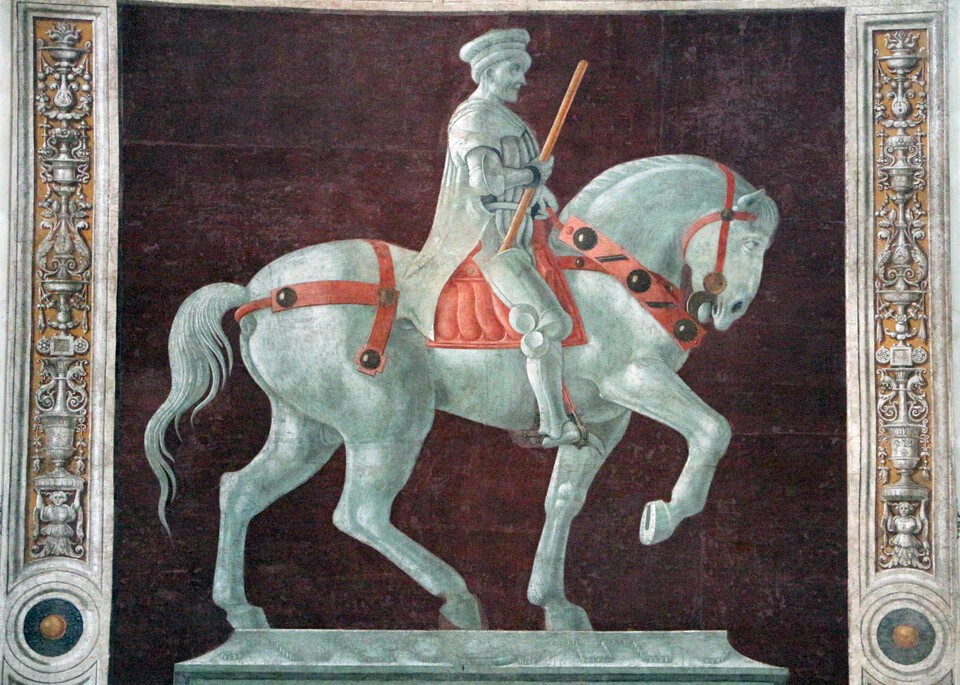
Another important work of his is “Equestrian Monument to John Hawkwood.” It is a fresco inside Florence Cathedral, Santa Maria del Fiore. John Hawkwood was a mercenary commander from England. In 1436, the Florentine Republic commissioned Uccello to create an equestrian monument in his honor.
“Equestrian Monument to John Hawkwood” is not an actual sculpture. It is a painting on a wall. Yet viewers feel as though the horse and rider are placed on the wall like a sculpture. Uccello created the effect of sculpture through painting. The fresco shows that perspective can be not just ornament but a technique for deceiving space.
Uccello’s art stands between the International Gothic style and the Renaissance style. International Gothic was a late medieval style that valued delicate lines, vivid colors, and ornamental expression. Uccello’s works retain ornate armor, horse decorations, and decorative outlines. At the same time, figures and objects are arranged within a geometric order.
That is why Uccello is regarded less as a fully mature Renaissance painter than as an experimenter in a period of transition. His figures are sometimes stiff and unnatural. Horses and soldiers can look more like stage props than real participants in battle. But within that awkwardness lies an important change: the moment painting began to calculate and reconstruct the world before the eye.
Perspective later became the basic language of Renaissance art. Painters such as Piero della Francesca, Leonardo da Vinci, and Raphael handled space and the human body with greater precision. Uccello had already shown that a canvas could have a mathematical structure. His relentless experiments expanded the foundation of Renaissance painting.
The key to understanding Paolo Uccello is “space.” He was not merely a painter of beautiful scenes. He was an artist who asked what order could be used to transfer the visible world onto the canvas. The spears, horses, soldiers, and armor in “The Battle of San Romano” are both tools of war and tools of perspective.
Paolo Uccello shows the process by which painting moved beyond the reproduction of sensation and into the realm of intellectual construction. Ornament and mathematics, the Middle Ages and the Renaissance, overlap in his paintings. His obsession with perspective left Uccello as a distinctive figure in 15th-century Florentine art.