
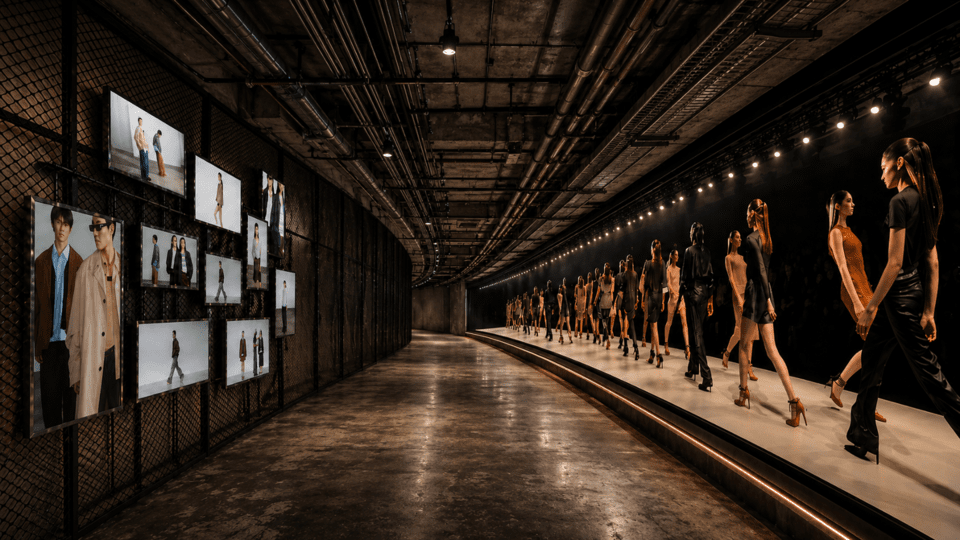
How can an abandoned empty space in the middle of the city be used again? Seoul’s answer was: do not dig up the ground again.
Thirteen meters below Seoul Plaza, a 9.5-meter-wide, 335-meter-long underground idle space that had been dormant for more than 40 years will be transformed into a “K-content culture and experience platform.” The city said on the 24th that it will develop the space into an urban cultural and experiential hub and open it in October.
The space is an idle area wedged between the upper section of the Line 2 subway track and the lower section of the nation’s first underground shopping arcade. It is believed to have been incidentally created during construction in 1983, when the City Hall Station underground shopping arcade was connected to Euljiro 1(il)-ga Station. Because it had never been developed or used commercially, its original early-1980s structure has remained almost intact.
In September 2023, Seoul City discovered the space as part of its subway station innovation project, “Fun Station,” and ran citizen exploration programs there.
The strong public response became the starting point for this project. After confirming public interest, the city sequentially reviewed the space’s safety, operating model, and potential for private-sector participation before moving ahead in earnest.
◆ A regeneration model that does not dig
Building a new cultural facility in the city center requires securing land, along with enormous costs and time. Reviving an already existing empty space bypasses that burden.
Even the rough texture of the concrete walls and pillars is not treated as something to be removed, but as a backdrop for exhibitions. Leaving it untouched becomes both a cost-saving measure and a differentiation strategy.
Media art that projects images and light onto the long walls and structures of the underground tunnel will be installed. Interactive content that responds to visitors’ movements with screens and sound will also be prepared.
The tunnel-like layout will be used as a stage for K-fashion exhibitions, runway shows, and brand showcases. A pop-up store combining K-pop artist merchandise, video content, and virtual idol universes is also planned.
The city’s goal is to create a space where people do not simply view exhibitions and leave, but stay and experience them.
◆ Public safety, private content: a division of roles that created a model
Another feature of the project is the way responsibilities are divided. Seoul City will handle the creation of public infrastructure, while content planning and operations will be entrusted to a private specialist company.
Operations will be carried out by Creative Meot, a company specializing in immersive content planning and production. The company holds hologram patents and has extensive experience building immersive content. It plans to directly design and operate immersive experiences that combine AI, real-time holograms, augmented reality (VR), and Unreal Engine-based CG with K-content.
If the public shoulders everything, content competitiveness weakens; if the private sector takes over entirely, publicness can be undermined. The city chose a division of labor in which it retains public responsibility for safety while delegating the creativity-driven areas to the private sector. This is why the model is being viewed as a new framework for cooperation in the use of public spaces.
There are, however, clear challenges to address.
The underground setting itself increases safety concerns. The city is currently building ventilation, firefighting, and evacuation facilities together with Seoul Metro, and is carrying out construction while checking the overall design, construction, and safety management.
It plans to coordinate infrastructure work and private operating plans in parallel, and to proceed step by step with follow-up procedures such as the creation of private interior facilities in line with construction progress. Once construction is completed, the platform will be accessible through Exit 2 of Euljiro 1(il)-ga Station on Line 2.
This project will not end at a single location.
Kim Yong-hak, director of Seoul’s Future Space Planning Bureau, said, “This is a stage of transforming an underground idle space, whose expansion potential was confirmed when it was first opened to the public three years ago, into a future-oriented cultural space that more citizens can use. We will prepare Fun Stations tailored to the characteristics of each site, including Gangdong Station and Gasan Digital Complex Station, and create new vitality in citizens’ everyday lives.”
In a city where land is scarce, the value of existing empty spaces grows. The October opening of the underground space at Seoul Plaza is expected to serve as a test case for how other dormant spaces might be put to use.