
As deaths from extreme heat continue to mount across Europe, a personal cooling booth has emerged in Japan as a possible response to the heat crisis.
U.S. online outlet Gadget Review reported on the 20th (local time) that Do Hiemon Box, a personal cooling booth developed by Japanese refrigeration and vending machine maker SDRS and sold by industrial supply company Trusco Nakayama, was launched in April.
The product was designed to reduce heat stress among outdoor workers in Japan, where midsummer temperatures repeatedly climb above 40 degrees Celsius every year. Its appearance resembles a beverage vending machine, earning it the nickname “human refrigerator.” It is drawing attention as a practical solution from a country where extreme heat has become part of everyday life.
◆ 1,000 excess deaths in France alone… Cooling has become a matter of survival
The backdrop is a reality in which extreme heat has reached disaster levels. France’s public health agency said that about 1,000 excess deaths occurred during the week when record heat peaked at the end of last month. Preliminary estimates show that heat-related deaths in France and Spain alone exceeded 2,000 last month.
Extreme heat is often called a silent disaster. Unlike typhoons or floods, it causes no visible destruction, but it strikes down older adults, people with underlying conditions, and outdoor workers first. In France, deaths in private homes were also confirmed, prompting criticism that access to a place to escape the heat determined life or death.
Late last month, temperature records were broken across Europe. Germany reached 41.7 degrees Celsius, the Czech Republic 41.9 degrees, and France 40.6 degrees. The World Health Organization said Europe is the fastest-warming continent and urged stronger efforts to protect citizens.
There was also an announcement that the World Health Organization estimated 1,300 heat-related deaths in Europe. Concerns are growing that the pace of rising temperatures is outstripping the speed at which response systems are being prepared.
A widening gap in access to air conditioning is being cited as a major factor behind the growing damage from heat waves. In areas where cooling equipment is not sufficiently widespread, there is simply nowhere to escape the heat, leaving older adults and outdoor workers exposed to harm. The key challenge in responding to heat waves has thus become how quickly, and how widely, relief from the heat can be provided.
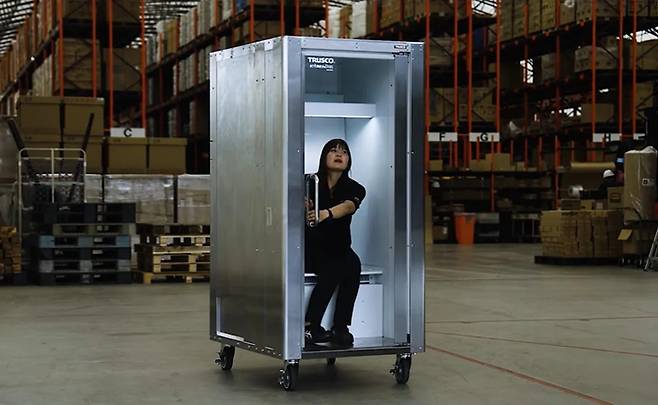
◆ Body temperature can be regulated in five minutes… Concentrated cooling for one person cuts power use in half
Do Hiemon Box is a product that reverses the usual approach. Instead of cooling an entire room, it boosts energy efficiency by providing concentrated cooling to one person.
It is also notable that the product was made by a refrigeration and vending machine manufacturer, suggesting that cooling and insulation technology designed to rapidly chill and maintain small spaces was adapted for a booth that a person can enter.
Once inside, the interior temperature is immediately maintained at 15 degrees Celsius. Cold air at 5 degrees is directed at body parts that release heat quickly, such as the head, neck, shoulders, and back. According to the manufacturer, just 5 to 10 minutes of rest in a 20- to 40-degree environment can help regulate body temperature.
The design targeting specific areas such as the head and neck is based on physiological reasoning. By cooling the parts of the body where heat is released most rapidly, body temperature can be lowered more quickly than by cooling the entire space. Narrowing the cooling target from the room to the human body also reduces energy waste.
Operating costs are modest. According to the manufacturer, the hourly operating cost is about 16 yen (about 145 won), roughly half the electricity consumption of a portable air conditioner with similar performance. It includes an automatic 20-minute shutoff function to prevent overcooling, and the fan speed can be adjusted in three stages.
At 16 yen per hour, even running it for eight hours a day costs only about 130 yen, or roughly 1,200 won. The calculation suggests that even continuous use throughout the heat wave season would not create a major electricity bill burden.
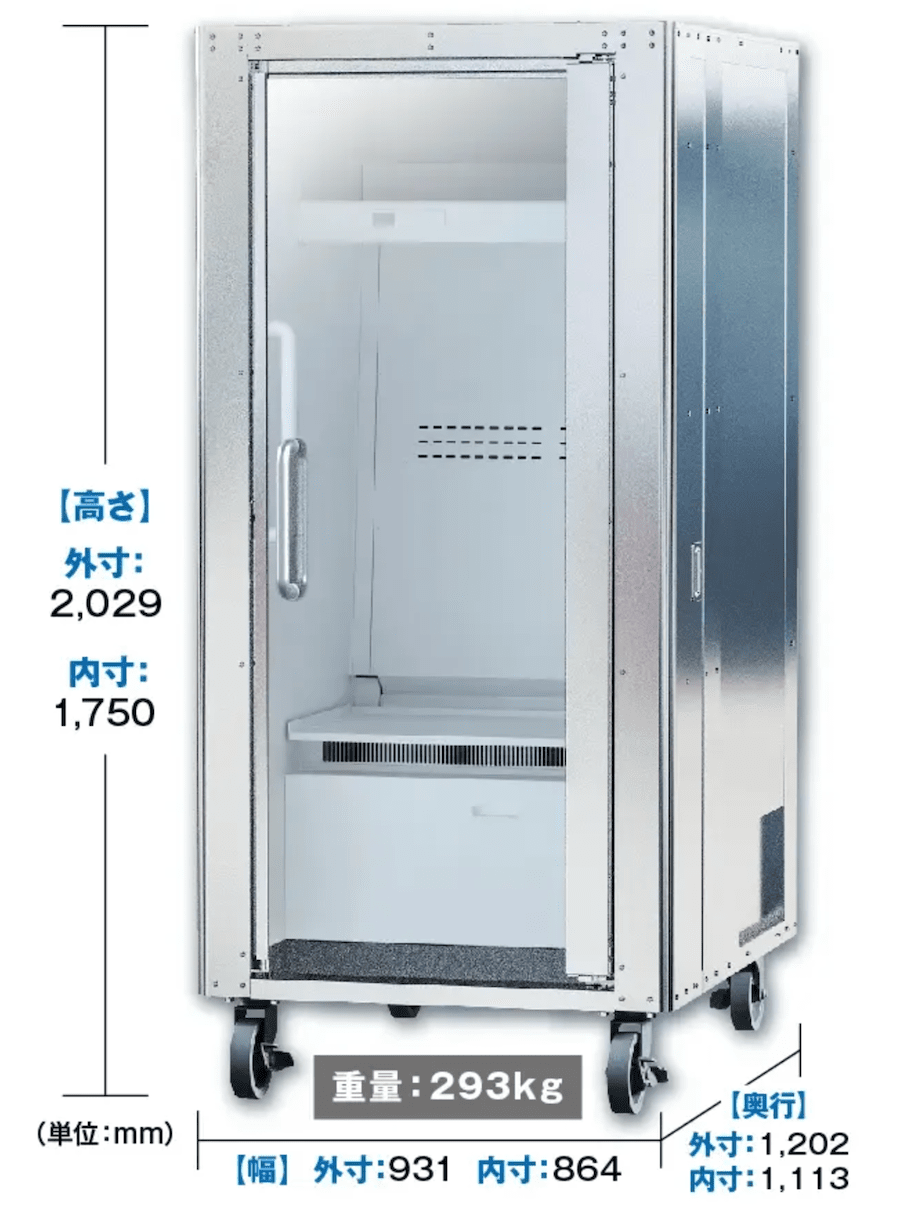
The installation threshold has also been lowered. Measuring 2,029 mm in height, 931 mm in width, and weighing 293 kg, the unit has wheels for mobility and can be used immediately by simply plugging it into an outlet, with no additional construction required. Its ability to be deployed flexibly in areas lacking cooling infrastructure is seen as a major advantage as a heat-response device.
◆ 13.7 million won and a one-person limit… Potential to expand into a shelter model
The price is not for the general public. At about $9,300 before tax (roughly 13.7 million won) per unit, it is classified as industrial capital equipment rather than a consumer product. Construction sites, factories, warehouses, and outdoor event venues are identified as the main target locations.
From an industrial safety standpoint, some say the investment can be justified by its effect. If a worker collapses from heat-related illness, costs follow in treatment, work stoppages, and labor shortages. If a short cooling break can reduce accidents, the equipment price may be viewed as a type of insurance expense.
Public-sector trials have also begun. At Maebashi City Hall in Gunma Prefecture, the unit has been donated for pilot operation and is being offered free of charge to visitors. However, because only one person can use it at a time, some point out that waiting times may become long during peak heat periods.
One way to lower the price barrier is leasing rather than buying. Since the equipment is needed only for the few summer months when heat waves are most intense, some suggest that rent-to-use models or shared procurement by local governments could help reduce the burden and make adoption easier.
Among experts on heat-wave response, there is growing recognition that shifting the focus from space cooling to human-body cooling carries important implications. In a situation where it is difficult to rapidly expand citywide cooling infrastructure, placing small cooling devices where people gather may be a realistic complementary measure.
There is also a vision that cooling booths placed throughout streets like vending machines could function as a network of shelters during heat waves. Because the product is designed to provide sufficient cooling in just 5 to 10 minutes, higher turnover could partly offset the limitation of serving only one person at a time.
The situation is also relevant to South Korea. As preventing heat-related illnesses at outdoor and high-temperature work sites such as construction sites and logistics warehouses remains a recurring summer issue, there is room to consider adding concentrated cooling equipment to existing measures centered on heat shelters and portable shade structures.
How to offset the limits of price and capacity is likely to be the key to wider adoption. As heat waves grow more intense every year, attention is turning to whether small devices that cool people directly can become a complementary tool filling the gaps in cooling infrastructure.