
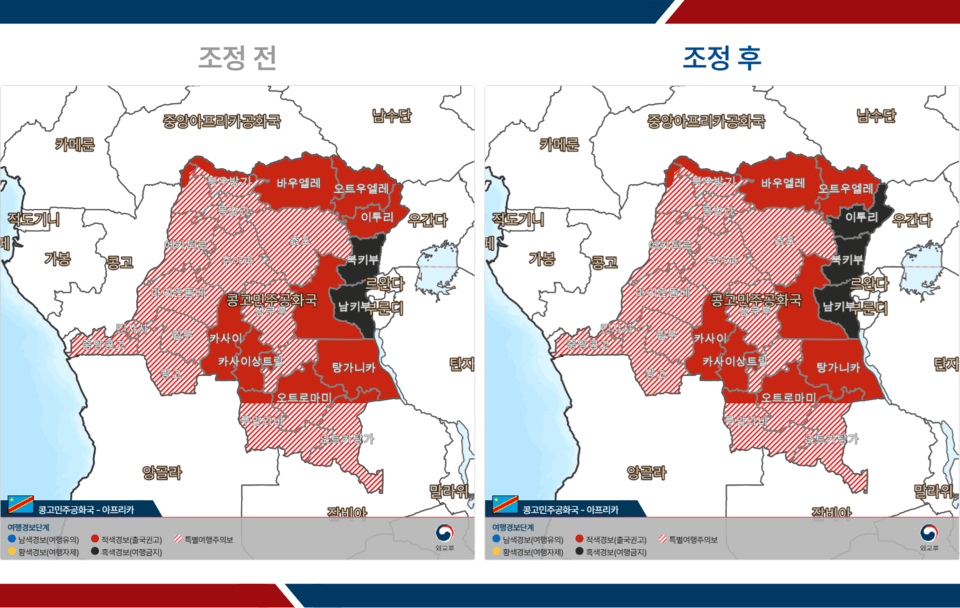
The Ministry of Foreign Affairs imposed a travel ban on the entire Ituri Province of the Democratic Republic of the Congo at 2 p.m. on the 22nd. It is a sign that Ebola is spreading again in a way dangerous enough to legally bar people from entering.
Ituri Province is located in the northeastern part of the Democratic Republic of the Congo in central Africa. With this measure, the number of places under travel bans within Congo has risen to three, following North Kivu and South Kivu provinces.
Anyone caught entering without permission is subject to punishment under the Passport Act. It is rare for a government to close off a specific region of a country to this extent.
The disease in question is officially called Ebola virus disease. It was previously known as Ebola hemorrhagic fever. Although “hemorrhagic” in the name makes it sound like a disease that causes the body to bleed profusely, most patients actually die from multiple organ failure. The organs collapse before the illness reaches the stage of uncontrollable bleeding.
◆ A disease transmitted by a drop of body fluid
What makes Ebola so frightening is its fatality rate. Depending on the type of virus and the level of medical care, more than half of those infected can die in places where treatment is not properly available. Academic studies place the fatality rate between 50% and 90%.
The route of infection is relatively clear. The World Health Organization says Ebola is not spread through the air and is transmitted through direct contact with bodily fluids such as blood, saliva, sweat, and other secretions from patients. In other words, it is not a disease you catch simply by being in the same space, unlike COVID-19.
But this characteristic also makes containment more difficult. Family members and medical workers who care for patients at close range are the first to become infected. In regions where customs remain in place to wash and touch the bodies of the dead during funerals, corpses become another source of infection. Records from the West African outbreak, during which 184 health workers worldwide were infected and half of them died, show how ruthless this disease can be to medical staff.
The incubation period ranges from as short as two days to as long as three weeks. It usually begins with a high fever, headache, and muscle aches, making it difficult to distinguish from a cold or flu.
After several days, vomiting and diarrhea follow, and liver and kidney function decline rapidly. Because the symptoms begin in a common way, patients often spread the disease to others without realizing it.
◆ Eastern Congo, a place where the virus lingers
It was in the Democratic Republic of the Congo that Ebola first appeared before humanity in 1976. Since then, the disease has broken out 17 times in this country alone. The same disease has returned to the same land repeatedly for half a century.
There is more than one reason. Ebola virus is believed to reside quietly in the bodies of wild animals such as fruit bats. Humans are infected when they come into contact with these animals, allowing the virus to cross into the human world.
Eastern Congo has many mines, which means heavy movement of people, and long-running conflicts among armed groups have left hospitals and public health workers weakened. Even when the virus enters, the net for catching it early is too loose.
The same weakness is being exposed in this Ituri Province outbreak. Reports say treatment tents were burned down and residents clashed with health authorities over the handover of the bodies of people believed to have died from Ebola. As quarantine measures for disease control spark public resistance, a vicious cycle that instead fuels the spread is repeating itself.
The World Health Organization has declared an international public health emergency over the Ebola outbreaks in Congo and Uganda. It is the highest-level warning issued when a danger may spread beyond national borders.
◆ A variable called a vaccine that does not work
Ebola is no longer a disease with no way to fight back at all. For the most common Zaire strain, approved vaccines and treatments exist. These are the weapons humanity has secured in its fight against Ebola.
The problem is that Ebola is not a single type of virus. The Ebola virus genus contains five species, and the degree to which vaccines and treatments work differs by species.
International aid groups suggest that the virus identified in the current Congo outbreak may be the Bundibugyo strain, which is different from previous ones. It is known that there is currently no approved vaccine or dedicated treatment for this type.
However, since the exact virus type can change depending on laboratory analysis results, it is too early to say anything for certain.
If it does turn out to be a type that existing vaccines do not work against, this outbreak would be a fight in which medical workers have been stripped of one of their weapons. The Ministry of Foreign Affairs’ decision to seal off the entire Ituri Province is also based on that uncertainty.
At present, the likelihood of domestic entry into South Korea is assessed as low. Ebola does not spread through the air, and since there are no direct flights between Korea and Congo, the possibility of an asymptomatic patient entering the country is limited. However, health authorities are advising arrivals who have visited affected regions to monitor symptoms such as fever for 21 days.
The fact that Ebola has returned to the same land for 50 years reminds us that this disease is not simply a medical issue.
Unless the three factors of a broken medical system, endless conflict, and the distance between nature and humans that harbor the virus are resolved, Ebola will knock on Congo’s door again even if a vaccine is developed.