
As the supply of naphtha, a key plastic feedstock, is shaken by the war in the Middle East, discarded banner material is gaining new value as a source for automobile interior materials and construction supplies.
In just two years, the number of local government ordinances promoting the recycling of discarded banners has surged 25-fold, signaling a voluntary circular-economy shift.
Last year, 2,418 tons, or 48.4%, of the 4,971 tons of discarded banners generated nationwide were recycled. Meanwhile, the Ministry of the Interior and Safety and the Ministry of Climate, Energy and Environment are accepting applications until June 19 for the “3rd Discarded Banner Resource Circulation Competition.”
Amid rising concern over supply instability in naphtha due to the war in the Middle East, discarded banners are securing added value as materials for automobile interiors and construction products.
With the June 3 nationwide local elections approaching, the amount of election banners is expected to reach around 1,500 tons. Whether collection and recycling systems are properly established will now be put to the test.
The Ministry of the Interior and Safety and the Ministry of Climate, Energy and Environment are recruiting participants for the “3rd Discarded Banner Resource Circulation Competition.” The two ministries are accepting discarded-banner circulation plans until June 19.
Last year, 4,971 tons of discarded banners were generated nationwide. Of that total, 2,418 tons, or 48.4%, were recycled. Compared with 2024, when 5,409 tons were generated, the volume fell 8%, while the recycling rate rose by 15.1 percentage points from 33.3% in 2024, or 1,801 tons. This is being interpreted as a sign that Korea’s resource circulation policy has reached a critical threshold.
Behind this lies structural pressure. As naphtha supply has become unstable due to the Middle East conflict, the industrial value of recycled plastics is coming into sharper focus.
With the June 3, 9th nationwide local elections approaching, the volume of election banners is also expected to rise. In the 8th local elections in 2022, 1,557 tons were generated.
◆ From 5 ordinances to 126: a change in local government
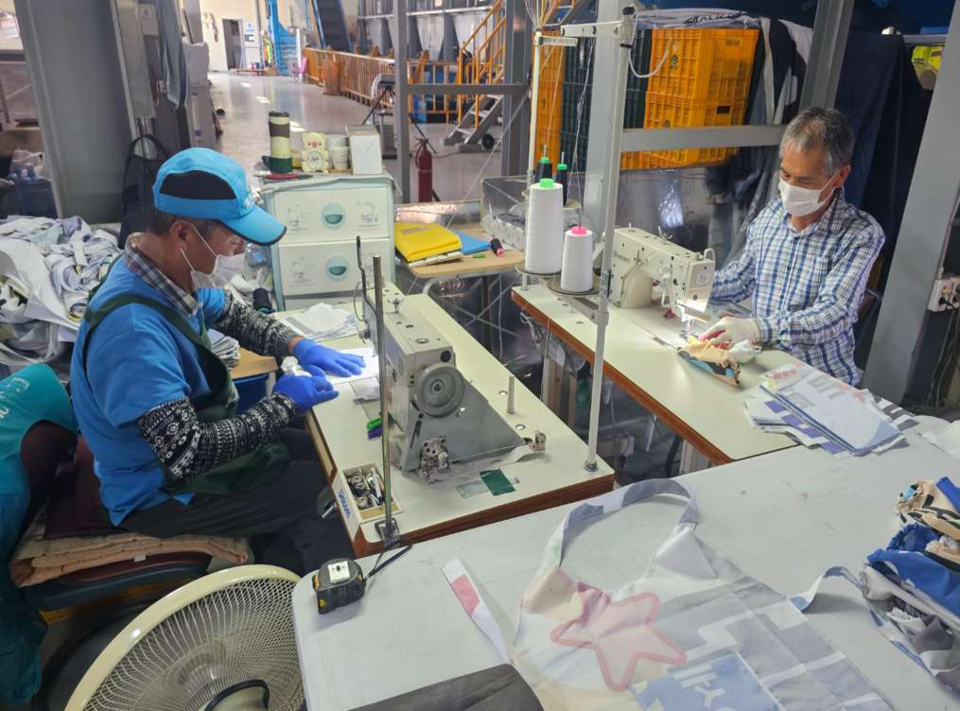
The most notable change is in local government ordinances. As of May 2024, there were only five ordinances related to discarded-banner recycling, but by May 2026, that number had risen to 126, a 25-fold increase.
These ordinances provide the legal basis for budget allocation, collection systems, and private-sector agreements. Once an ordinance is in place, administrative action becomes possible. The jump from five to 126 suggests that discarded-banner handling has shifted from being a burdensome task for environmental departments to a performance indicator for mayors and governors.
This change followed the joint competition launched by the Ministry of the Interior and Safety and the Ministry of Climate, Energy and Environment in 2024. The format of a joint award from two ministries appears to have influenced local governments. A project led by a single ministry can easily slip down the priority list, whereas a cross-ministerial initiative is harder for local governments to ignore.
◆ Evolving demand: from furniture and playground equipment to automotive interiors
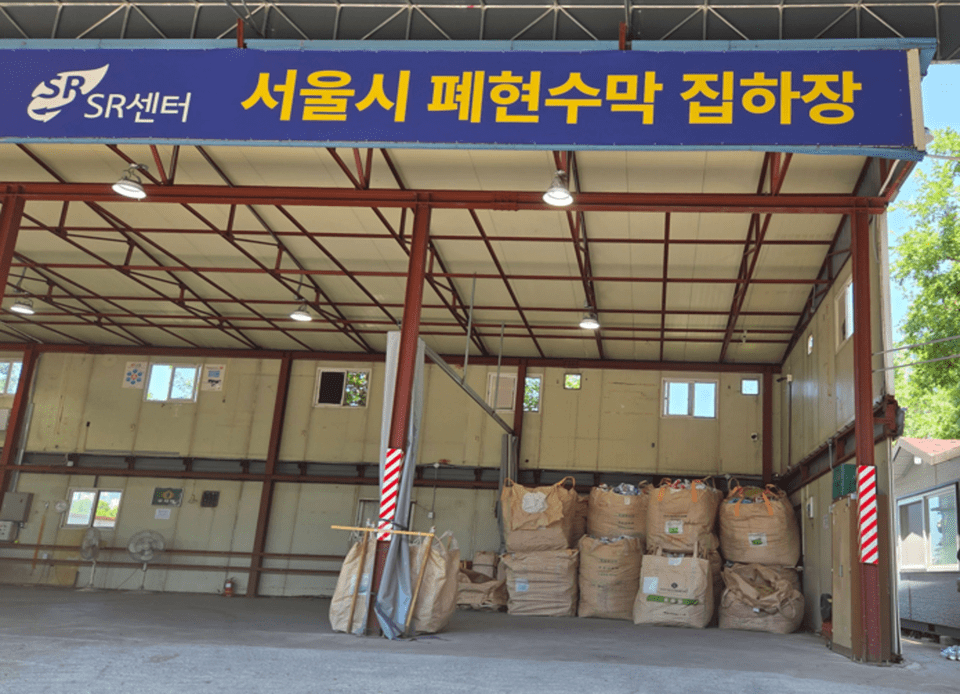
Last year’s award-winning projects show how recycling methods are evolving. Seoul, which won the top prize in the public-sector category, set up dedicated collection bins and shared collection sites and distributed manuals to district offices, offering a model for administrative standardization.
In the public-private cooperation category, the top prize went to the Busan-Ulsan-Gyeongnam regional headquarters of the National Health Insurance Service and Hyundai Outlet Gasan Five Branch. They collected discarded banners, turned them into upcycled products, and then donated them to welfare facilities. The project was recognized as the first case in which a public institution and a private company joined forces to complete a resource-circulation loop.
Last year, the Ministry of the Interior and Safety signed agreements with five local governments—Sejong, Gangneung, Cheongju, Naju, and Changwon—and four private companies—SK Chemicals, Sejin Plus, Revelop, and Kakao—to build a virtuous-cycle system.
In February, the Ministry of Climate, Energy and Environment granted a circular-economy regulatory exemption for a project to develop materials for automotive interior and exterior parts using discarded banners. The move was intended to remove barriers in waste classification systems and recycling standards that could hinder the development of new materials.
The center of gravity in recycling is shifting from low-value upcycling to high-value industrial materials. The polyester (PET) used in banners can be turned into high-quality recycled feedstock through proper processing. If industries with stable demand, such as automotive interiors and construction materials, absorb recycled feedstock, the economics of recycling will take another leap forward.
◆ Half is still incinerated: the remaining challenge
The limits of progress are also clear. A recycling rate of 48.4% means that 51.6% of generated banners are still being incinerated or landfilled.
According to the Ministry of Environment, it costs about 300,000 won to incinerate one ton of discarded banners. The incineration process also emits harmful substances such as dioxins, adding to environmental concerns.
Industry observers say chemical recycling technologies have already been commercialized mainly by large corporations, making it difficult for smaller operators to enter the market. They also point out that collection standards vary by local government, leaving the stability of feedstock supply insufficient.
The next stage of solutions can be grouped into three areas: policies to reduce the amount of waste generated, the establishment of nationally consistent collection and sorting standards, and securing stable demand for recycled materials. Industry experts say recycling can continue to grow beyond the 50% mark only if these three pillars move in tandem.
◆ The June local elections as a turning point
The June 3 local elections will serve as a real-world test of the resource-circulation system that has been developed so far. If the 1,557-ton scale seen in the previous 8th local elections is repeated, a month’s worth of ordinary waste will be generated in just a few days.
According to the Ministry of Climate, Energy and Environment, the 7.3 tons of discarded banners collected by Seoul immediately after last year’s 21st presidential election were all recycled. Considering that Seoul’s discarded-banner recycling rate had previously been around 30%, this is a case showing how infrastructure changes outcomes.
However, local governments with dedicated collection sites and manuals remain in the minority. Whether all 126 ordinances have translated into real infrastructure is a separate issue. The recycling rate for discarded banners generated in this local election will likely serve as a gauge of whether the policy changes made over the past two years are truly working.
Kim Geun-ho, director-general of balanced regional development at the Ministry of the Interior and Safety, said, “The discarded-banner issue goes beyond simple waste disposal and is a life-centered task that connects carbon neutrality and resource-circulation policies.” He added, “Through the competition, we will discover and spread creative recycling models from local communities and contribute to the realization of a sustainable circular economy.”
Kim Go-eung, director-general of resource circulation at the Ministry of Climate, Energy and Environment, said, “To build a plastic circular-economy ecosystem, we need to reduce waste at the source and expand sustainable design, production, collection, and recycling.” He added, “We will lead the shift away from plastics by supporting high-value recycling of discarded banners.”
Institutions that pass the first screening of the competition must submit performance reports by October 30. After evaluation by experts in resource circulation and outdoor advertising, six outstanding teams will be selected in November. Three teams in the public sector will receive the Minister of the Interior and Safety Award, while three teams in the public-private partnership category will receive the Minister of Climate, Energy and Environment Award.