
Samsung Electronics closed at 286,000 won, down 9.06 percent from the previous trading day, while SK hynix finished at 2,187,000 won, down 14.57 percent.
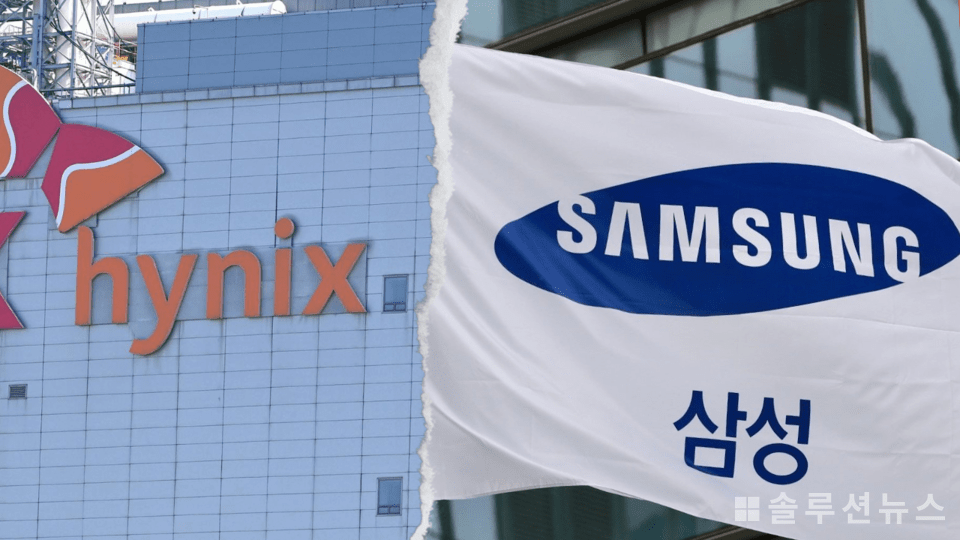
On the 2nd, Samsung Electronics closed at 286,000 won, down 9.06 percent, and SK hynix closed at 2,187,000 won, down 14.57 percent. (Photo=Solution News)
The semiconductor giants crumbled in a single day. Samsung Electronics and SK hynix plunged in tandem, dragging down the KOSPI.
According to the Korea Exchange on the 2nd, Samsung Electronics ended trading at 286,000 won, down 9.06 percent from the previous session. It fell below the 300,000-won mark. SK hynix closed at 2,187,000 won, down 14.57 percent.
SK hynix suffered the larger drop. It marked the steepest decline in about 17 years, since November 2008 during the financial crisis. Because the two companies account for more than half of the KOSPI’s market capitalization, the index also sank sharply.
The trigger for the plunge came from U.S. tech giant Meta.
◆ The meaning of the “Meta shock”

Meta had bought massive amounts of computing equipment for its AI services at its data centers. News emerged that it is seeking to launch a cloud business that would lease out the unused portion of those resources to other companies. Bloomberg reported an internal plan called “Meta Compute.”
Why is this bad news for semiconductors? Running AI requires high-performance chips. Until now, the belief that these chips were in short supply had pushed semiconductor prices higher. But if the resources Big Tech had already bought turn out to be surplus, that logic weakens. Concerns spread that AI infrastructure may be overbuilt, raising fears of oversupply.
Overnight, U.S. markets were rattled first. Meta’s share price rose 8.8 percent, while Micron, a leading memory-chip maker, fell more than 10 percent. Intel and AMD also declined. The Philadelphia Semiconductor Index, the benchmark U.S. chip index, dropped 6.27 percent. That shock then spread to Asia.
◆ Why Samsung and SK hynix were hit especially hard
The two companies had been viewed as the biggest beneficiaries of the AI memory boom. In particular, SK hynix leads the HBM, or high-bandwidth memory, market used in AI semiconductors. Samsung Electronics is also moving quickly to expand HBM supply and improve product competitiveness.
Because expectations had been so high, the correction was also severe. Their share prices had reflected a heavy dose of optimism that conditions would improve further. Once the supply-shortage narrative weakens, those expectations are the first to be cut back. In other words, the stock prices reacted before actual earnings deteriorated, as valuation expectations were lowered.
Foreign selling deepened the losses. Foreign investors sold 1.668 trillion won worth of SK hynix and 1.4765 trillion won worth of Samsung Electronics on the day. Foreign brokerages appeared among the top selling channels.
Seo Sang-young, a researcher at Mirae Asset Securities, said Meta’s plan to sell excess resources raised concerns about Big Tech overinvestment and the possibility that AI demand may have already peaked. Bessern Ling, managing director at Swiss asset manager Union Bancaire Privée, said the very idea of selling surplus resources signals the possibility of overinvestment and could weigh on the semiconductor sectors in Korea and Japan.
◆ Is it an earnings headwind, or profit-taking?
There is also no shortage of dissenting views. Many in the securities industry believe that an actual slowdown in earnings has not yet materialized. Korea’s exports last month exceeded $100 billion for the first time ever, with semiconductors at the center. Semiconductor exports surged 199.5 percent from a year earlier.
Many see this sharp decline as profit-taking after the strong rally in the second quarter. The view is that, as in last year’s “DeepSeek” episode, AI investment narratives are being clouded by noise, but it is still too early to interpret this as a signal of weakening demand. Hanwha Investment & Securities said that if Meta’s cloud business becomes fully operational, AI semiconductor demand could actually increase further.
Some firms have even raised their target prices. NH Investment & Securities and IBK Investment & Securities both lifted their target prices for SK hynix, factoring expanded demand for AI memory into their earnings outlooks.
Joshua Crabb, head of Asia-Pacific equities at Hong Kong-based Robeco, said AI-related stocks have risen so much that expectations are already very high, making investors quick to sell even on small negative news.
The market is now focused on this week’s schedule. Samsung Electronics is set to release preliminary second-quarter earnings on the 7th, and SK hynix is scheduled to list its American depositary receipts on the 10th. It is still unclear whether the Meta news will translate into an actual drop in orders. Short-term investor sentiment and medium- to long-term demand are moving in opposite directions. How firm semiconductor expectations really are will be revealed in the upcoming earnings results.