
The memory semiconductor boom is changing even the stock assets of executives. As the stock valuation of Samsung Electronics and SK hynix executives has surged into the tens of billions of won, an online tracking site that shows each executive’s holdings in real time has also appeared.
According to the industry on the 18th, a website has opened that compiles and displays the stock holdings, changes in holdings, and valuations based on share prices of executives at the two companies using Financial Supervisory Service electronic disclosure materials. It allows users to check each executive’s stock assets with just a few clicks, without having to search through disclosure documents one by one.
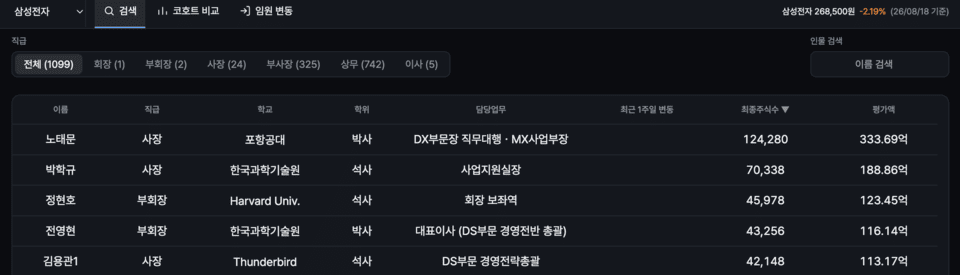
As of the market close on the 14th, Samsung Electronics CEO Yoon Tae-moon held the largest amount. His 124,280 shares of company stock were worth about 34.1 billion won when multiplied by the closing price of 274,500 won.
Vice Chairman Jeon Young-hyun held 43,256 shares worth about 11.9 billion won, Vice Chairman and aide to Chairman Chung Hyun-ho held 45,978 shares worth about 12.6 billion won, and DS division strategy chief Kim Yong-kwan held 42,148 shares worth about 11.6 billion won.
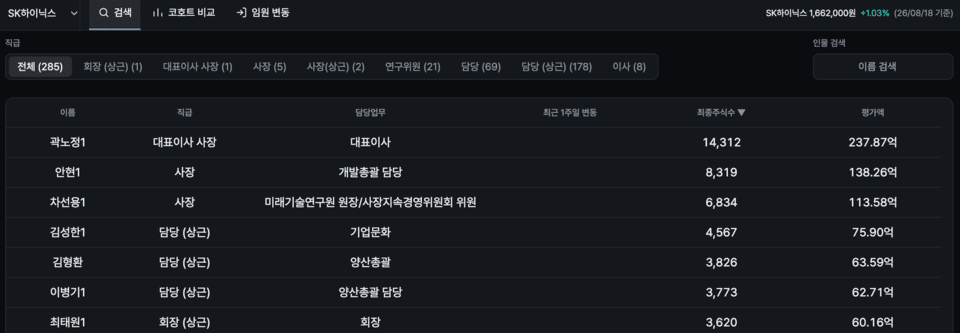
At SK hynix, CEO Kwak Noh-jung held the largest stake with 14,312 shares worth about 23.5 billion won. Chief Development Officer Ahn Hyun held 8,319 shares worth about 13.7 billion won, and Head of Future Technology Research Center Cha Sun-yong held 6,834 shares worth about 11.2 billion won. SK Group Chairman Chey Tae-won’s recently purchased 3,620 shares of SK hynix were valued at about 6 billion won.
Even among holdings in the 10 billion won range, the number of shares differs greatly. As of the 14th, SK hynix shares were priced at 1,645,000 won, about six times Samsung Electronics’ share price. With just a few thousand shares, the valuation can rise rapidly.
The basis for the sharp rise in valuations is stock prices. As the memory market recovered on the back of expanded AI data center investment and rising demand for HBM, the two stocks surged. HBM is an essential memory for the AI era that stacks multiple layers of DRAM to widen data pathways.
The scale of the increase is also confirmed by industry analysis. In a survey released in May by corporate analysis firm CXO Research Institute, Samsung Electronics’ stock price had risen 187.4% in about six months since the end of October last year, while SK hynix had climbed 287.5%. In the same survey, the number of non-owner executives with stock valuations of at least 1 billion won rose to 258, more than eight times the 31 recorded six months earlier.
Looking at individual cases, bargain buying at low points stands out. CEO Yoon is known to have personally purchased 28,000 shares of Samsung Electronics between 2021 and 2024, when the stock was stuck in the 60,000 to 80,000 won range, as part of responsible management. The stock, which at the time could not even reach the so-called “100,000 won Samsung,” has now risen into the 270,000 won range, making the value of those purchases several times higher.
At SK hynix, stock options made a major difference. According to Financial Supervisory Service disclosures, CEOs Kwak and Cha exercised stock options in April that allowed them to buy shares at 138,980 won per share. At the time of exercise, the stock price was in the 880,000 won range. It is a case where rights granted as performance compensation overlapped with a stock rally to generate large profits.
You should not take the valuation figures at face value. They are merely the product of multiplying a specific day’s closing price by the number of shares, and if sold, taxes would apply and market impact from large-scale selling would also occur. They are far from the cash an executive could immediately put in hand. If stock prices fall, the valuation shrinks at the same pace.
Still, executives’ shareholding disclosures are considered information that investors keep an eye on. That is because buying by an insider who knows the company best is often read as a sign of confidence, while large-scale selling is often seen as a warning signal. Electronic disclosures are public information available to anyone, but they required effort to sift through; reprocessed services like tracking sites are said to be lowering that barrier.
There is also an interpretation that these mechanisms align executive compensation with shareholder interests. The logic is that when executives buy company stock with their own money or are compensated in shares, they have a greater incentive to push up the stock price. On the other hand, there are also concerns that while the benefits of the earnings boom flow into executives’ stock assets, the gap between that and the experience of ordinary employees and small shareholders remains wide.
If the semiconductor rally continues, executives’ valuations are likely to keep growing as well. Since executives’ buy and sell disclosures serve as reference indicators for reading the industry cycle, understanding the limits of the numbers and using them as signals is left to investors.