
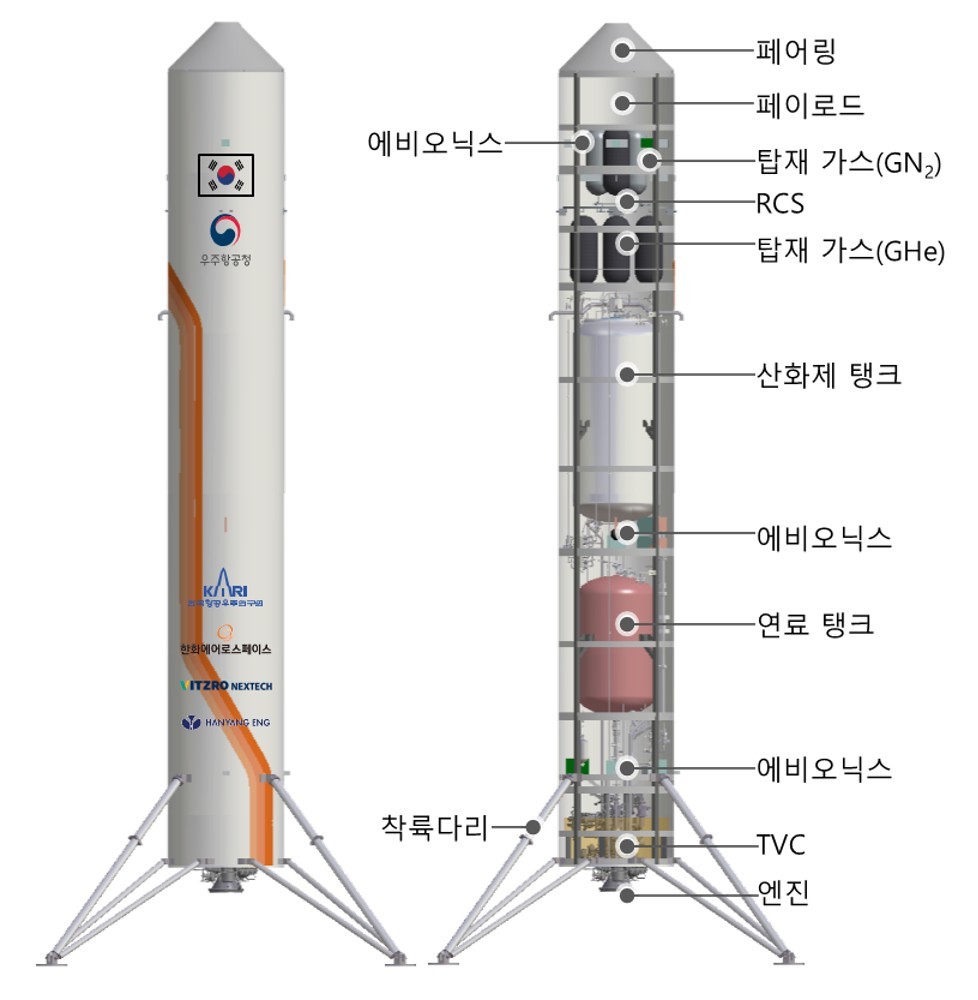
A vehicle that will test rocket recovery technology in Korea has begun assembly.
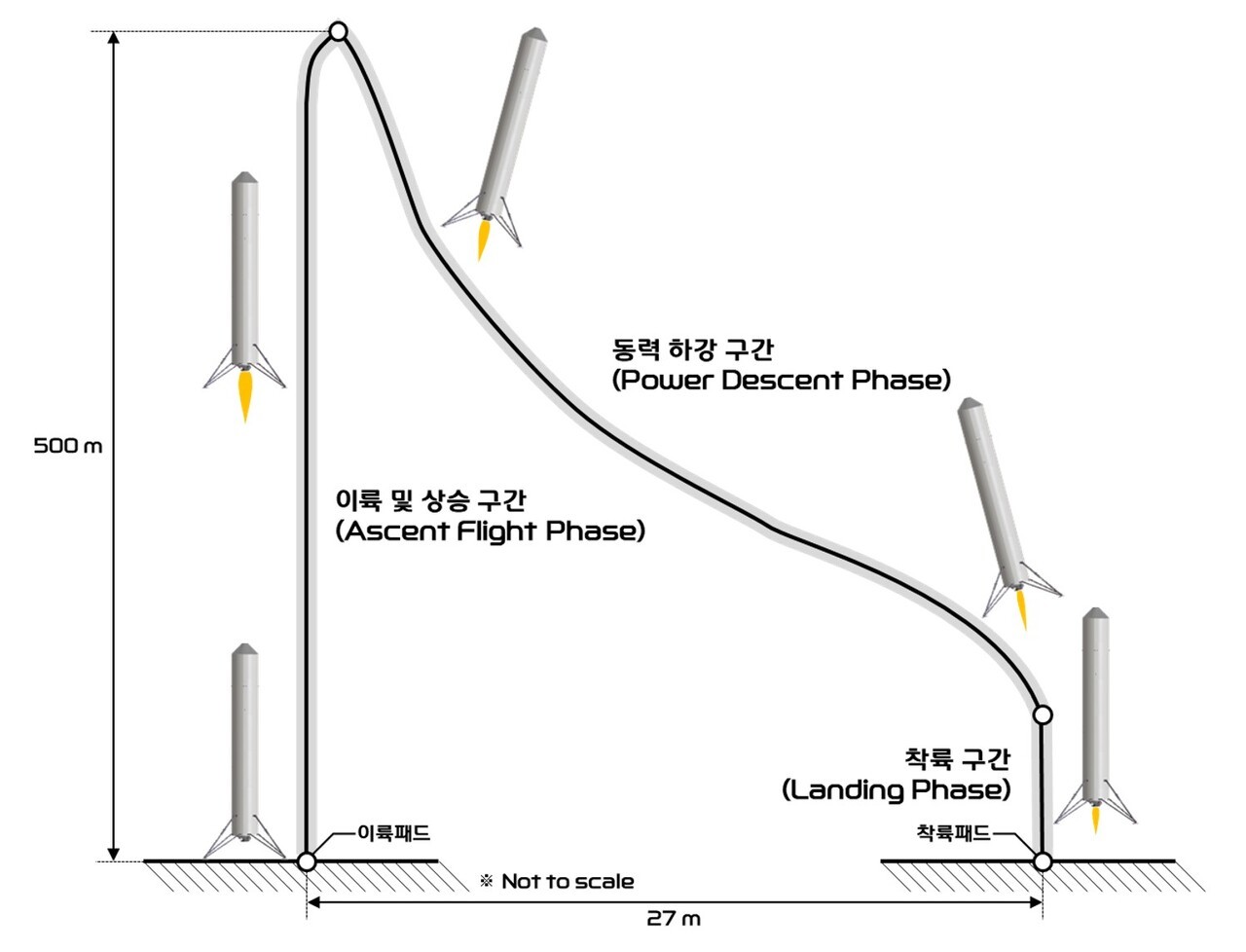
Hanwha Aerospace said on the 30th that it had begun full assembly of a technology demonstrator for reusable launch vehicles. In 2028, it is set to fly to an altitude of 500 meters before landing vertically at its launch point.
◆ A 12.2-meter demonstrator will climb to 500 meters and return
The project is led by the Korea Aerospace Research Institute (KARI). Hanwha Aerospace is responsible for the system integration, including the design and assembly of the entire demonstrator. Korean space companies Vitzro Nextech and Hanyang ENG are also taking part.
The demonstrator is 12.2 meters tall and 1.5 meters in diameter. It will be equipped with one engine: a staged-combustion-cycle turbopump engine whose thrust can be adjusted. In a staged-combustion cycle, some of the fuel is burned in advance to produce gas that drives the turbopump. That gas is then sent to the main combustion chamber and burned again. The process is highly efficient because no propellant is wasted.
The flight test is scheduled for 2028. The goal is for the vehicle to rise vertically from the ground, reach an altitude of 500 meters in about 90 seconds, and then land vertically at a designated spot. Hanwha Aerospace and KARI plan to complete the demonstration by 2028 and secure key reusable-launch-vehicle technologies, such as those used by SpaceX’s Falcon 9.
◆ Reusing the first stage of the next-generation launch vehicle
Landing a rocket for reuse requires technologies different from those used during ascent: adjusting engine thrust to match changing conditions, controlling the vehicle’s attitude to keep it stable during descent, and guiding it to a designated landing spot.
Hanwha Aerospace said the demonstrator’s development will validate technologies for engine-thrust adjustment, attitude control, and guidance and control.
The results of the demonstration will feed into the next-generation launch vehicle. Hanwha Aerospace aims to lay the groundwork for reusing its first stage, a capability planned for the mid-2030s, and to enter the global space transportation market by lowering launch costs.
The government has also changed course. On December 22 last year, the Korea AeroSpace Administration finalized a decision to shift the next-generation launch vehicle from an expendable design to a reusable vehicle powered by methane engines.
The first- and second-stage engines will be consolidated into a single 80-ton-thrust-class methane engine, and the total project budget will increase by 278.8 billion won to about 2.292 trillion won. The additional funding will go toward methane-propellant test facilities and the development of key reusable-vehicle technologies.
◆ Reusing just the first stage can sharply cut costs
Reusability is key to competing on launch costs. SpaceX, the first company in the world to commercialize reusable launch vehicles, is known to have significantly lowered launch costs per kilogram by reusing the first stage of its Falcon 9 rockets dozens of times. The industry expects that reusing only the first stage—the bottom section of a launch vehicle—could substantially reduce launch costs.
A Hanwha Aerospace official said, “Securing reusable-launch-vehicle technology is essential to growing into a ‘Korean SpaceX.’ We will successfully carry out the research with KARI and our partner companies, contributing to stronger space transportation capabilities in Korea and the growth of the private space industry ecosystem.”