
As renewable energy grows, the power grid becomes more unstable. That may sound paradoxical, but it is true. The government has introduced “grid-forming” as a technology to solve this problem. On June 24, the Ministry of Climate, Energy and Environment announced that it would begin full-scale adoption of grid-forming for inverter-based facilities.
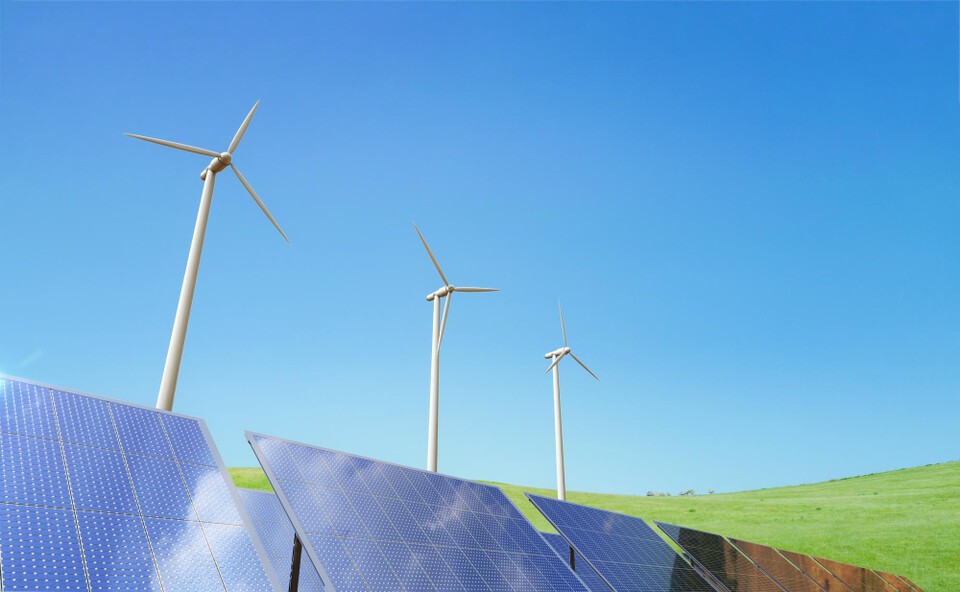
Grid-forming is a technology that allows facilities such as solar power and batteries to generate voltage and frequency on their own. The government has decided to make this capability mandatory for large battery energy storage systems starting with those scheduled to begin operation in December 2027. The term may be unfamiliar, but it is being seen as a key pillar supporting the power grid in the era of renewable energy.
◆ The more sunlight and wind increase, the more the grid becomes vulnerable
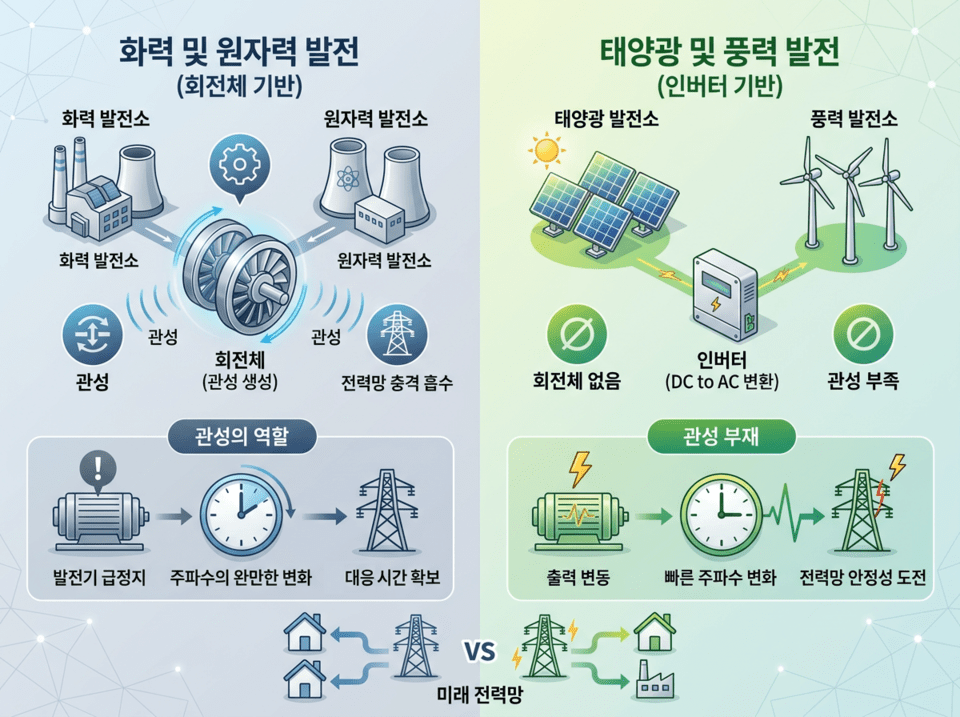
Thermal and nuclear power plants generate electricity through large rotating masses. That rotation creates “inertia,” the force that helps the power grid withstand shocks. Even if one generator suddenly stops, the frequency changes only gradually, giving other equipment time to respond.
Solar and wind power are different. They generate electricity through inverters. An inverter is a device that converts direct current from solar panels or batteries into the alternating current we use. Because there are no rotating masses, there is no inertia.
As renewable energy grows, the grid’s inertia declines. Frequency can swing sharply even with small disturbances, and voltage can also fluctuate. The power grid must keep frequency steady near 60 hertz. If that balance collapses, it can lead to large-scale blackouts.
This risk is already becoming reality. Jeju, where the share of renewable energy is the highest in the country, is a case in point. Electricity can be generated, but because the grid cannot handle it, generation is often forcibly curtailed. This is known as “output restriction,” meaning electricity that could have been produced is simply discarded.
The scale is rising rapidly. Jeju’s renewable output restrictions increased from just three cases in 2015 to well over 100 recently. Jeju Energy Corporation expects the number to reach 326 cases per year by 2034. It estimates that 40% of potentially produced electricity will be wasted, resulting in losses of 510 billion won.
There is another cost as well. To keep the grid stable, part of the thermal generation fleet must keep running. This happens even on days with abundant sunlight and wind. It is a structure in which clean electricity is wasted while carbon-emitting generators cannot be shut down, undermining carbon neutrality.
◆ Inverters can “build” electricity on their own
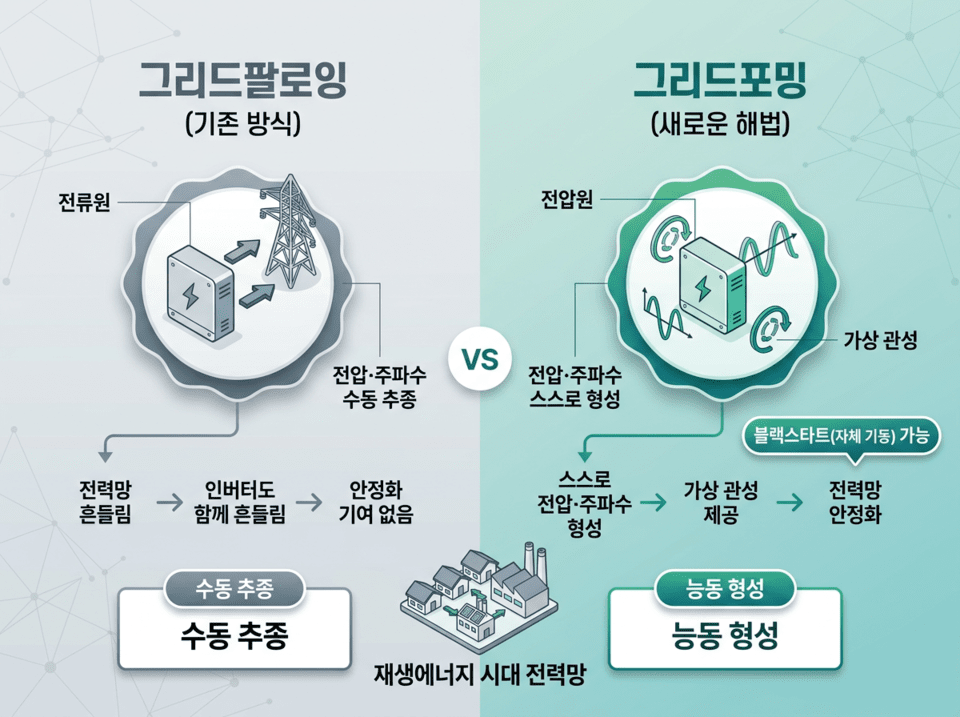
Conventional inverters only followed the grid. They supplied electricity according to the voltage and frequency set by the grid. This is called “grid-following.” When the grid shook, they shook with it.
Grid-forming is the opposite. The inverter itself establishes voltage and frequency like a generator. It creates “virtual inertia,” imitated through software. Even without rotating masses, it can serve as a support structure similar to a thermal generator. It can even include a function that allows it to restart on its own after a blackout without external power, known as black start.
The performance requirements set by the government are stringent. If a disturbance occurs in the grid, the system must respond within 5 milliseconds. It must also be able to maintain voltage on its own in weak grids where power flow is limited. In effect, it is being asked to take over what synchronous generators have done.
The rollout will be phased. Starting with large battery storage systems for transmission that begin commercial operation in December 2027, the technology must be equipped with this capability. Under the 11th Basic Plan for Electricity Supply and Demand, long-duration batteries with capacities of 540 megawatts in 2027 and 2028, and 600 megawatts in 2029, will be installed. Businesses that attach grid-forming equipment to the transmission network must follow designated operating standards.
The technology trend is not unique to Korea. Australia, Europe, and the United States have already been advancing grid-forming demonstrations. In Korea, the Korea Electric Power Research Institute, the Korea Power Exchange, universities, and venture firms have been conducting demonstrations in Jeju. The government’s move to mandate the technology is effectively bringing those achievements into the regulatory framework.
◆ Batteries move from “storage” to “stability devices”
The significance of this decision lies in the changing role of batteries. Until now, battery energy storage systems have largely been seen as containers that store electricity and release it later. Once grid-forming capability is added, their role changes. They will not only store electricity but also support the grid’s frequency and voltage. In other words, the storage unit also becomes a stability device.
It also opens up a new market. The grid’s “inertia” could become a tradable commodity. Resources that provide inertia and reserve power that responds instantly could be assigned value in the market. Kang Ji-seong, CEO of Korea Grid Forming, previously said, “Korea will inevitably have a market for inertia resources or ultra-fast responsive reserve power.”
The industry sees this as an opportunity. The performance requirements set by the government will effectively become a benchmark for technology. If domestic inverter manufacturers meet these standards and build up their expertise, they will have a stepping stone toward overseas markets. Grid-forming is a challenge the world is trying to solve together. The government has also indicated it will help domestic companies compete globally.
What remains is clear: fine-tune the performance requirements, establish verification systems, and expand demonstration projects. Market design that gives proper value to inertia and reserve power must also follow. Lee Jae-sik, director of power grid policy at the Ministry of Climate, Energy and Environment, said the government will continue strengthening grid-forming performance requirements. A power grid powered primarily by renewable energy is not far off. Whether that grid runs without disruption depends on the technology being laid today.
◆ Learn the key terms
Grid-forming
A control method in which a device independently forms its own voltage and frequency and operates as an independent voltage source, maintaining synchronization not only in steady state but also when grid disturbances occur, thereby contributing to grid stabilization.
Grid-following
A control method in which a device follows the grid’s voltage and frequency and operates as a current source.
Inverter
A type of power conversion device that converts direct current into alternating current.
Inertia
The ability of a power system to maintain stable frequency.
Robustness
The ability of a power system to maintain stable voltage.
Long-duration battery energy storage system (BESS)
A large-capacity battery energy storage system capable of continuous discharge based on rated output for an extended period (in the case of the central contract market, six hours or more).
Transmission equipment
An aggregate of electric facilities used for power transmission, including transmission lines, transformers, switchgear, busbars, reactive power compensation facilities, and related equipment.